Question
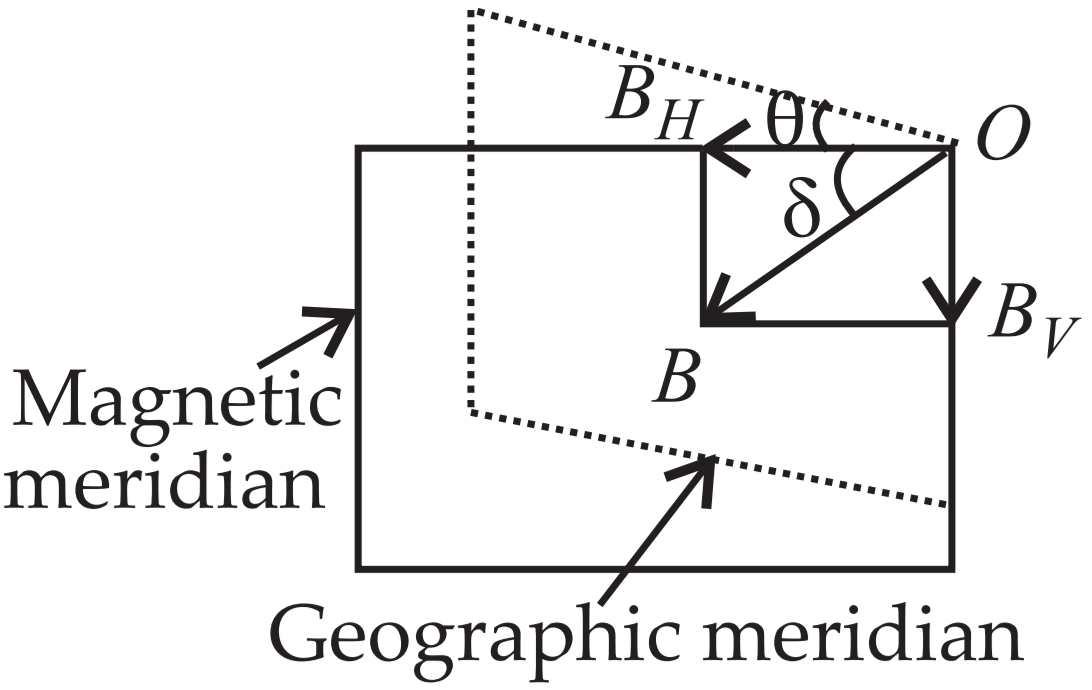
✓
Answer
- (b) $\frac{\pi}{3}$
Explanation:
$\tan\theta=\frac{\text{B}_\text{V}}{\text{B}_\text{H}}$ and $\text{B}_\text{H}=\frac{\text{B}_\text{V}}{\sqrt{3}}$
$\therefore\tan\theta=\sqrt{3}\text{ i.e. }\theta=\frac{\pi}{3}$
- (b) Magnetic declination.
Explanation:
The angle between the true geographic north and the north shown by a compass needle is called as magnetic declination or simply declination.
- (d) 90º, 0º
Explanation:
Since angle of dip at a place is defined as the angle $\delta,$ which is the direction of total intensity of earth's magnetic field B makes with a horizontal tine in magnetic meridian,
At poles $\text{B}=\text{B}_\text{V}$ and $\text{B}_\text{V}=\text{B}\sin\delta\therefore\sin\delta=1\Rightarrow\delta=90^\circ$
At equator $\text{B}=\text{B}_\text{H}$ and $\text{B}_\text{H}=\text{B}\cos\delta$
$\therefore\cos\delta=1\Rightarrow\delta=-0^\circ.$
- (a) Will become rigid showing no movement.
Explanation:
A compass needle which is allowed to move in a horizontal plane is taken to a geomagnetic pole. It will stay in any position as the horizontal component of earth's magnetic field becomes zero at the geomagnetic pole.
- (c) Magnetic dip increases as we move away from the equator towards the magnetic pole.
Explanation:
At equator, $\delta=0^\circ$
At poles, $\delta=90^\circ$
$\therefore\delta$ increases as we move from equator towards poles.
Need a full question paper?
Generate a complete, print-ready paper with questions like this in minutes — across 16+ boards, with answer keys.
Explore more
Similar questions
A sample contains a mixture of 108Ag and 110Ag isotopes each having an activity of 8.0 × 10⁸ disintegration per second. 110Ag is known to have larger half-life than 108Ag. The activity A is measured as a function of time and the following data are obtained.
→| Time (s) | Activity (A) (108 disinte- grations s-1) | Time (s) | Activity (A) (108 disinte-grations s-1) |
| 20 | 11.799 | 200 | 3.0828 |
| 40 | 9.1680 | 300 | 1.8899 |
| 60 | 7.4492 | 400 | 1.1671 |
| 80 | 6.2684 | 500 | 0.7212 |
| 100 | 5.4115 |
- Plot ln $\Big(\frac{\text{A}}{\text{A}_0}\Big)$ versus time.
- See that for large values of time, the plot is nearly linear. Deduce the half-life of 110Ag from this portion of the plot.
- Use the half-life of 110Ag to calculate the activity corresponding to 108Ag in the first 50s.
- Plot In $\Big(\frac{\text{A}}{\text{A}_0}\Big)$ versus time for 108Ag for the first 50s.
- Find the half-life of 108Ag.
For the past some time, Aarti had been observing some erratic body movement, unsteadiness and lack of coordination in the activities of her sister Radha, who also used to complain of severe headache occasionally. Aarti suggested to her parents to get a medical check-up of Radha. The doctor thoroughly examined Radha and diagnosed that she has a brain tumour.
- What, according to you, are the values displayed by Aarti?
- How can radioisotopes help a doctor to diagnose brain tumour?
Establish the expression for equivalent parallel combination of resistance separately.
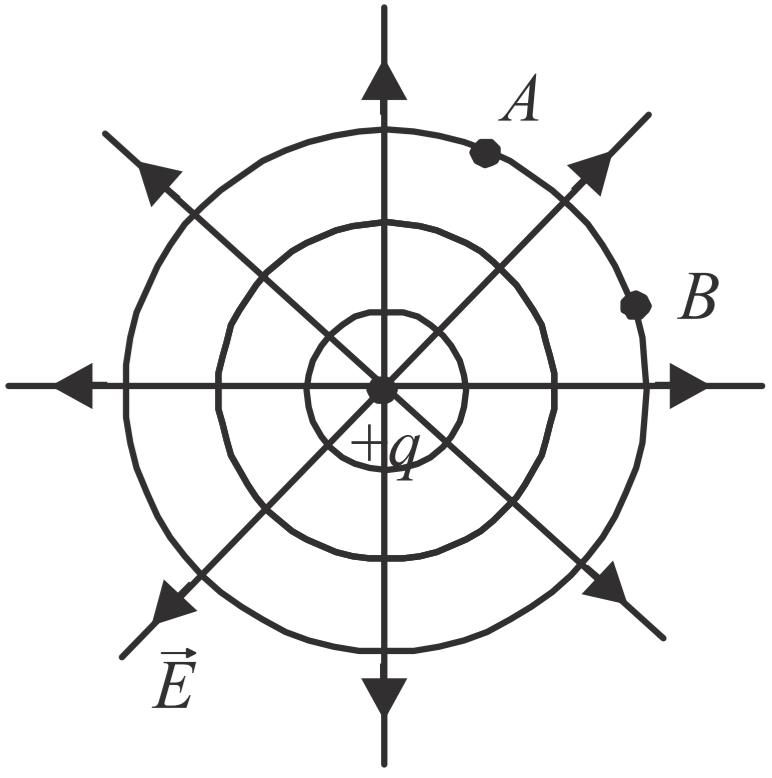
For the various charge systems, we represent equipotential surfaces by curves and line of force by full line curves. Between any two adjacent equipotential surfaces, we assume a constant potential difference the equipotential surfaces of a single point charge are concentric spherical shells with their centres at the point charge. As the tines of force point radially outwards, so they are perpendicular to the equipotential surfaces at all points.
→
- Identify the wrong statement.
- Equipotential surface due to a single point charge is spherical.
- Equipotential surface can be constructed for dipoles too.
- The electric field is normal to the equipotential surface through the point.
- The work done to move a test charge on the equipotential surface is positive.
- Nature of equipotential surface for a point charge is:
- Ellipsoid with charge at foci.
- Sphere with charge at the centre of the sphere.
- Sphere with charge on the surface of the sphere.
- Plane with charge on the surface.
- A spherical equipotential surface is not possible:
- Inside a uniformly charged sphere.
- For a dipole.
- Inside a spherical condenser.
- For a point charge.
- The work done in carrying a charge q once round a circle of radius a with a charge Q at its centre is:
- $\frac{\text{qQ}}{4\pi\in_0\text{a}}$
- $\frac{\text{qQ}}{4\pi\in_0\text{a}^2}$
- $\frac{\text{q}}{4\pi\in_0\text{a}}$
- $\text{Zero}$
- The work done to move a unit charge along an equipotential surface from P to Q:
- Must be defined as $-\int\limits_{\text{P}}^{\text{Q}}\vec{\text{E}}\cdot\text{d}\vec{\text{l}}.$
- Is zero.
- Can have a non-zero value.
- Both (a) and (b) are correct.
Two point charges $+3.2 \times 10^{-19}$ Coulomb and $-3.2 \times 10^{-19}$ Coulomb are kept at a distance of 2.4 $\times 10^{-10}$ meters from each other. This dipole is placed at an angle of $30^{\circ}$ to the field direction in a uniform field of intensity of $3 \times 10^4$ Newton/Coulomb. Find the value of the moment of the couple acting on it. What will be the maximum value of this torque?
→Hydrogen is the simplest atom of nature. There is one proton in its nucleus and an electron moves around the nucleus in a circular orbit. According to Niels Bohr, this electron moves in a stationary orbit. When this electron is in the stationary orbit, it emits no electromagnetic radiation.The angular momentum of the electron is quantized, i.e., $\text{mvr}=\big(\frac{\text{nh}}{2\pi}\big)$ where m = mass of the electron, v = velocity of the electron in the orbit, r = radius of the orbit and n = 1, 2, 3, .... When transition takes place from Kth orbit to Jth orbit, energy photon is emitted. If the wavelength of the emitted photon is $\lambda$ we find that $\frac{1}{\lambda}=\text{R}\bigg[\frac{1}{\text{J}^2}-\frac{1}{\text{K}^2}\bigg]$where find that On a different planet, the hydrogen atom's structure was somewhat different from ours. The angular momentum of electron was $\text{P}=2\text{n}\Big(\frac{\text{h}}{2\pi}\Big)$ i.e., an even multiple of $\Big(\frac{\text{h}}{2\pi}\Big)$.
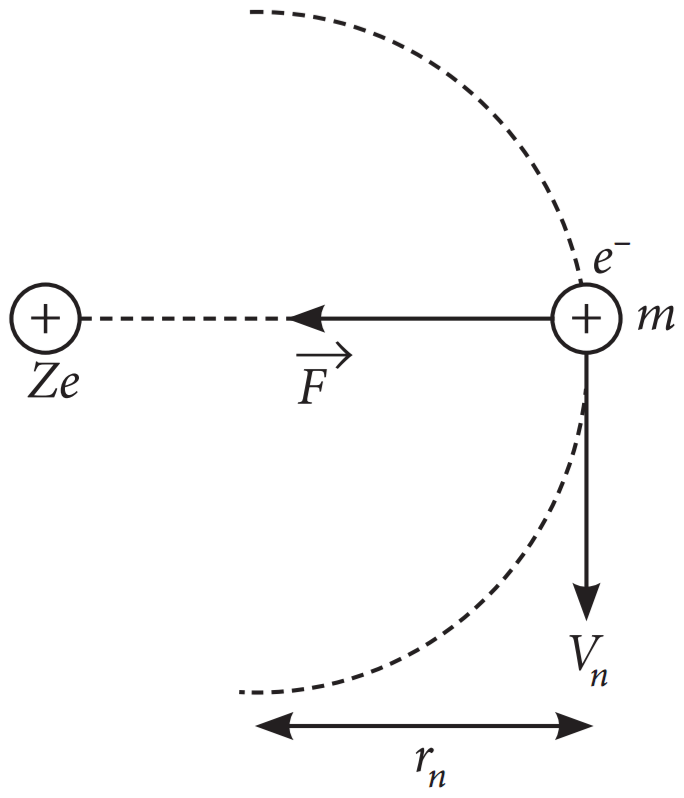
→- The minimum permissible radius of the orbit will be.
- $\frac{2\in_0\text{h}^2}{\text{m}\pi\text{e}^2}$
- $\frac{4\in_0\text{h}^2}{\text{m}\pi\text{e}^2}$
- $\frac{\in_0\text{h}^2}{\text{m}\pi\text{e}^2}$
- $\frac{\in_0\text{h}^2}{\text{2m}\pi\text{e}^2}$
- In our world, the velocity of electron is v0 when the hydrogen atom is in the ground state. The velocity of electron in this state on the other planet should be.
- $\text{v}_0$
- $\frac{\text{v}_0}{2}$
- $\frac{\text{v}_0}{4}$
- $\frac{\text{v}_0}{8}$
- In our world, the ionization potential energy of a hydrogen atom is 13.6eV. On the other planet, this ionization potential energy will be.
- 13.6eV
- 3.4eV
- 1.5eV
- 0.85eV
- Check the correctness of the following statements about the Bohr model of hydrogen atom.
- The acceleration of the electron in n = 2 orbit is more than that in n = 1 orbit.
- The angular momentum of the electron in n = 2 orbit is more than that in n = 1 orbit.
- The kinetic energy of the electron in n = 2 orbit is less than that in n = 1 orbit.
- Only (III) and (I) are correct
- Only (III) and (I) are correct
- Only (II) and (III) are correct.
- All the statements are correct.
- In Bohr's model of hydrogen atom, let PE represent potential energy and TE the total energy. In going to a higher orbit.
- PE increases, TE decreases
- PE decreases, TE increases
- PE increases, TE increases
- PE decreases, TE decreases
In an electromagnetic wave both the electric and magnetic fields are perpendicular to the direction of propagation, that is why electromagnetic waves are transverse in nature. Electromagnetic waves carry energy as they travel through space and this energy is shared equally by the electric and magnetic fields. Energy density of an electromagnetic waves is the energy in unit volume of the space through which the wave travels.
→- The electromagnetic waves propagated perpendicular to both $\vec{\text{E}}$ and $\vec{\text{B}}.$ The electromagnetic waves travel in the direction of.
- $\vec{\text{E}}\times\vec{\text{B}}$
- $\vec{\text{E}}\times\vec{\text{B}}$
- $\vec{\text{B}}\times\vec{\text{E}}$
- $\vec{\text{B}}\times\vec{\text{E}}$
- Fundamental particle in an electromagnetic wave is:
- Photon
- Electron
- Phonon
- Proton
- Electromagnetic waves are transverse in nature is evident by:
- Polarisation
- Interference
- Reflection
- Diffraction
- For a wave propagating in a medium, identify the property that is independent of the others.
- Velocity
- Wavelength
- Frequency
- All these depend on each other.
- The electric and magnetic fields of an electromagnetic waves are:
- In opposite phase and perpendicular to each other.
- In opposite phase and parallel to each other.
- In phase and perpendicular to each other.
- In phase and parallel to each other.
A galvanometer can be converted into voltmeter of given range by connecting a suitable resistance R, in series with the galvanometer, whose value is given by,
$\text{R}_\text{s}=\frac{\text{V}}{\text{I}_\text{g}}-\text{G}$
where Vis the voltage to be measured, lg is the current for full scale deflection of galvanometer and G is the resistance of galvanometer.
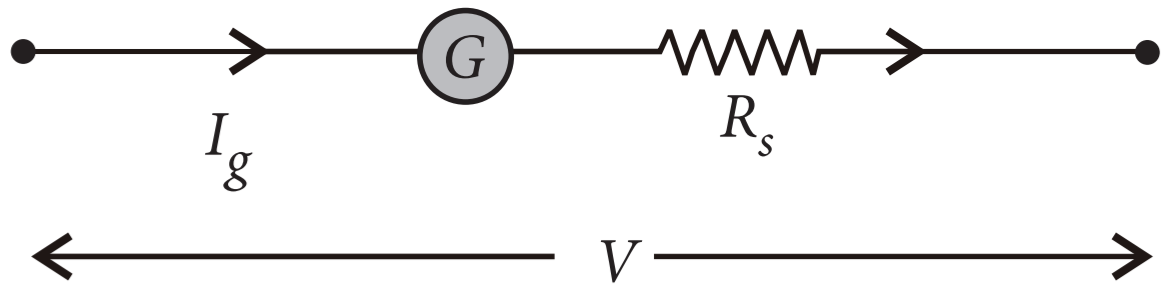
Series resistor(R,) increases range of voltmeter and the effective resistance of galvanometer. It also protects the galvanometer from damage due to large current. Voltmeter is a high resistance instrument and it is always connected in parallel with the circuit element across which potential difference is to be measured. An ideal voltmeter has infinite resistance. In order to increase the range of voltmeter n times the value of resistance to be connected in series with galvanometer is Rs = (n - 1)G.
→$\text{R}_\text{s}=\frac{\text{V}}{\text{I}_\text{g}}-\text{G}$
where Vis the voltage to be measured, lg is the current for full scale deflection of galvanometer and G is the resistance of galvanometer.
Series resistor(R,) increases range of voltmeter and the effective resistance of galvanometer. It also protects the galvanometer from damage due to large current. Voltmeter is a high resistance instrument and it is always connected in parallel with the circuit element across which potential difference is to be measured. An ideal voltmeter has infinite resistance. In order to increase the range of voltmeter n times the value of resistance to be connected in series with galvanometer is Rs = (n - 1)G.
- 10mA current can pass through a galvanometer of resistance $25\Omega$ What resistance in series should be connected through it, so that it is converted into a voltmeter of 100V?
- $0.975\Omega$
- $99.75\Omega$
- $975\Omega$
- $9975\Omega$
- There are 3 voltmeter A, B, C having the same range but their resistance are $15000\Omega,10000\Omega$, and $5000\Omega$ respectively. 'Tile best voltmeter amongst them is the one whose resistance is
- $5000\Omega$
- $10000\Omega$
- $15000\Omega$
- all are equally good.
- A milliammeter of range 0 to 25mA and resistance of $10\Omega$ is to be converted into a voltmeter with a range of 0 to 25V. 'Tile resistance that should be connected in series will be:
- $930\Omega$
- $960\Omega$
- $990\Omega$
- $1010\Omega$
- To convert a moving coil galvanometer (MCG) into a voltmeter:
- A high resistance R is connected in parallel with MCG.
- A low resistance R is connected in parallel with MCG.
- A low resistance R is connected in series with MCG.
- A high resistance R is connected in series with MCG.
- To increase the current sensitivity of a moving coil galvanometer, we should decrease:
- Zero.
- Low.
- High.
- Infinity.
The number of free electrons in a unit volume copper conductor estimated in Example 8.1 is 8.5 x 1028 per m3.How long does an electron take to drift from one end of a wire 3.0 m long to its other end? The area of cross-section of the wire is 2.0 x 10⁻⁶ m2and it is carrying a current of 3.0 A.
LASER: Electromagnetic radiation is a natural phenomenon found in almost all areas of daily life, from radio waves to sunlight to x-rays. Laser radiation - like all light - is also a form of electromagnetic radiation. Electromagnetic radiation that has a wavelength between 380 nm and 780 nm is visible to the human eye and is commonly referred to as light. At wavelengths longer than 780 nm, optical radiation is termed infrared (IR) and is invisible to the eye. At wavelengths shorter than 380 nm, optical radiation is termed ultraviolet (UV) and is also invisible to the eye. The term laser light refers to a much broader range of the electromagnetic spectrum that just the visible spectrum, anything between 150 nm up to 11000 nm (i.e., from the UV up to the far IR). The term laser is an acronym which stands for light amplification by stimulated emission of radiation. Einstein explained the stimulated emission. In an atom, electron may move to higher energy level by absorbing a photon. When the electron comes back to the lower energy level it releases the same photon. This is called spontaneous emission. This may also so happen that the excited electron absorbs another photon, releases two photons and returns to the lower energy state. This is known as stimulated emission.
Laser emission is therefore a light emission whose energy is used, in lithotripsy, for targeting and ablating the tone inside human body organ.
Apart from medical usage, laser is used for optical disk drive, printer, barcode reader etc.
(i) What is the full form of LASER?
(a) light amplification by simultaneous emission of radiation
(b) light amplified by synchronous emission of radiation
(c) light amplified by stimulated emission of radiation
(d) light amplification by stimulated emission of radiation
(ii) The stimulated emission is the process of
(a) absorption of two photon when electron moves from lower to higher energy level
(b) release of two photons by absorbing one photon when electron comes back from higher to lower energy level
(c) release of a photon when electron comes back from higher to lower energy level
(d) absorption of a photon when electron moves from lower to higher energy level
(iii) What is the range of amplitude of LASER?
(a) 150 nm - 400 nm
(b) 700 nm - 11000 nm
(c) Both 150 nm - 400 nm and 700 nm 11000 nm
(d) 800 nm - 12000 nm
OR
LASER is used in
(a) Ionization
(b) Transmitting Satellite signal
(c) Optical disk drive
(d) Radio communication
(iv) Lithotripsy is
(a) Laboratory application
(b) An industrial application
(c) A medical application
(d) Process control application
Laser emission is therefore a light emission whose energy is used, in lithotripsy, for targeting and ablating the tone inside human body organ.
Apart from medical usage, laser is used for optical disk drive, printer, barcode reader etc.
(i) What is the full form of LASER?
(a) light amplification by simultaneous emission of radiation
(b) light amplified by synchronous emission of radiation
(c) light amplified by stimulated emission of radiation
(d) light amplification by stimulated emission of radiation
(ii) The stimulated emission is the process of
(a) absorption of two photon when electron moves from lower to higher energy level
(b) release of two photons by absorbing one photon when electron comes back from higher to lower energy level
(c) release of a photon when electron comes back from higher to lower energy level
(d) absorption of a photon when electron moves from lower to higher energy level
(iii) What is the range of amplitude of LASER?
(a) 150 nm - 400 nm
(b) 700 nm - 11000 nm
(c) Both 150 nm - 400 nm and 700 nm 11000 nm
(d) 800 nm - 12000 nm
OR
LASER is used in
(a) Ionization
(b) Transmitting Satellite signal
(c) Optical disk drive
(d) Radio communication
(iv) Lithotripsy is
(a) Laboratory application
(b) An industrial application
(c) A medical application
(d) Process control application