A mass $m$ is suspended from the two coupled springs connected in series. The force constant for springs are ${K_1}$ and ${K_2}$. The time period of the suspended mass will be
AIPMT 1990,AIIMS 2019, Easy
Download our app for free and get started
(c) In series ${k_{eq}} = \frac{{{k_1}{k_2}}}{{{k_1} + {k_2}}}$
so time period $T = 2\pi \sqrt {\frac{{m({k_1} + {k_2})}}{{{k_1}{k_2}}}} $

Download our appand get started for free
Experience the future of education. Simply download our apps or reach out to us for more information. Let's shape the future of learning together!No signup needed.*
Similar Questions
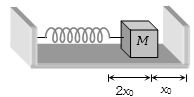
- 1One end of a spring of force constant k is fixed to a vertical wall and the other to a block of mass m resting on a smooth horizontal surface. There is another wall at a distance ${x_0}$ from the black. The spring is then compressed by $2{x_0}$ and released. The time taken to strike the wall isView Solution
- 2View SolutionIn case of a simple pendulum, time period versus length is depicted by
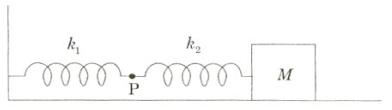
- 3The mass $M$ shown in the figure oscillates in simple harmonic motion with amplitude $A$. The amplitude of the point $P$ isView Solution
- 4A potential is given by $V(x)=k(x+a)^2 / 2$ for $x < 0$ and $V(x)=k(x-a)^2 / 2$ for $x > 0$. The schematic variation of oscillation period $T$ for a particle performing periodic motion in this potential as a function of its energy $E$ isView Solution
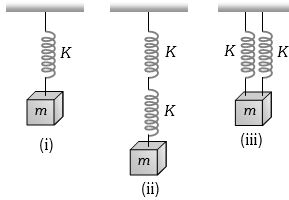
- 5View SolutionFive identical springs are used in the following three configurations. The time periods of vertical oscillations in configurations (i), (ii) and (iii) are in the ratio
- 6Equations $y = 2A \cos ^2 \omega \,t$ and $y = A (\sin \omega t + \cos \omega t )$ represent the motion of two particles.View Solution
- 7A simple pendulum is set up in a trolley which moves to the right with an acceleration a on a horizontal plane. Then the thread of the pendulum in the mean position makes an angle $\theta $ with the verticalView Solution
- 8$Y = A \sin \left(\omega t +\phi_{0}\right)$ is the time-displacement equation of a SHM. At $t=0$ the displacement of the particle is $Y =\frac{ A }{2}$ and it is moving along negative $x$ -direction. Then the initial phase angle $\phi_{0}$ will be ...... .View Solution
- 9Velocity at mean position of a particle executing $S.H.M.$ is $v$, they velocity of the particle at a distance equal to half of the amplitudeView Solution
- 10In an engine the piston undergoes vertical simple harmonic motion with amplitude $7\, cm$ . A washer rests on top of the piston and moves with it. The motor speed is slowly increased. The frequency of the piston at which the washer no longer stays in contact with the piston, is close to ...... $Hz$View Solution