MCQ
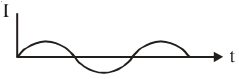
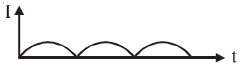
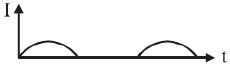
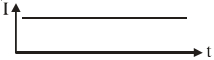
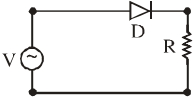
A $p-n$ junction $(D)$ shown in the figure can act as a rectifier. An alternating current source $(V)$ is connected in the circuit. The current $(I)$ in the resistor $(R)$ can be shown by
  • A

  • B


  • D

Answer

Correct option: C.

c
We know that a single $p-n$ junction diode connected to an $a-c$ source acts as a half wave rectifier [Forward biased in one half cycle and reverse biased in the other half cyclel.

Need a full question paper?

Generate a complete, print-ready paper with questions like this in minutes — across 16+ boards, with answer keys.

Start Generating Free

Similar questions

A coil having $N$ $turns$ is wound tightly in the form of a spiral with inner and outer radii $a$ and $b$ respectively. When a current $I$ passes through the coil, the magnetic field at the centre is
A transistor oscillator is
$(i)$ an amplifier with positive feedback $(ii)$ an amplifier with reduced gain $(iii)$ the one in which $dc$ supply energy is converted into an output energy. Then
If $f_a$ and $f_f$ represent the carrier wave frequencies for amplitude and frequency modulations respectively, then
Two uncharged bodies on rubbing, get charged due to:
Magnetic field inside a solenoid is:
The diffraction pattern of a light of wavelength $400$ $\mathrm{nm}$ diffracting from a slit of width $0.2 \mathrm{~mm}$ is focused on the focal plane of a convex lens of focal length $100 \mathrm{~cm}$. The width of the $1^{\text {st }}$ secondary maxima will be :
The electrostatic force of interaction between an uniformly charged rod having total charge $Q$ and length $L$ and a point charge $q$ as shown in figure is
Ultraviolet rays coming from sun are absorbed by:
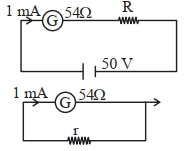
For designing a voltmeter of range $50\,V$ and an ammeter of range $10\,mA$ using a galvanometer which has a coil of resistance $54\,\Omega$ showing a full scale deflection for $1\,mA$ as in figure.

$(A)$ for voltmeter $R \approx 50\,k\Omega$

$(B)$ for ammeter $r \approx 0.2\,\Omega$

$(C)$ for ammeter $r \approx 6\,\Omega$

$(D)$ for voltmeter $R \approx 5\,k \Omega$

$(E)$ for voltmeter $R \approx 500 \Omega$

Choose the correct answer from the options given below
No bias is applied to a P-N junction, then the current