Question
  1. A parallel plate capacitor $(C_1)$ having charge $Q$ is connected, to an identical uncharged capacitor $C_2$ in series. What would be the charge accumulated on the capacitor $C_2?$
  2. Three identical capacitors each of capacitance $3mF$ are connected, in tern, in series and in parallel combination to the common source of $V$ volt. Find out the ratio of the energies stored in two configurations.
Answer

  1. Zero.
  2. We have $\text{C}_{series} = \frac{3\mu\text{F}}{3} =1 \mu\text{F}$
Also, $\text{C}_{parallel} =( 3 + 3 +3 ) =9 \mu\text{F}$
Energy stored $ = \frac{1}{2}\text{CV}^{2}$
$\therefore$Energy in series combination $ =\frac{1}{2}1 \times10^{-6}\times\text{V}^{2}$
Energy in parallel combination $ =\frac{1}{2}9 \times10^{-6}\times\text{V}^{2}$
$\therefore$ Ratio $= 1:9.$

Need a full question paper?

Generate a complete, print-ready paper with questions like this in minutes — across 16+ boards, with answer keys.

Start Generating Free

Similar questions

A light ray falling at an angle of $45^\circ$ with the surface of a clean slab of ice of thickness $1m$ is refracted into it at an angle of $30^\circ$ . Calculate the time taken by the light rays, to cross the slab. Speed of light in vacuum $= 3 \times 10^8m/s$
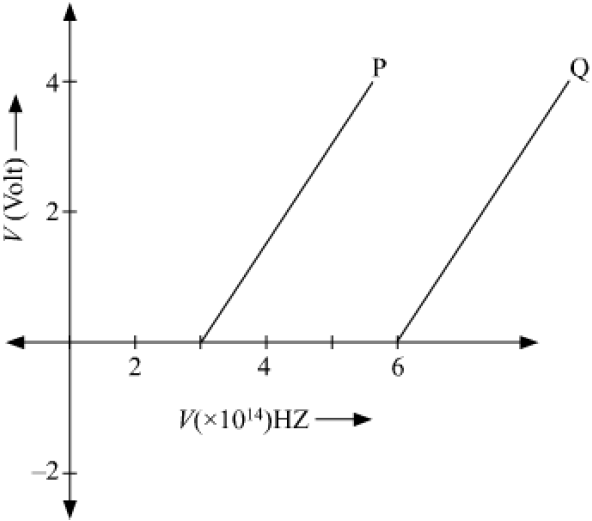
In the study of a photoelectric effect the graph between the stopping potential $V$ and frequency $v$ of the incident radiation on two different metals $P$ and $Q$ is shown below
  1. Which one of the two metals has higher threshold frequency?
  2. Determine the work function of the metal which has greater value.
  3. Find the maximum kinetic energy of electron emitted by light of frequency $8 \times 10^{14} Hz$ for this metal.
A long, straight wire of radius r carries a current i and is placed horizontally in a uniform magnetic field B pointing vertically upward. The current is uniformly distributed over its cross-section.
  1. At what points will the resultant magnetic field have maximum magnitude? What will be the maximum magnitude?
  2. What will be the minimum magnitude of the resultant magnetic field?
Three particles, each of mass $200g,$ are kept at the corners of an equilateral triangle of side $10\ cm.$ Find the moment of inertia of the system about an axis:
  1. Joining two of the particles.
  2. Passing through one of the particles and perpendicular to the plane of the particles.
  1. Using Bohr's second postulate of quantization of orbital angular momentum show that the circumference of the electron in the $n^{th}$ orbital state in hydrogen atom is n times the de Broglie wavelength associated with it.
  2. The electron in hydrogen atom is initially in the third excited state.What is the maximum number of spectral lines which can be emitted when it finally moves to the ground state?
Suppose while sitting in a parked car, you notice a jogger approaching towards you in the side view mirror of $R=2 m$. If the jogger is running at a speed of $5 m s ^{-1}$, how fast the image of the jogger appear to move when the jogger is (a) $39 m$, (b) $29 m$, (c) $19 m$, and (d) $9 m$ away.
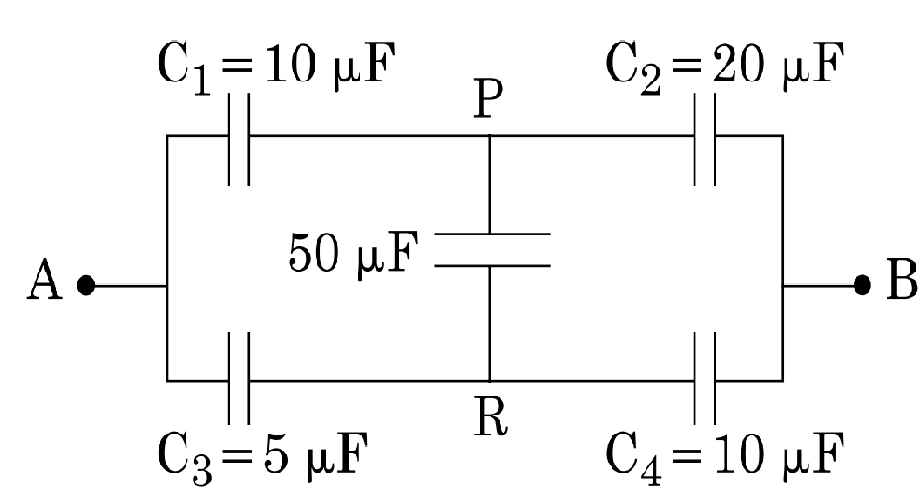
Calculate the equivalent capacitance between points $A$ and $B$ in the circuit below. If a battery of $10 V$ is connected across $A$ and $B,$ calculate the charge drawn from the battery by the circuit.
i. Differentiate between three segments of a transistor on the basis of their size and level of doping.
ii. When is a transistor said to be in active state?
iii. Draw a plot of transfer characteristic ($V _0$ vs. $V _{ i }$ ) and show which portion of the characteristic is used in amplification and why?
iv. Draw the circuit diagram of the base bias transistor amplifier in CE configuration and briefly explain its working.
Suppose the glass of the previous problem is covered by a jar and the air inside the jar is completely pumped out.
  1. What will be the answers to the problem?
  2. Show that the answers do not change if a glass of different shape is used provided the height, the bottom area and the volume are unchanged.
The force of surface tension acts tangentially to the surface whereas the force due to air pressure acts perpendicularly on the surface. How is then the force due to excess pressure inside a bubble balanced by the force due to the surface tension?