Question
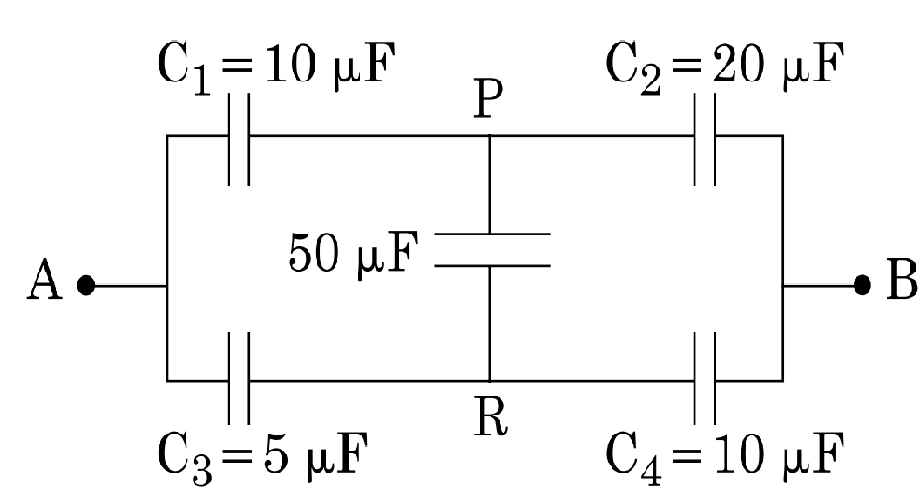
Calculate the equivalent capacitance between points $A$ and $B$ in the circuit below. If a battery of $10 V$ is connected across $A$ and $B,$ calculate the charge drawn from the battery by the circuit.
Answer

$\because\frac{\text{C}_{1}}{\text{C}_{2}} = \frac{\text{C}_{3}}{\text{C}_{4}}$
This is the condition of balance so there will be no current across $PR (50 \mu F$ capacitor$)$
Now $?_{1 }$ and $?_2$ are in series,
$\text{C}_{12} = \frac{\text{C}_{1}\text{C}_{2}}{\text{C}_{1} + \text{C}_{2}} = \frac{10\times20}{10 + 20 } = \frac{200}{30} =\frac{20}{3}\mu\text{F}$
$\because$ $?_3$ and $?_4$ are in series,
$\text{C}_{34} = \frac{\text{C}_{3}\text{C}_{4}}{\text{C}_{3} + \text{C}_{4}} =\frac{5\times10}{5 + 10 } =\frac{50}{15} = \frac{10}{3}\mu\text{F}$
Equivalent capacitance between $A$ and $B$ is
$\text{C}_{AB} = \text{C}_{12} + \text{C}_{34} =\frac{20}{3} + \frac{10}{3} = 10 \mu\text{F}$
Charge drawn from battery $(q) = CV$
$ = 10 \times 10 \mu\text{C}$
$ = 10\mu\text{C} \text{ or }10^{-4}\text{ C}.$

Need a full question paper?

Generate a complete, print-ready paper with questions like this in minutes — across 16+ boards, with answer keys.
Start Generating Free

Similar questions

What is meant by nuclear mass defect?
The graph shown here shows the variation of terminal potential difference V, across a combination of three cells in series to a resistor, versus current i:
  1. Calculate the emf of each cell.
  2. For what current i, will the power dissipation of the circuit be maximum?
Establish the relation between critical angle and refractive index.
What is the area of the plates of a $2F$ parallel plate capacitor, given that the separation between the plates is $0.5 \ cm? [$ You will realise from your answer why ordinary capacitors are in the range of $\mu F$ or less. However, electrolytic capacitors do have a much larger capacitance $(0.1F)$ because of very minute separation between the conductors.$]$
The conductivity of a pure semiconductor is roughly proportional to $\text{T}^\frac{3}{2}\text{e}^{\frac{-\Delta\text{E}}{2\text{kT}}}$ where $\Delta\text{E}$ is the band gap. The band gap for germanium is 0.74eV at 4K and 0.67eV at 300K. By what factor does the conductivity of pure germanium increase as the temperature is raised from 4K to 300K?
Figure, shows a string stretched by a block going over a pulley. The string vibrates in its tenth harmonic in unison with a particular tuning fork. When a beaker containing water is brought under the block so that the block is completely dipped into the beaker, the string vibrates in its eleventh harmonic. Find the density of the material of the block.
Six particles situated at the corners of a regular hexagon of side a move at a constant speed v. Each particle maintains a direction towards the particle at the next corner. Calculate the time the particles will take to meet each other.
A block of mass $250g$ is kept on a vertical spring of spring constant $100N/m$ fixed from below. The spring is now compressed to have a length $10\ cm$ shorter than its natural length and the system is released from this position. How high does the block rise? Take $g =10m/s^2.$
An inductor-coil, a capacitor and an AC source of rms voltage 24V are connected in series. When the frequency of the source is varied, a maximum rms current of 6.0A is observed. If this inductor coil is connected to a battery of emf 12V and internal resistance $4.0\Omega,$ what will be the current?
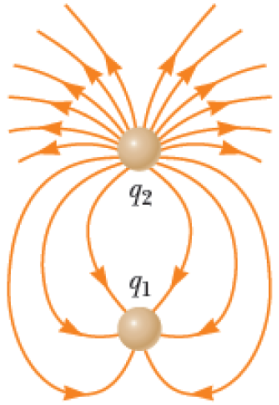
Consider the situation shown in figure. What are the signs of $q_1$ and $q_2$? If the lines are drawn in proportion to the charge, what is the ratio $\frac{\text{q}_1}{\text{q}_2}?$