A particle excutes $SHM$ on a straight line path. The amplitude of oscillation is $2\,cm$. When the displacement of the particle from the mean position is $1\,cm$, the numerical value of magnitude of acceleration is equal to the numerical value of magnitude of velocity. The frequency of $SHM$ is (in $second^{-1}$)
Medium
Download our app for free and get started
$\mathrm{V}=\omega \sqrt{\mathrm{a}^{2}-(\mathrm{a} / 2)^{2}}=\frac{\sqrt{3}}{2} \mathrm{a} \omega$
$\operatorname{acc}^{\mathrm{n}} \mathrm{f}=\frac{\omega^{2} \mathrm{a}}{2}$
$\therefore \mathrm{V}=\mathrm{f}$
$\frac{\omega^{2} a}{2}=\frac{\sqrt{3}}{2} a \omega$
$2 \pi n=\sqrt{3}$
$\mathrm{n}=\frac{\sqrt{3}}{2 \pi}$

Download our appand get started for free
Experience the future of education. Simply download our apps or reach out to us for more information. Let's shape the future of learning together!No signup needed.*
Similar Questions
- 1View SolutionA particle is moving with constant angular velocity along the circumference of a circle. Which of the following statements is true
- 2The displacements of two particles executing $S.H.M.$ on the same line are given. as $y_1=a \sin \left(\frac{\pi}{2} t+\phi\right)$ and $y_2=b \sin \left(\frac{2 \pi}{3} t+\phi\right)$. The phase difference between them at $t=1 \,s$ is .........View Solution
- 3A simple pendulum of length $l$ is made to oscillate with an amplitude of $45$ degrees. The acceleration due to gravity is $g$. Let $T_0=2 \pi \sqrt{l / g}$. The time period of oscillation of this pendulum will beView Solution
- 4A particle executes $S.H.M.$ with amplitude $'a'$ and time period $V$. The displacement of the particle when its speed is half of maximum speed is $\frac{\sqrt{ x } a }{2} .$ The value of $x$ is $\ldots \ldots \ldots$View Solution
- 5View SolutionIn a simple harmonic oscillator, at the mean position
- 6A particle is performing $S.H.M.$ with energy of vibration $90 \,J$ and amplitude $6 \,cm$. When the particle reaches at distance $4 \,cm$ from mean position, it is stopped for a moment and then released. The new energy of vibration will be ........... $J$View Solution
- 7A spring mass system executes damped harmonic oscillations given by the equationView Solution
$y = A{e^{ - \frac{{bt}}{{2m}}}}\sin (\omega 't + \phi )$
where the symbols have their usual meanings. If a $2\ kg$ mass $(m)$ is attached to a spring of force constant $(K)$ $1250\ N/m$ , the period of the oscillation is $\left( {\pi /12} \right)s$ . The damping constant $‘b’$ has the value. ..... $kg/s$
- 8In the figure, ${S_1}$ and ${S_2}$ are identical springs. The oscillation frequency of the mass $m$ is $f$. If one spring is removed, the frequency will becomeView Solution
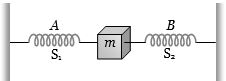
- 9A particle moving along the $X-$axis executes simple harmonic motion, then the force acting on it is given byView Solution
Where $A$ and $K$ are positive constants
- 10On a frictionless horizontal plane, a bob of mass $m=0.1 kg$ is attached to a spring with natural length $l_0=0.1 m$. The spring constant is $k_1=0.009 Nm ^{-1}$ when the length of the spring $I > l_0$ and is $k_2=0.016 Nm ^{-1}$ when $ I < l_0$. Initially the bob is released from $l=0.15 m$. Assume that Hooke's law remains valid throughout the motion. If the time period of the full oscillation is $T=(n \pi) s$, then the integer closest to $n$ is. . . . .View Solution