Question
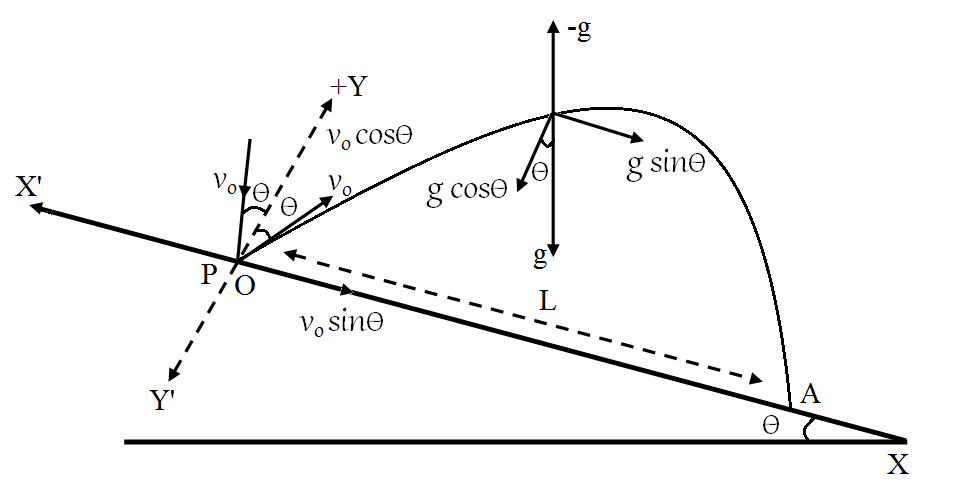
A particle falling vertically from a height hits a plane surface inclined to horizontal at an angle $\theta$ with speed $\text{v}_0$ and rebounds elastically. Find the distance along the plane where if will hit second time.
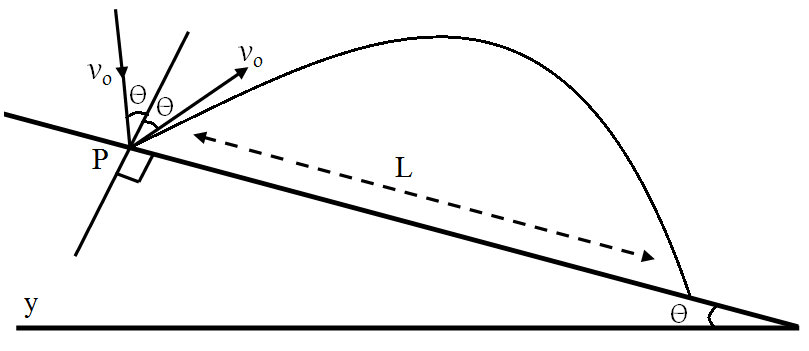
(Hint:

  1. After rebound, particle still has speed Vo to start.
  2. Work out angle particle speed has with horizontal after it rebounds.
  3. Rest is similar to if particle is projected up the incline.
Answer

Particle rebounces from P so it will be an elastic collision. As it strikes plane inclined at  $\text{v}_0$ speed so speed of particle after rebounces will be $\text{v}_0$

Again consider the new axia X'OX and YOY' axis at P as origin 'O'. The componenets of g and $\text{v}_0$ in new OX and OY axis are:

$\text{v}_\text{x}=\text{v}_0\sin\theta\text{ and v}_\text{y}=\text{v}_0\cos\theta$

$\text{g}_\text{x}=\text{g}\cos\theta,\text{g}_\text{y}=\text{g}\sin\theta$ acting vertically downwords 

Consider the motion of particle from O to A in new YOY' axis.

$\text{s}_\text{y}=\text{u}_\text{y}\text{t}+\frac{1}{2}\text{a}_\text{y}\text{t}^2$

$\text{s}_\text{y}=0\ \text{v}_\text{y}=\text{v}_0\cos\theta\ \text{a}_\text{y}=-\text{g}\sin\theta $ (upward)

$\therefore\text{t=T}$ (time of flight)

$0=\text{T}\Big[\text{v}_0\cos\theta-\frac{1}{2}\text{g}\text{ sin}\theta\text{ T}\Big]$

This means either $\text{T}=0\text{ or v}_0\cos\theta-\frac{\text{g}\cos\theta(\text{T})}{2}=0$

T cannot be zero $\Rightarrow\text{T}=\frac{2\text{v}_0\cos\theta}{\text{g}\cos\theta}$

$\text{T}=\frac{2\text{v}_0}{\text{g}}$

Now consider the motion along OX axis.

$\text{S}_\text{x}=\text{L, u}_\text{x}=\upsilon_0\sin\theta,\text{a}_\text{x}=\text{g}\sin\theta,\text{t}=\text{T}=\frac{2\upsilon_0}{\text{g}}$

$\text{S}_\text{x}=\text{u}_\text{x}\text{t}+\frac{1}{2}\text{a}_\text{x}\text{t}^2$

$\text{L}=\Big[\frac{2\text{v}_\text{0}}{\text{g}}\Big]\text{v}_0\sin\theta+\frac{1}{2}\text{g}\sin\theta\Big[\frac{2\text{v}_0}{\text{g}}\Big]^2$

$\text{L}=\frac{2\text{v}^2_0}{\text{g}}\sin\theta+\frac{1}{2}\text{g}\sin\theta.\frac{4\text{v}^2_0}{\text{g}^2}$

$=\frac{2\text{v}^2_0}{\text{g}}[\sin\theta+\sin\theta]=\frac{2\text{v}^2_0}{\text{g}}2\sin\theta$

$\Rightarrow\text{L}=\frac{4\text{v}^2_0}{\text{g}}\sin\theta.$

Need a full question paper?

Generate a complete, print-ready paper with questions like this in minutes — across 16+ boards, with answer keys.

Start Generating Free

Similar questions

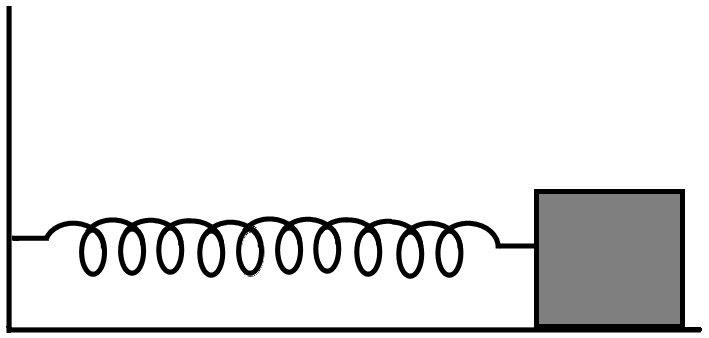
For three situations, the initial and final positions respectively, along x-axis for the block in Fig are (a) - 3cm, 2cm. (b) 2cm, 3 cm and (c) -2cm, 2cm. In each situation, is the work done by the spring force on the block positive, negative or zero?

A capacitor of capacitance $8.0\mu\text{F}$ is connected to a battery of emf 6.0V through a resistance of $24\Omega.$ Find the current in the circuit (a) just after the connections are made and (b) one time constant after the connections are made.
The intensities due to two sources of sound are I0 and 4I0. What is the intensity at a point where the phase difference between two waves is:
  1. $0^\circ$
  2. $\frac{\pi}{2}$
  3. $\pi?$
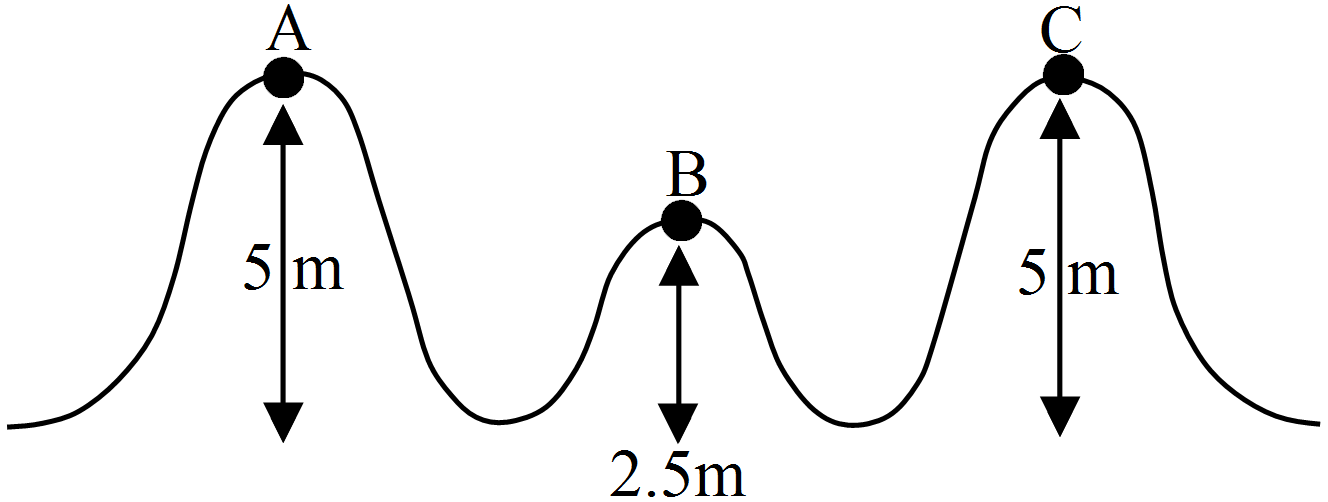
A curved surface is shown in. The portion BCD is free of friction. There are three spherical balls of identical radii and masses. Balls are released from rest one by one from A which is at a slightly greater height than C.

With the surface AB, ball 1 has large enough friction to cause rolling down without slipping, ball 2 has a small friction and ball 3 has a negligible friction.

  1. For which balls is total mechanical energy conserved?
  2. Which ball (s) can reach D?
  3. For balls which do not reach D, which of the balls can reach back A?
Find the speed at which the kinetic enei:gy of a particle will differ by 1% from its nonrelativistic value $\frac{1}{2}\text{m}_0\text{v}^2$
A mass 5kg starts sliding from A on a smooth surface shown in the figure. Find the velocity of the mass at B and C?

A body of mass m makes an elastic collision with another identical body at rest. Show that if the collision is not head-on, the bodies go at right angle to each other after the collision.
In nature, the failure of structural members usually result from large torque because of twisting or bending rather than due to tensile or compressive strains. This process of structural breakdown is called buckling and in cases of tall cylindrical structures like trees, the torque is caused by its own weight bending the structure. Thus the vertical through the centre of gravity does not fall within the base. The elastic torque caused because of this bending about the central axis of the tree is given by $\frac{\text{Y}\pi\text{r}^4}{4\text{R}}.$ Y is the Young’s modulus, r is the radius of the trunk and R is the radius of curvature of the bent surface along the height of the tree containing the centre of gravity (the neutral surface). Estimate the critical height of a tree for a given radius of the trunk.
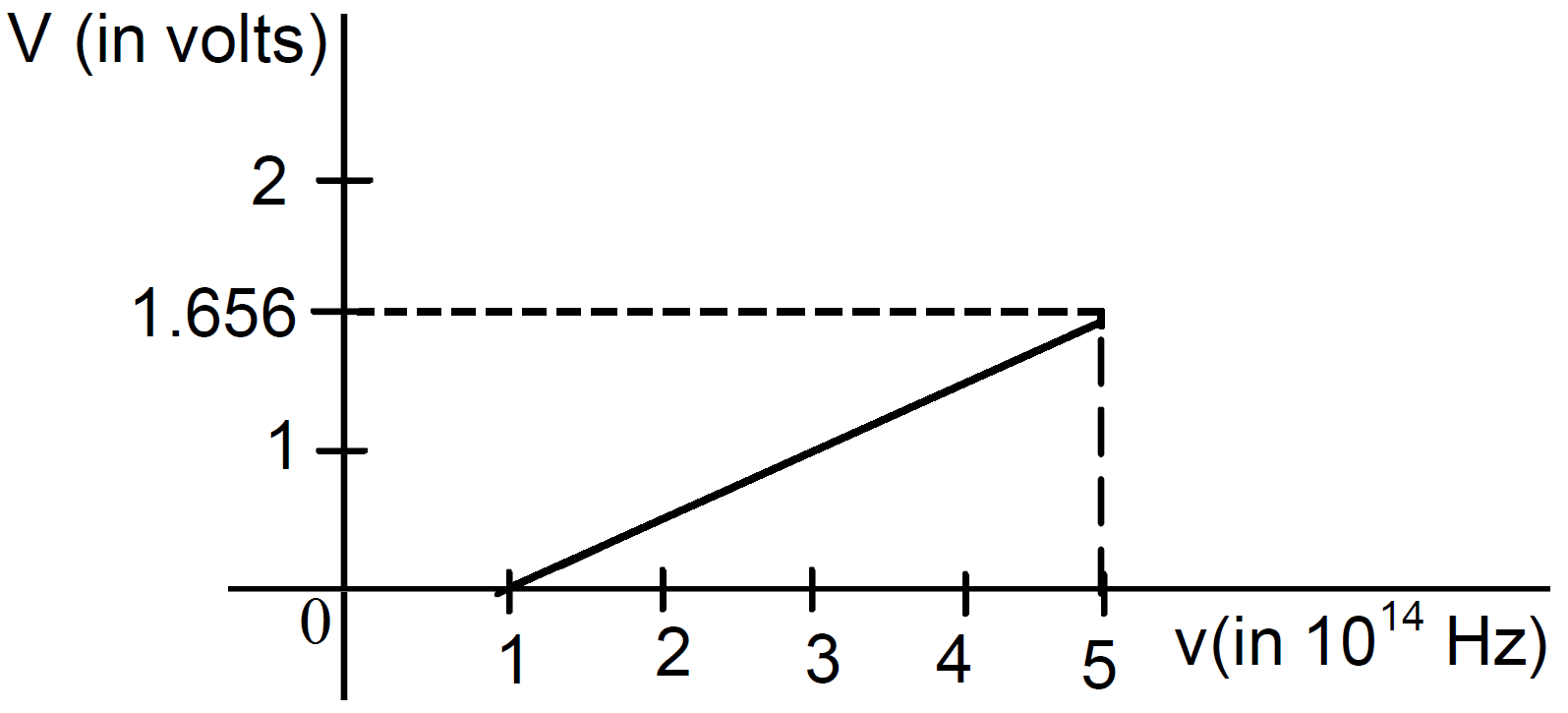
Figure is the plot of the stopping potential versus the frequency of the light used in an experiment on photoelectric effect. Find.

  1. The ratio h/e and.
  2. The work function.

Explain how Carnot's cycle works with the heat flow diagram. Using the same, explain the working of a refrigerator. Also, give its coefficient of performance.