A particle in $S.H.M.$ is described by the displacement function $x(t) = a\cos (\omega t + \theta )$. If the initial $(t = 0)$ position of the particle is $1\, cm $ and its initial velocity is $\pi \,cm/s$. The angular frequency of the particle is $\pi \,rad/s$, then it’s amplitude is
Diffcult
Download our app for free and get started
(b) $x = a\cos (\omega \,t + \theta )$ ….(i)
and $v = \frac{{dx}}{{dt}} = - a\omega \sin (\omega \,t + \theta )$ ….(ii)
Given at $t = 0$, $x = 1\,cm$ and $v = \pi $ and $\omega = \pi $
Putting these values in equation (i) and (ii) we will get $\sin \theta = \frac{{ - 1}}{a}$ and $\cos \theta = \frac{1}{A}$
==> ${\sin ^2}\theta + {\cos ^2}\theta = {\left( { - \frac{1}{a}} \right)^2} + {\left( {\frac{1}{a}} \right)^2}$
==> $a = \sqrt 2 \,cm$

Download our appand get started for free
Experience the future of education. Simply download our apps or reach out to us for more information. Let's shape the future of learning together!No signup needed.*
Similar Questions
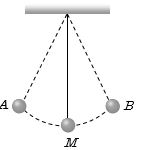
- 1What is the velocity of the bob of a simple pendulum at its mean position, if it is able to rise to vertical height of $10\,cm$ ($g = 9.8\, m/s^2$) ..... $m/s$View Solution
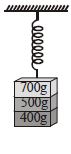
- 2Three masses $700g, 500g$ and $400g$ are suspended at the end of a spring a shown and are in equilibrium. When the $700g$ mass is removed, the system oscillates with a period of $3\,seconds$, when the $500g$ mass is also removed, it will oscillate with a period of .... $s$View Solution
- 3Two particles $P$ and $Q$ describe simple harmonic motions of same period, same amplitude, along the same line about the same equilibrium position $O.$ When $P$ and $Q$ are on opposite sides of $O$ at the same distance from $O$ they have the same speed of $1.2 \,m/s$ in the same direction, when their displacements are the same they have the same speed of $1.6\, m/s$ in opposite directions. The maximum velocity in $m/s$ of either particle isView Solution
- 4View SolutionThe velocity of a particle performing simple harmonic motion, when it passes through its mean position is
- 5The general displacement of a simple harmonic oscillator is $x = A \sin \omega t$. Let $T$ be its time period. The slope of its potential energy (U) - time (t) curve will be maximum when $t=\frac{T}{\beta}$. The value of $\beta$ is $.........$View Solution
- 6View SolutionTime period of pendulum, on a satellite orbiting the earth, is
- 7View SolutionWhich of the following function represents a simple harmonic oscillation
- 8The total energy of particle performing $S.H.M.$ depend onView Solution
- 9A point particle is acted upon by a restoring force $-k x^{3}$. The time-period of oscillation is $T$, when the amplitude is $A$. The time-period for an amplitude $2 A$ will beView Solution
- 10The amplitude of a damped oscillator becomes one third in $2\, sec$. If its amplitude after $6\, sec$ is $1/n$ times the original amplitude then the value of $n$ isView Solution