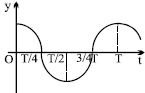
The displacement-time graph of a particle executing $SHM$ is shown. Which of the following statements is/are true ?
Advanced
Download our app for free and get started
$v=0$ at $t=T / 2$
a is maximum at extremes
$F=0$ at $t=\frac{3 T}{4}$
$\mathrm{K.E.}=0$ at $\mathrm{t}=\mathrm{T} / 2$

Download our appand get started for free
Experience the future of education. Simply download our apps or reach out to us for more information. Let's shape the future of learning together!No signup needed.*
Similar Questions
- 1A spring executes $SHM$ with mass of $10\,kg$ attached to it. The force constant of spring is $10\,N/m$.If at any instant its velocity is $40\,cm/sec$, the displacement will be .... $m$ (where amplitude is $0.5\,m$)View Solution
- 2A particle executes simple harmonic motion represented by displacement function as $x(t)=A \sin (\omega t+\phi)$View Solution
If the position and velocity of the particle at $t=0\, {s}$ are $2\, {cm}$ and $2\, \omega \,{cm} \,{s}^{-1}$ respectively, then its amplitude is $x \sqrt{2} \,{cm}$ where the value of $x$ is ..... .
- 3The amplitude of a damped oscillator becomes one third in $2\, sec$. If its amplitude after $6\, sec$ is $1/n$ times the original amplitude then the value of $n$ isView Solution
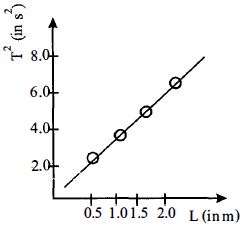
- 4In an experiment for determining the gravitational acceleration $g$ of a place with the help of a simple pendulum, the measured time period square is plotted against the string length of the pendulum in the figure. What is the value of $g$ at the place? ...... $m/s^2$View Solution
- 5A particle executing simple harmonic motion with amplitude of $0.1 \,m$. At a certain instant when its displacement is $0.02 \,m$, its acceleration is $0.5 \,m/s^2$. The maximum velocity of the particle is (in $m/s$)View Solution
- 6In a seconds pendulum, mass of bob is $30\, gm$. If it is replaced by $90\, gm$ mass. Then its time period will .... $\sec$View Solution
- 7An object of mass $0.2\, kg$ executes simple harmonic along $X-$ axis with frequency of $\frac{{25}}{\pi }Hz$. At the position $x = 0.04m$, the object has kinetic energy of $0.5 \,J$ and potential energy of $0.4\, J$ amplitude of oscillation in meter is equal toView Solution
- 8If a spring extends by $x$ on loading, then energy stored by the spring is (if $T$ is the tension in the spring and $K$ is the spring constant)View Solution
- 9Infinite springs with force constant $k$, $2k$, $4k$ and $8k$.... respectively are connected in series. The effective force constant of the spring will beView Solution
- 10The ratio of maximum acceleration to maximum velocity in a simple harmonic motion is $10\,s^{-1}$. At, $t = 0$ the displacement is $5\, m$. What is the maximum acceleration ? The initial phase is $\frac{\pi }{4}$View Solution