Question
A particle is projected with a speed u at an angle $\theta$ with the horizontal. Consider a small part of its path near the highest position and take it approximately to be a circular arc. What is the radius of this circle? This radius is called the radius of curvature of the curve at the point.

Answer


Particle is projected with speed ‘u’ at an angle $\theta.$ At the highest pt. the vertical component of velocity is‘0’.
So, at that point, velocity $=\text{u}\sin\theta$
centripetal force $=\text{mu}^2\cos^2\Big(\frac{\theta}{\text{r}}\Big)$
At highest pt.
$\text{mg}=\frac{\text{mv}^2}{\text{r}}$
$\Rightarrow\text{r}=\frac{\text{u}^2\cos^2\theta}{\text{g}}$

Need a full question paper?

Generate a complete, print-ready paper with questions like this in minutes — across 16+ boards, with answer keys.

Start Generating Free

Similar questions

  1. What is total internal reflection? Under what conditions does it occur?
  2. Find a relation between critical angle and refractive index.
  3. Name one phenomenon which is based on total internal reflection.
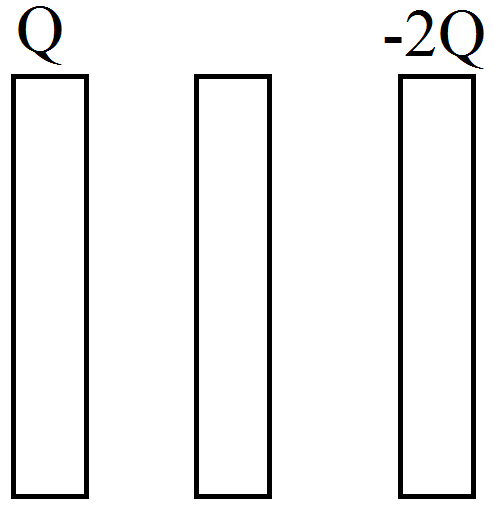
Three identical metal plates with large surface areas are kept parallel to each other as shown in figure. The leftmost plate is given a charge Q, the rightmost a charge -2Q and the middle one remains neutral. Find the charge appearing on the outer surface of the rightmost plate.
A short bar magnet has a magnetic moment of $0.48\ J\ T^{–1}$. Give the direction and magnitude of the magnetic field produced by the magnet at a distance of 10 cm from the centre of the magnet on.(a) the axis, (b) the equatorial lines (normal bisector) of the magnet.
A convex lens produces a double size real image when an object is placed at a distance of 18cm from it. Where should the object be placed to produce a triple size real image?
The near point and the far point of a child are at 10cm and 100cm. If the retina is 2.0cm behind the eye-lens, what is the range of the power of the eye-lens?
In a Geiger - Marsden experiment, calculate the distance of closest approach to the nucleus of Z = 80, when an α-particle of 8 MeV nergy impinges on it before it comes momentarily to rest and reverses its direction.
How will the distance of closest approach be affected when the kinetic energy of the α-particle is doubled?
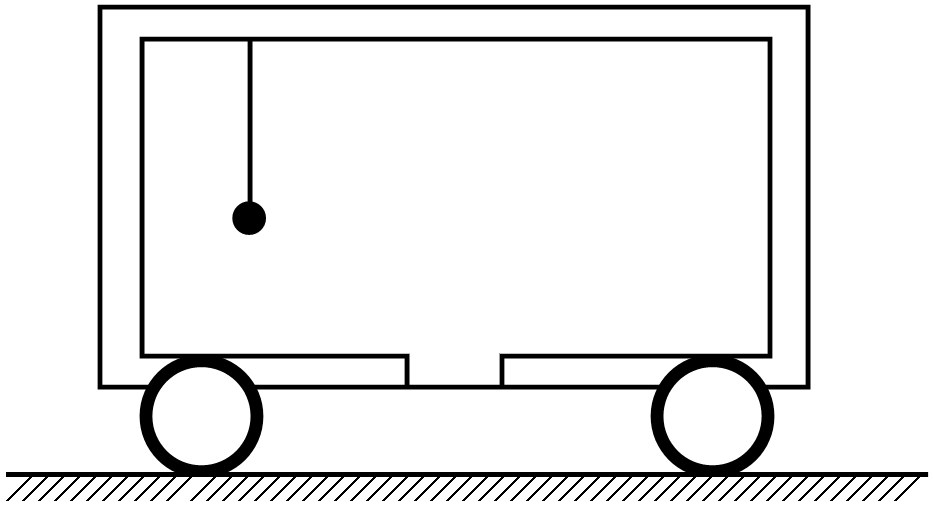
A cart of mass M is at rest on a frictionless horizontal surface and a pendulum bob of mass m hangs from the roof of the cart. The string breaks, the bob falls on the floor, makes several collisions on the floor and finally lands up in a small slot made in the floor. The horizontal distance between the string and the slot is L. Find the displacement of the cart during this process.
A tightly-wound, long solenoid carries a current of 2.00A. An electron is found to execute a uniform circular motion inside the solenoid with a frequency of $1.00 \times 10^8$ rev/s. Find the number of turns per metre in the solenoid.
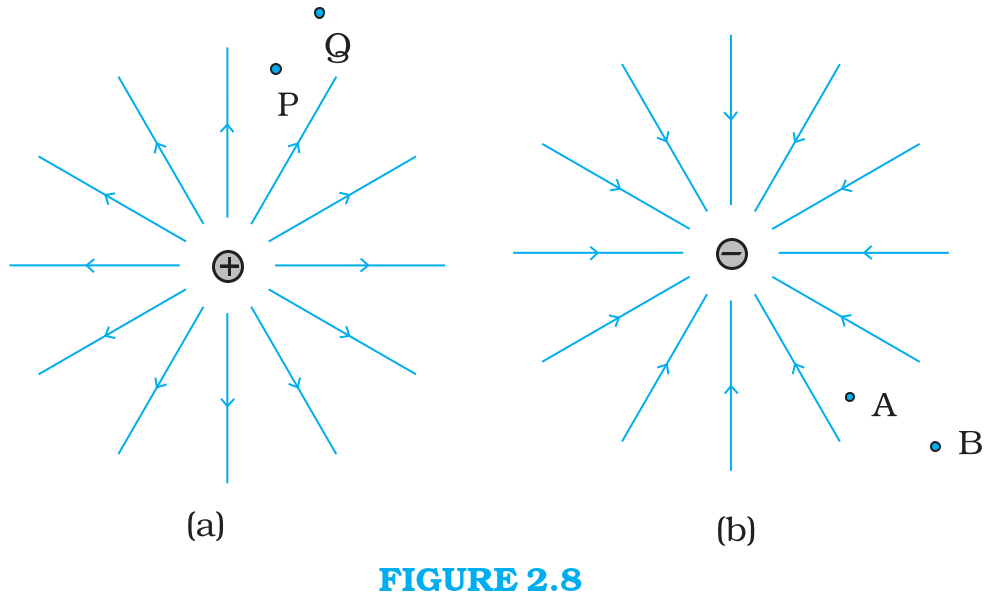
Figures 2.8 (a) and (b) show the field lines of a positive and negative point charge respectively.
Image
(a) Give the signs of the potential difference $V_{ P }-V_{ Q } ; V_{ B }-V_{ A }$.
(b) Give the sign of the potential energy difference of a small negative charge between the points $O$ and $P ; A$ and $B$.
(c) Give the sign of the work done by the field in moving a small positive charge from $Q$ to $P$.
(d) Give the sign of the work done by the external agency in moving a small negative charge from $B$ to $A$.
(e) Does the kinetic energy of a small negative charge increase or decrease in going from $B$ to $A$ ?
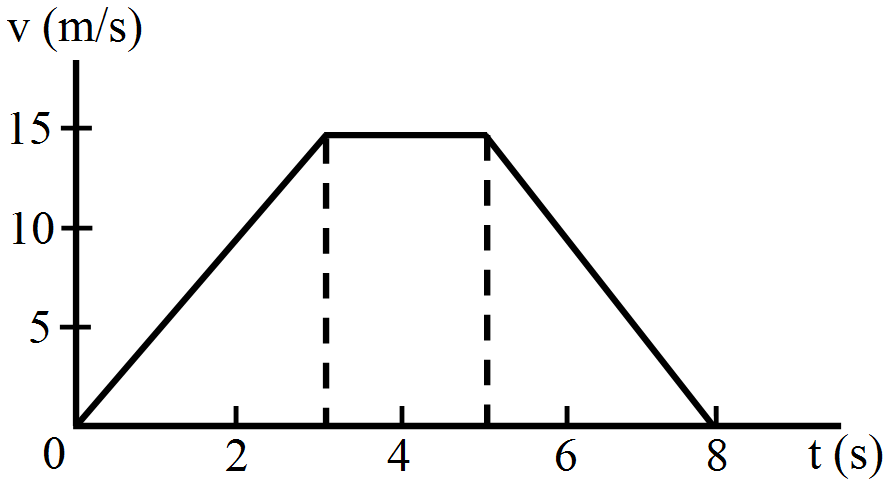
A particle of mass 50g moves on a straight line. The variation of speed with time is shown in figure. Find the force acting on the particle at t = 2, 4 and 6 seconds.