A particle of mass $2 \,kg$, executing $SHM$ has amplitude $20 \,cm$ and time period $1 \,s$. Its maximum speed is ......... $m / s$
Easy


Download our appand get started for free
Experience the future of education. Simply download our apps or reach out to us for more information. Let's shape the future of learning together!No signup needed.*
Similar Questions
- 1A $ U$ tube of uniform bore of cross-sectional area $A$ has been set up vertically with open ends facing up. Now $m$ gm of a liquid of density $d$ is poured into it. The column of liquid in this tube will oscillate with a period $T$ such thatView Solution
- 2When the potential energy of a particle executing simple harmonic motion is one-fourth of its maximum value during the oscillation, the displacement of the particle from the equilibrium position in terms of its amplitude $a$ isView Solution
- 3A mass $m$ attached to free end of a spring executes SHM with a period of $1\; s$. If the mass is increased by $3\; kg$ the period of oscillation increases by one second, the value of mass $m$ is $..............kg$.View Solution
- 4In damped oscillations, damping force is directly proportional to speed of oscillator. If amplitude becomes half of its maximum value in $1 \,s$, then after $2 \,s$ amplitude will be $\left(A_0-\right.$ initial amplitude)View Solution
- 5The mass $M$ shown in the figure oscillates in simple harmonic motion with amplitude $A$. The amplitude of the point $P$ isView Solution
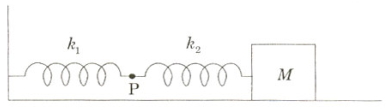
- 6The amplitude of a damped oscillator becomes one third in $2\, sec$. If its amplitude after $6\, sec$ is $1/n$ times the original amplitude then the value of $n$ isView Solution
- 7A block of mass $m$ is attached to two springs of spring constants $k_1$ and $k_2$ as shown in figure. The block is displaced by $x$ towards right and released. The velocity of the block when it is at $x/2$ will beView Solution
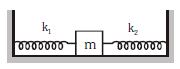
- 8A system of two identical rods ($L-$ shaped) of mass $m$ and length $l$ are resting on a peg $P$ as shown in the figure. If the system is displaced in its plane by a small angle $\theta ,$ find the period of oscillations :View Solution
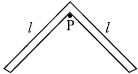
- 9A circular disc of mass $10 \;kg$ is suspended by a wire attached to its centre. The wire is twisted by rotating the disc and released. The period of torsional oscillations is found to be $1.5 \;s$. The radius of the disc is $15\; cm .$ Determine the torsional spring constant of the wire in $N\;m\;rad^{-1}$. (Torsional spring constant $\alpha$ is defined by the relation $J=-\alpha \theta,$ where $J$ is the restoring couple and $\theta$ the angle of twist).View Solution
- 10Four harmonic waves of equal frequencies and equal intensities $I_0$ have phase angles $0, \pi / 3,2 \pi / 3$ and $\pi$. When they are superposed, the intensity of the resulting wave is $nI _0$. The value of $n$ isView Solution