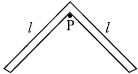
A system of two identical rods ($L-$ shaped) of mass $m$ and length $l$ are resting on a peg $P$ as shown in the figure. If the system is displaced in its plane by a small angle $\theta ,$ find the period of oscillations :
Advanced
Download our app for free and get started
$\mathrm{T}=2 \pi \sqrt{\frac{\mathrm{I}}{\mathrm{mg} \mathrm{L}}}$
Here $I=\frac{m l^{2}}{3}+\frac{m l^{2}}{3}=\frac{2 m g l^{2}}{3}$
From figure: $\sin 45^{\circ}=\frac{L}{l / 2}$
$\therefore \mathrm{L}=\frac{l}{2 \sqrt{2}}$
$\therefore \quad \mathrm{T}=2 \pi \sqrt{\frac{2 \mathrm{m} l^{2}}{3 \times \frac{l}{2 \sqrt{2}} \mathrm{mg}}}=2 \pi \sqrt{\frac{2 \sqrt{2} l}{3 \mathrm{g}}}$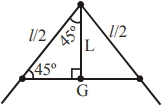

Download our appand get started for free
Experience the future of education. Simply download our apps or reach out to us for more information. Let's shape the future of learning together!No signup needed.*
Similar Questions
- 1A simple pendulum hanging from the ceiling of a stationary lift has a time period $T_1$. When the lift moves downward with constant velocity, the time period is $T_2$, thenView Solution
- 2A particle is performing $S.H.M.$ with energy of vibration $90 \,J$ and amplitude $6 \,cm$. When the particle reaches at distance $4 \,cm$ from mean position, it is stopped for a moment and then released. The new energy of vibration will be ........... $J$View Solution
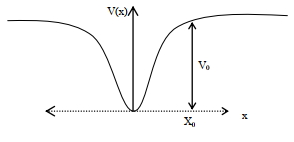
- 3When a particle of mass $m$ moves on the $x$-axis in a potential of the form $V(x)=\mathrm{kx}^2$ it performs simple harmonic motion. The corresponding time period is proportional to $\sqrt{\frac{\mathrm{m}}{\mathrm{k}}}$, as can be seen easily using dimensional analysis. However, the motion of a particle can be periodic even when its potential energy increases on both sides of $\mathrm{x}=0$ in a way different from $\mathrm{kx}^2$ and its total energy is such that the particle does not escape to infinity. Consider a particle of mass $\mathrm{m}$ moving on the $x$-axis. Its potential energy is $V(x)=\alpha x^4(\alpha>0)$ for $|x|$ near the origin and becomes a constant equal to $\mathrm{V}_0$ for $|x| \geq X_0$ (see figure). $Image$View Solution
$1.$ If the total energy of the particle is $E$, it will perform periodic motion only if
$(A)$ $E$ $<0$ $(B)$ $E$ $>0$ $(C)$ $\mathrm{V}_0 > \mathrm{E}>0$ $(D)$ $E > V_0$
$2.$ For periodic motion of small amplitude $\mathrm{A}$, the time period $\mathrm{T}$ of this particle is proportional to
$(A)$ $\mathrm{A} \sqrt{\frac{\mathrm{m}}{\alpha}}$ $(B)$ $\frac{1}{\mathrm{~A}} \sqrt{\frac{\mathrm{m}}{\alpha}}$ $(C)$ $\mathrm{A} \sqrt{\frac{\alpha}{\mathrm{m}}}$ $(D)$ $\mathrm{A} \sqrt{\frac{\alpha}{\mathrm{m}}}$
$3.$ The acceleration of this particle for $|\mathrm{x}|>\mathrm{X}_0$ is
$(A)$ proportional to $\mathrm{V}_0$
$(B)$ proportional to $\frac{\mathrm{V}_0}{\mathrm{mX}_0}$
$(C)$ proportional to $\sqrt{\frac{\mathrm{V}_0}{\mathrm{mX}_0}}$
$(D)$ zero
Give the answer qustion $1,2$ and $3.$
- 4A particle executes simple harmonic motion according to equation $4 \frac{d^2 x}{d t^2}+320 x=0$. Its time period of oscillation is .........View Solution
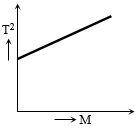
- 5The graph shown was obtained from experimental measurements of the period of oscillations $T$ for different masses $M$ placed in the scale pan on the lower end of the spring balance. The most likely reason for the line not passing through the origin is that theView Solution
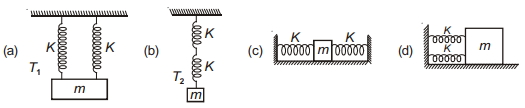
- 6A mass $m$ is attached to two springs of same force constant $K$, as shown in following four arrangements. If $T_1, T_2, T_3$ and $T_4$ respectively be the time periods of oscillation in the following arrangements, in which case time period is maximum?View Solution
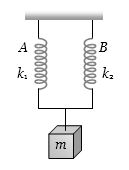
- 7A mass $m$ is suspended by means of two coiled spring which have the same length in unstretched condition as in figure. Their force constant are $k_1$ and $k_2$ respectively. When set into vertical vibrations, the period will beView Solution
- 8The amplitude of the vibrating particle due to superposition of two $SHMs,$View Solution
$y_1 = \sin \left( {\omega t + \frac{\pi }{3}} \right)$ and $y_2 = \sin \omega t$ is :
- 9A flat horizontal board moves up and down under $S.H.M.$ vertically with amplitude $A$. The shortest permissible time period of the vibration such that an object placed on the board may not lose contact with the board is ..........View Solution
- 10If a particle under S.H.M. has time period 0.1 sec and amplitude $2 \times 10^{-3}$. It has maximum velocityView Solution