$A$ particle of mass m is constrained to move on $x$ -axis. $A$ force $F$ acts on the particle. $F$ always points toward the position labeled $E$. For example, when the particle is to the left of $E, F$ points to the right. The magnitude of $F$ is a constant $F$ except at point $E$ where it is zero. The system is horizontal. $F$ is the net force acting on the particle. The particle is displaced a distance $A$ towards left from the equilibrium position $E$ and released from rest at $t = 0.$ Find minimum time it will take to reach from $x = - \frac{A}{2}$ to $0$.
Advanced
Download our app for free and get started

Download our appand get started for free
Experience the future of education. Simply download our apps or reach out to us for more information. Let's shape the future of learning together!No signup needed.*
Similar Questions
- 1Aheavy brass sphere is hung from a light spring and is set in vertical small oscillation with a period $T.$ The sphere is now immersed in a non-viscous liquid with a density $1/10\,th$ the density of the sphere. If the system is now set in vertical $S.H.M.,$ its period will beView Solution
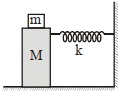
- 2In the given figure, a mass $M$ is attached to a horizontal spring which is fixed on one side to a rigid support. The spring constant of the spring is $k$. The mass oscillates on a frictionless surface with time period $T$ and amplitude $A$. When the mass is in equilibrium position, as shown in the figure, another mass $m$ is gently fixed upon it. The new amplitude of oscillation will beView Solution
- 3A particle of mass $2 \,kg$, executing $SHM$ has amplitude $20 \,cm$ and time period $1 \,s$. Its maximum speed is ......... $m / s$View Solution
- 4A vibratory motion is represented by $x = 2A\,\cos \omega t + A\,\cos \,\left( {\omega t + \frac{\pi }{2}} \right) + A\,\cos \,\left( {\omega t + \pi } \right)$ $ + \frac{A}{2}\,\cos \left( {\omega t + \frac{{3\pi }}{2}} \right)$. The resultant amplitude of the motion isView Solution
- 5A $LCR$ circuit behaves like a damped harmonic oscillator. Comparing it with a physical springmass damped oscillator having damping constant $\mathrm{b}$, the correct equivalence would be:View Solution
- 6When an oscillator completes $100$ oscillations its amplitude reduced to $\frac{1}{3}$ of initial value. What will be its amplitude, when it completes $200$ oscillations?View Solution
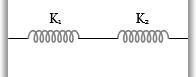
- 7View SolutionThe effective spring constant of two spring system as shown in figure will be
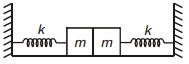
- 8View SolutionAn assembly of identical spring-mass systems is placed on a smooth horizontal surface as shown. At this instant, the springs are relaxed. The left mass is displaced to the/left and theiright mass is displaced to the right by same distance and released. The resulting collision is elastic. The time period of the oscillations of system is
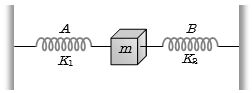
- 9View SolutionIn arrangement given in figure, if the block of mass m is displaced, the frequency is given by
- 10If a body of mass $0.98\, kg$ is made to oscillate on a spring of force constant $4.84\, N/m$, the angular frequency of the body is ..... $ rad/s$View Solution