A pendulum has time period $T$. If it is taken on to another planet having acceleration due to gravity half and mass $ 9 $ times that of the earth then its time period on the other planet will be
Easy


Download our appand get started for free
Experience the future of education. Simply download our apps or reach out to us for more information. Let's shape the future of learning together!No signup needed.*
Similar Questions
- 1A particle of mass $m$ executes simple harmonic motion with amplitude $a$ and frequency $v$. The average kinetic energy during its motion from the position of equilibrium to the end isView Solution
- 2View SolutionThe velocity of a particle performing simple harmonic motion, when it passes through its mean position is
- 3For a periodic motion represented by the equation $Y=\sin \omega t+\cos \omega t$ The amplitude of the motion isView Solution
- 4Two masses $m_1$ and $m_2$ connected by a spring of spring constant $k$ rest on a frictionless surface. If the masses are pulled apart and let go, the time period of oscillation isView Solution
- 5A sphere of radius $r$ is kept on a concave mirror of radius of curvature $R$. The arrangement is kept on a horizontal table (the surface of concave mirror is frictionless and sliding not rolling). If the sphere is displaced from its equilibrium position and left, then it executes $S.H.M.$ The period of oscillation will beView Solution
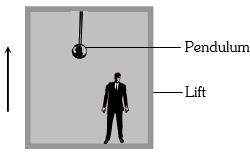
- 6A man measures the period of a simple pendulum inside a stationary lift and finds it to be $T$ sec. If the lift accelerates upwards with an acceleration $\frac{g}{4}$, then the period of the pendulum will beView Solution
- 7View SolutionTwo particles are oscillating along two close parallel straight lines side by side, with the same frequency and amplitudes. They pass each other, moving in opposite directions when their displacement is half of the amplitude. The mean positions of the two particles lie on a straight line perpendicular to the paths of the two particles. The phase difference is
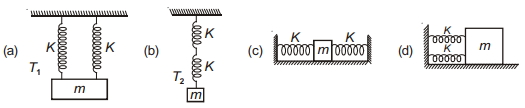
- 8A mass $m$ is attached to two springs of same force constant $K$, as shown in following four arrangements. If $T_1, T_2, T_3$ and $T_4$ respectively be the time periods of oscillation in the following arrangements, in which case time period is maximum?View Solution
- 9A mass m oscillates with simple harmonic motion with frequency $f = \frac{\omega }{{2\pi }}$ and amplitude A on a spring with constant $K$ , thereforeView Solution
- 10The displacement of a particle moving in $S.H.M.$ at any instant is given by $y = a\sin \omega t$. The acceleration after time $t = \frac{T}{4}$ is (where $T$ is the time period)View Solution