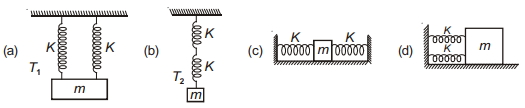
A mass $m$ is attached to two springs of same force constant $K$, as shown in following four arrangements. If $T_1, T_2, T_3$ and $T_4$ respectively be the time periods of oscillation in the following arrangements, in which case time period is maximum?
Easy
Download our app for free and get started
(b)
$T=2 \pi \sqrt{\frac{m}{K}}$
Time period is maximum when $K$ is minimum. In $(a), (c)$ and $(d)$ the spring constants are in parallel so the $K_{ eq }=2 K$. Only in case $(b)$ springs are in series.
So, $K_{\text {eq }}=\frac{K}{2}$
Hence time period in this case will be maximum.

Download our appand get started for free
Experience the future of education. Simply download our apps or reach out to us for more information. Let's shape the future of learning together!No signup needed.*
Similar Questions
- 1Which graph represents the difference between total energy and potential energy of a particle executing $SHM$ Vs it's distance from mean position?View Solution
- 2A simple harmonic oscillator has a period of $0.01 \,sec$ and an amplitude of $0.2\, m$. The magnitude of the velocity in $m{\sec ^{ - 1}}$ at the centre of oscillation isView Solution
- 3An ideal spring with spring-constant $K$ is hung from the ceiling and a block of mass $M$ is attached to its lower end. The mass is released with the spring initially unstretched. Then the maximum extension in the spring isView Solution
- 4The equation of a simple harmonic motion is $X = 0.34\cos (3000t + 0.74)$ where $X$ and $t$ are in $mm$ and $sec$. The frequency of motion isView Solution
- 5The displacement of a particle varies according to the relation $x = 3 \sin 100 \, t + 8 \cos ^2 50\,t $. Which of the following is/are correct about this motion .View Solution
- 6A particle executes linear simple harmonic motion with an amplitude of $2\, cm$. When the particle is at $1\, cm$ from the mean position the magnitude of its velocity is equal to that of its acceleration. Then its time period in seconds isView Solution
- 7A particle in $SHM $ is described by the displacement equation $x(t) = A\cos (\omega t + \theta ).$ If the initial $(t = 0)$ position of the particle is $1 \,cm$ and its initial velocity is $\pi $cm/s, what is its amplitude? The angular frequency of the particle is $\pi {s^{ - 1}}$View Solution
- 8A particle performs $SHM$ about $x = 0$ such that at $t = 0$ it is at $x = 0$ and moving towards positive extreme. The time taken by it to go from $x = 0$ to $x = \frac{A}{2}$ is ..... times the time taken to go from $x = \frac{A}{2}$ to $A$. The most suitable option for the blank space isView Solution
- 9A particle is executing simple harmonic motion with an amplitude of $0.02$ metre and frequency $50\, Hz$. The maximum acceleration of the particle isView Solution
- 10The instantaneous displacement of a simple pendulum oscillator is given by $x = A\,\cos \,\left( {\omega t + \frac{\pi }{4}} \right)$ . Its speed will be maximum at timeView Solution