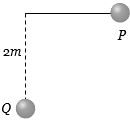
A pendulum of length $2\,m$ lift at $P$. When it reaches $Q$, it losses $10\%$ of its total energy due to air resistance. The velocity at $Q$ is .... $m/sec$
Medium
Download our app for free and get started
(a) If $v$ is velocity of pendulum at $Q$
and $10\%$ energy is lost while moving from $P$ to $Q$
Hence, by applying conservation of between $P$ and $Q$
$\frac{1}{2}m{v^2} = 0.9\,(mgh)$
and $10\%$ energy is lost while moving from $P$ to $Q$
Hence, by applying conservation of between $P$ and $Q$
$\frac{1}{2}m{v^2} = 0.9\,(mgh)$
==>${v^2} = 2 \times 0.9 \times 10 \times 2$
==> $v = 6\,m/sec$

Download our appand get started for free
Experience the future of education. Simply download our apps or reach out to us for more information. Let's shape the future of learning together!No signup needed.*
Similar Questions
- 1A particle is executing $S.H.M.$ with time period $T^{\prime}$. If time period of its total mechanical energy is $T$ then $\frac{T^{\prime}}{T}$ is ........View Solution
- 2The variation of the acceleration $a$ of the particle executing $S.H.M.$ with displacement $x$ is as shown in the figureView Solution
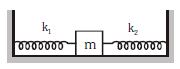
- 3A block of mass $m$ is attached to two springs of spring constants $k_1$ and $k_2$ as shown in figure. The block is displaced by $x$ towards right and released. The velocity of the block when it is at $x/2$ will beView Solution
- 4A point mass is subjected to two simultaneous sinusoidal displacements in x-direction, $x_1(t)=A \sin \omega t $ and $ x_2(t)=A \sin \left(\omega t+\frac{2 \pi}{3}\right)$. Adding a third sinusoidal displacement $x_3(t)=B \sin (\omega t+\phi)$ brings the mass to a complete rest. The values of $B$ and $\phi$ areView Solution
- 5The function $sin^2\,(\omega t)$ representsView Solution
- 6The $ P.E.$ of a particle executing $SHM$ at a distance $x$ from its equilibrium position isView Solution
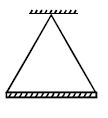
- 7A rod of mass $m$ and length $l$ is suspended from ceiling with two string of length $l$ as shown. When the rod is given a small push in the plane of page and released time period is $T_1$ and when the rod is given a push perpendicular to plane time period of oscillation is $T_2$ . The ratio $\frac{{T_1^2}}{{T_2^2}}$ isView Solution
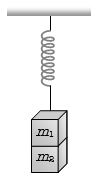
- 8Two masses $m_1$ and $m_2$ are suspended together by a massless spring of constant $K$. When the masses are in equilibrium, $m_1$ is removed without disturbing the system. The amplitude of oscillations isView Solution
- 9The displacement of a particle undergoing $SHM$ of time period $T$ is given by $x(t) = x_m\,cos\, (\omega t + \phi )$. The particle is at $x = -x_m$ at time $t = 0$. The particle is at $x = + x_m$ whenView Solution
- 10A point particle is acted upon by a restoring force $-k x^{3}$. The time-period of oscillation is $T$, when the amplitude is $A$. The time-period for an amplitude $2 A$ will beView Solution