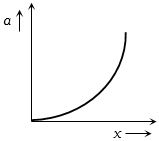
The variation of the acceleration $a$ of the particle executing $S.H.M.$ with displacement $x$ is as shown in the figure
- A
- B
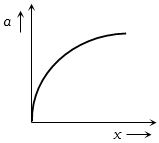
- C
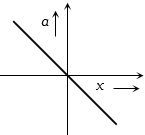
- D
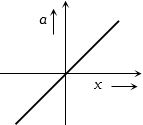
Easy


Download our appand get started for free
Experience the future of education. Simply download our apps or reach out to us for more information. Let's shape the future of learning together!No signup needed.*
Similar Questions
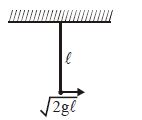
- 1A simple pendulum having length $\ell $ is having speed $\sqrt {2g\ell }$ at bottom most point of its trajectory. Its motion will beView Solution
- 2Two masses $m_1$ and $m_2$ connected by a spring of spring constant $k$ rest on a frictionless surface. If the masses are pulled apart and let go, the time period of oscillation isView Solution
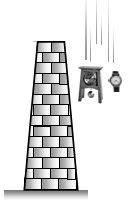
- 3A man having a wrist watch and a pendulum clock rises on a $TV$ tower. The wrist watch and pendulum clock per chance fall from the top of the tower. ThenView Solution
- 4View SolutionA simple pendulum is set into vibrations. The bob of the pendulum comes to rest after some time due to
- 5The length of a simple pendulum is increased by $1\%$. Its time period willView Solution
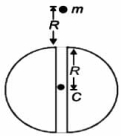
- 6A particle of mass $m$ is dropped from a height $R$ equal to the radius of the earth above the tunnel dug through the earth as shown in the figure. Hence the correct statement isView Solution
- 7The displacement of a particle is given at time $t$, by:$x=A \sin (-2 \omega t)+B \sin ^2 \omega t \quad$ Then,View Solution
- 8The position, velocity and acceleration of a particle executing simple harmonic motion are found to have magnitudes of $4 \mathrm{~m}, 2 \mathrm{~ms}^{-1}$ and $16 \mathrm{~ms}^{-2}$ at a certain instant. The amplitude of the motion is $\sqrt{\mathrm{x}} \mathrm{m}$ where $\mathrm{x}$ is. . . . . . .View Solution
- 9View SolutionIf the metal bob of a simple pendulum is replaced by a wooden bob, then its time period will
- 10Two particles are in $SHM$ in a straight line. Amplitude $A$ and time period $T$ of both the particles are equal. At time $t=0,$ one particle is at displacement $y_1= +A$ and the other at $y_2= -A/2,$ and they are approaching towards each other. After what time they cross each other ?View Solution