A pendulum of length $2\,m$ lift at $P$. When it reaches $Q$, it losses $10\%$ of its total energy due to air resistance. The velocity at $Q$ is .... $m/sec$
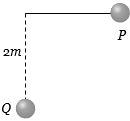
Medium


Download our appand get started for free
Experience the future of education. Simply download our apps or reach out to us for more information. Let's shape the future of learning together!No signup needed.*
Similar Questions
- 1The amplitude of a damped oscillator decreases to $0.9$ times its original magnitude in $5\ s$. In another $10\ s$ it will decrease to $\alpha $ times its original magnitude, where $\alpha $ equalsView Solution
- 2When an oscillator completes $100$ oscillations its amplitude reduced to $\frac{1}{3}$ of initial value. What will be its amplitude, when it completes $200$ oscillations?View Solution
- 3The displacement of a particle is given at time $t$, by:$x=A \sin (-2 \omega t)+B \sin ^2 \omega t \quad$ Then,View Solution
- 4The potential energy of a simple harmonic oscillator of mass $2\, kg$ in its mean position is $5\, J.$ If its total energy is $9\,J$ and its amplitude is $0.01\, m,$ its time period would beView Solution
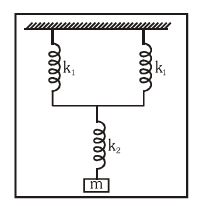
- 5View SolutionThe total spring constant of the system as shown in the figure will be
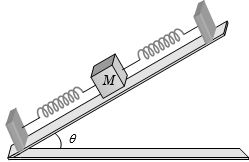
- 6On a smooth inclined plane, a body of mass $M$ is attached between two springs. The other ends of the springs are fixed to firm supports. If each spring has force constant $K$, the period of oscillation of the body (assuming the springs as massless) isView Solution
- 7Find the ratio of time periods of two identical springs if they are first joined in series $\&$ then in parallel $\&$ a mass $m$ is suspended from them :View Solution
- 8A pendulum clock that keeps correct time on the earth is taken to the moon it will run (it is given that $g_{Moon} = g_{Earth}/6$ )View Solution
- 9A particle is executing $S.H.M.$ with time period $T^{\prime}$. If time period of its total mechanical energy is $T$ then $\frac{T^{\prime}}{T}$ is ........View Solution
- 10If a spring has time period $T$, and is cut into $n$ equal parts, then the time period of each part will beView Solution