A pendulum with time period of $1\, s$ is losing energy due to damping. At certain time its energy is $45\, J$. If after completing $15\,oscillations$ , its energy has become $15\, J$, its damping constant (in $s^{-1}$ ) is
JEE MAIN 2015, Medium
Download our app for free and get started
As we know, $E=E_{0} e^{-\frac{b t}{m}}$
$15=45 e^{-\frac{b 15}{m}}$
[As no. of oscillations $=15 \text { so } t=15 \mathrm{sec}]$
$\frac{1}{3}=e^{-\frac{b 15}{m}}$
Taking log on both sides
$\frac{b}{m}=\frac{1}{15} \ell \mathrm{n} 3$

Download our appand get started for free
Experience the future of education. Simply download our apps or reach out to us for more information. Let's shape the future of learning together!No signup needed.*
Similar Questions
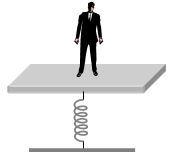
- 1A man weighing $60\, kg$ stands on the horizontal platform of a spring balance. The platform starts executing simple harmonic motion of amplitude $0.1\, m$ and frequency $\frac{2}{\pi }Hz$. Which of the following statement is correctView Solution
- 2The displacement of a particle is given at time $t$, by:$x=A \sin (-2 \omega t)+B \sin ^2 \omega t \quad$ Then,View Solution
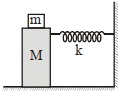
- 3In the given figure, a mass $M$ is attached to a horizontal spring which is fixed on one side to a rigid support. The spring constant of the spring is $k$. The mass oscillates on a frictionless surface with time period $T$ and amplitude $A$. When the mass is in equilibrium position, as shown in the figure, another mass $m$ is gently fixed upon it. The new amplitude of oscillation will beView Solution
- 4Two identical pendulums oscillate with a constant phase difference $\frac{\pi}{4}$ and same amplitude. If the maximum velocity of one is $v$, the maximum velocity of the other will be ........View Solution
- 5The particle executing $SHM$ of amplitude $'a'$ has displacement $-\frac {a}{2}$ at $t = \frac {T}{4}$ and a positive velocity. Find the initial phase of particleView Solution
- 6View SolutionIn case of a simple pendulum, time period versus length is depicted by
- 7If the length of second's pendulum is decreased by $2\%$, how many seconds it will lose per day ...... $\sec$View Solution
- 8The motion of a particle represented by $y\ =$ $\sin \omega t - \cos \omega t$ isView Solution
- 9A mass $m$ is suspended from the two coupled springs connected in series. The force constant for springs are ${K_1}$ and ${K_2}$. The time period of the suspended mass will beView Solution
- 10An object of mass $0.5\, {kg}$ is executing simple harmonic motion. Its amplitude is $5\, {cm}$ and time period (T) is $0.2\, {s} .$ What will be the potential energy of the object at an instant $t=\frac{T}{4}$ s starting from mean position. Assume that the initial phase of the oscillation is zero. (In ${J}$)View Solution