A person of mass $M$ is, sitting on a swing of length $L$ and swinging with an angular amplitude $\theta_0$. If the person stands up when the swing passes through its lowest point, the work done by him, assuming that his centre of mass moves by a distance $l\, ( l < < L)$, is close to
JEE MAIN 2019, Diffcult


Download our appand get started for free
Experience the future of education. Simply download our apps or reach out to us for more information. Let's shape the future of learning together!No signup needed.*
Similar Questions
- 1View SolutionWhich of the following function represents a simple harmonic oscillation
- 2A particle is performing $SHM$ according to the equation $x = (3\, cm)$ $\sin \,\left( {\frac{{2\pi t}}{{18}} + \frac{\pi }{6}} \right)$ where $t$ is in seconds. The distance travelled by the particle in $36\, s$ is ..... $cm$View Solution
- 3View SolutionIdentify the function which represents a nonperiodic motion.
- 4The piston in the cylinder head of locomotive has a stroke of $6\,m$ (which is twice the amplitude). If the piston executing simple harmonic motion with an angular frequency of $200\, rad\, min^{-1}$, its maximum speed is .... $ms^{-1}$View Solution
- 5A simple pendulum is attached to the roof of a lift. If time period of oscillation, when the lift is stationary is $T$. Then frequency of oscillation, when the lift falls freely, will beView Solution
- 6A particle of mass $m$ moves in the potential energy $U$ shown above. The period of the motion when the particle has total energy $E$ isView Solution
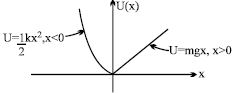
- 7A particle executes simple harmonic motion between $x =- A$ and $x =+ A$. If time taken by particle to go from $x=0$ to $\frac{A}{2}$ is $2 s$; then time taken by particle in going from $x =\frac{ A }{2}$ to $A$ is $.........\,s$View Solution
- 8The ratio of maximum acceleration to maximum velocity in a simple harmonic motion is $10\,s^{-1}$. At, $t = 0$ the displacement is $5\, m$. What is the maximum acceleration ? The initial phase is $\frac{\pi }{4}$View Solution
- 9Two simple harmonic motions, as shown, are at right angles. They are combined to form Lissajous figuresView Solution
$x\left( t \right) = A\,\sin \,\left( {at + \delta } \right)$
$y\left( t \right) = B\,\sin \,\left( {bt} \right)$
Identify the correct match below
- 10The composition of two simple harmonic motions of equal periods at right angle to each other and with a phase difference of $\pi $ results in the displacement of the particle alongView Solution