MCQ
A person running horizontally observes that rain is falling on his head vertically with speed $10\,m/s$. He stops and observes that rain is coming at an angle $30^o$ with vertical., find the speed with which man was running
  • A
    $20\,m/s$
  • B
    $\frac{{20}}{{\sqrt 3 }}\,m/s$
  • C
    $10\sqrt 3\,m/s $
  • $\frac{{10}}{{\sqrt 3 }}\,m/s$

Answer

Correct option: D.
$\frac{{10}}{{\sqrt 3 }}\,m/s$
d
$\mathrm{V}_{\mathrm{m}}=\mathrm{V}_{\mathrm{r}} \sin 30^{\circ}$

$=\frac{20}{\sqrt{3}} \times \frac{1}{2}=\frac{10}{\sqrt{3}} \mathrm{m} / \mathrm{s}$

Need a full question paper?

Generate a complete, print-ready paper with questions like this in minutes — across 16+ boards, with answer keys.

Start Generating Free

Similar questions

Which of the following sets cannot enter into the list of fundamental quantities in any system of units?
$A$ system of $N$ particles is free from any external forces. Which of the following is true for the magnitude of the total momentum of the system?
A metal wire of linear mass density of $9.8\, g/m$ is stretched with a tension of $10 kg$ weight between two rigid supports $1$ metre apart. The wire passes at its middle point between the poles of a permanent magnet, and it vibrates in resonance when carrying an alternating current of frequency $n.$ The frequency $n$ of the alternating source is ..... $Hz$
Trajectory of particle in a projectile motion is given as $y=x-\frac{x^2}{80}$. Here, $x$ and $y$ are in metre. For this projectile motion match the following with $g=10\,m / s ^2$.
$Column-I$ $Column-II$
$(A)$ Angle of projection $(p)$ $20\,m$
$(B)$ Angle of velocity with horizontal after $4\,s$ $(q)$ $80\,m$
$(C)$ Maximum height $(r)$ $45^{\circ}$
$(D)$ Horizontal range $(s)$ $\tan ^{-1}\left(\frac{1}{2}\right)$
Given below are two statements : one is labelled as Assertion $A$ and the other is labelled as Reason $R$.

Assertion $A$ : When a body is projected at an angle $45^{\circ}$, it's range is maximum.

Reason $R$ : For maximum range, the value of $\sin 2 \theta$ should be equal to one.

In the light of the above statements, choose the correct answer from the options given below :

A cylindrical wire of radius $1\,\, mm$, length $1 m$, Young’s modulus $= 2 × 10^{11} N/m^2$, poisson’s ratio $\mu = \pi /10$ is stretched by a force of $100 N$. Its radius will become
A bullet moving with a speed of $100$ $m{s^{ - 1}}$can just penetrate two planks of equal thickness. Then the number of such planks penetrated by the same bullet when the speed is doubled will be
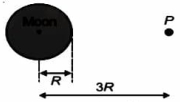
A stationary object is released from a point $P$ at a distance $3 R$ from the centre of the moon which has radius $R$ and mass $M$. Which of the following gives the speed of the object on hitting the moon?
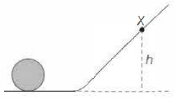
A solid sphere rolls without slipping, first horizontally and then up to a point $X$ at height $h$ on an inclined plane before rolling down, as shown in the figure below. The initial horizontal speed of the sphere is
Water enters through end $A$  with speed ${v_1}$ and leaves through end $B$ with speed ${v_2}$ of a cylindrical tube $AB$. The tube is always completely filled with water. In case $I$  tube is horizontal and in case $ II$  it is vertical with end $ A $ upwards and in case $ III $ it is vertical with end $B$ upwards. We have ${v_1} = {v_2}$ for