MCQ
A physical quantity is measured and its value is found to be $nu$ where $n = $ numerical value and $u = $ unit. Then which of the following relations is true
  • A
    $n \propto {u^2}$
  • B
    $n \propto u$
  • C
    $n \propto \sqrt u $
  • $n \propto \frac{1}{u}$

Answer

Correct option: D.
$n \propto \frac{1}{u}$
d
(d) $P = nu$

$\therefore \,\,n \propto \frac{1}{u}$

Need a full question paper?

Generate a complete, print-ready paper with questions like this in minutes — across 16+ boards, with answer keys.

Start Generating Free

Similar questions

A uniform thin wooden plank $A B$ of length $L$ and mass $M$ is kept on a table with its $B$ end slightly outside the edge of the table. When an impulse $J$ is given to the end $B$, the plank moves up with centre of mass rising a distance $h$ from the surface of the table. Then,
The temperature at which a black body of unit area loses its energy at the rate of $1$ joule/second is
The value of coefficient of volume expansion of glycerin is $5 \times 10^{-4}k^{-1} .$ The fractional change in the density of glycerin for a rise of $40^o C$ in its temperature, is
If the measurement errors in all the independent quantities are known, then it is possible to determine the error in any dependent quantity. This is done by the use of series expansion and truncating the expansion at the first power of the error. For example, consider the relation $z=x / y$. If the errors in $x, y$ and $z$ are $\Delta x, \Delta y$ and $\Delta z$, respectively, then

$\mathrm{z} \pm \Delta \mathrm{z}=\frac{\mathrm{x} \pm \Delta \mathrm{x}}{\mathrm{y} \pm \Delta \mathrm{y}}=\frac{\mathrm{x}}{\mathrm{y}}\left(1 \pm \frac{\Delta \mathrm{x}}{\mathrm{x}}\right)\left(1 \pm \frac{\Delta \mathrm{y}}{\mathrm{y}}\right)^{-1} .$

The series expansion for $\left(1 \pm \frac{\Delta y}{y}\right)^{-1}$, to first power in $\Delta y / y$, is $1 \mp(\Delta y / y)$. The relative errors in independent variables are always added. So the error in $\mathrm{z}$ will be $\Delta \mathrm{z}=\mathrm{z}\left(\frac{\Delta \mathrm{x}}{\mathrm{x}}+\frac{\Delta \mathrm{y}}{\mathrm{y}}\right)$.

The above derivation makes the assumption that $\Delta x / x<<1, \Delta \mathrm{y} / \mathrm{y} \ll<1$. Therefore, the higher powers of these quantities are neglected.

($1$) Consider the ratio $\mathrm{r}=\frac{(1-\mathrm{a})}{(1+\mathrm{a})}$ to be determined by measuring a dimensionless quantity a.

If the error in the measurement of $\mathrm{a}$ is $\Delta \mathrm{a}(\Delta \mathrm{a} / \mathrm{a} \ll<1)$, then what is the error $\Delta \mathrm{r}$ in

$(A)$ $\frac{\Delta \mathrm{a}}{(1+\mathrm{a})^2}$ $(B)$ $\frac{2 \Delta \mathrm{a}}{(1+\mathrm{a})^2}$ $(C)$ $\frac{2 \Delta \mathrm{a}}{\left(1-\mathrm{a}^2\right)}$ $(D)$ $\frac{2 \mathrm{a} \Delta \mathrm{a}}{\left(1-\mathrm{a}^2\right)}$

($2$) In an experiment the initial number of radioactive nuclei is $3000$ . It is found that $1000 \pm$ $40$ nuclei decayed in the first $1.0 \mathrm{~s}$. For $|\mathrm{x}| \ll 1$, In $(1+\mathrm{x})=\mathrm{x}$ up to first power in $x$. The error $\Delta \lambda$, in the determination of the decay constant $\lambda$, in $\mathrm{s}^{-1}$, is

$(A) 0.04$    $(B) 0.03$    $(C) 0.02$   $(D) 0.01$

Give the answer quetion ($1$) and ($2$)
A sound source is moving towards a stationary observer with $(1/10)$ of the speed of sound. The ratio of apparent to real frequency is .........
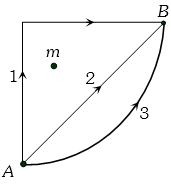
If ${W_1},\,{W_2}$ and ${W_3}$ represent the work done in moving a particle from $A$ to $B$ along three different paths $1, 2$ and $3$ respectively (as shown) in the gravitational field of a point mass m, find the correct relation between ${W_1},\,{W_2}$ and ${W_3}$
A block is attached to a spring as shown and very-very gradually lowered so that finally  spring expands by $"d"$. If same block is attached to spring & released suddenly then maximum expansion in spring will be-
At what temperature is the root mean square velocity of gaseous hydrogen molecules is equal to that of oxygen molecules at $47°C$ ..... $K$
The angular frequency of motion whose equation is $4\frac{{{d^2}y}}{{d{t^2}}} + 9y = 0$ is ($y =$ displacement and $t =$ time)
70 calories of heat are required to raise the temperature of 2 mole of an ideal gas at constant pressure from 30° C to 35° C. The amount of heat required to raise the temperature of the same gas through the same range at constant volume is:
  1. 30 calories.
  2. 50 calories.
  3. 70 calories.
  4. 90 calories.