Question
A projectile is projected horizontally with a velocity $u$. Show that its trajectory is parabolic. And obtain expressions for:
i. Time of flight
ii. Horizontal range
iii. Velocity at any instant $t$.
Answer

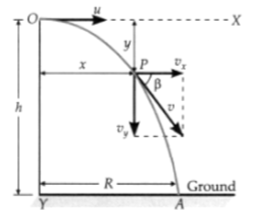
Projectile fired parallel to horizontal. As shown in figure, suppose a body is projected horizontally with velocity u from a point O at a certain height h above the ground level. The body is under the influence of two simultaneous independent motions:
i. Uniform horizontal velocity u.
ii. Vertically downward accelerated motion with constant acceleration g.
Under the combined effect of the above two motions, the body moves along the path OPA.
Image
Horizontal projection of a projectile.
Trajectory of the projectile. After the time t , suppose the body reaches the point $P ( x , y )$. The horizontal distance covered by the body in time $t$ is
$
x=ut . \therefore t=\frac{x}{u}
$
The vertical distance travelled by the body in time $t$ is given by
$
s=u t+\frac{1}{2} a t^2
$
or $y =0 \times t+\frac{1}{2} g t^2=\frac{1}{2} g t^2$ [For vertical motion, $u =0$ ]
or $y=\frac{1}{2} g\left(\frac{x}{u}\right)^2=\left(\frac{g}{2 u^2}\right) x^2\left[\because t=\frac{x}{u}\right]$
or $y = kx ^2$ [Here $k =\frac{g}{2 u^2}=$ a constant]
As y is a quadratic function of x , so the trajectory of the projectile is a parabola.
Time of flight. It is the total time for which the projectile remains in its flight (from O to A ). Let T be its time of flight.
For the vertical downward motion of the body, we use
$
s=u t+\frac{1}{2} a t^2 \text { or h }==0 \times T+\frac{1}{2} g T^2
$
or $T-\sqrt{\frac{2 h}{g}}$
Horizontal range. It is the horizontal distance covered by the projectile during its time of flight. It is equal to $O A=R$. Thus
$R =$ Horizontal velocity $\times$ time of flight $= u \times T$
or $R =u \sqrt{\frac{2 h}{g}}$
Velocity of the projectile at any instant. At the instant $t$ (when the body is at point P ), let the velocity of the projectile be v . The velocity v has two rectangular components:
Horizontal component of velocity, $v _{ x }= u$
Vertical component of velocity, $v _{ y }=0+ gt = gt$
$\therefore$ The resultant velocity at point P is
$
v=\sqrt{v_x^2+v_y^2}=\sqrt{u^2+g^2 t^2}
$
If the velocity v makes an angle p with the horizontal, then $\tan \beta=\frac{v_y}{v_x}=\frac{g t}{u}$
or $\beta=\tan ^{-1}\left(\frac{g t}{u}\right)$

Need a full question paper?

Generate a complete, print-ready paper with questions like this in minutes — across 16+ boards, with answer keys.

Start Generating Free

Similar questions

A wave $\text{Y} = \text{A}\sin(\omega\text{t} - \text{kx})$ allowed through a string gets reflected from a rigid support and forms stationary wave. Derive the expression for the standing wave.
An artificial satellite of mass 100kg is in a circular orbit at 500km above the earth's surface.
  1. Find the acceleration due to gravity at any point along the satellite path.
  2. What is the centripetal acceleration of the satellite?
Take radius of earth as 6.5 × 10⁶m.
Define degrees of freedom. How will you account for the five degrees of freedom in a diatomic molecule? Using the idea of equi-partition of energy, find the value of $\gamma$ for the same.
Show that if n equal rain droplets falling through air with equal steady velocity of 10cm s-1 coalesce, the resultant drop attains a new terminal velocity of 10n2/3cm s-1.
0.1 gm molecule of diatomic gas is isothermally expanded at 293 K to twice its initial volume. After that its adiabatic expansion is done until the final volume becomes four times the initial volume. Find the final temperature of the gas and also calculate the work done for both the expansion ( $R = 8 . 3$ joule $m o l ^{ l } K ^{-1}$, $\gamma=1.4)$
Plot the corresponding reference circle for each of the following simple harmonic motions. Indicate the initial $(t=0)$ position of the particle, the radius of the circle, and the angular speed of the rotating particle. For simplicity, the sense of rotation may be fixed to be anticlockwise in every case: ( $x$ is in cm and t is in s ).
a. $x=-2 \sin \left(3 t+\frac{\pi}{3}\right)$
b. $x=\cos \left(\frac{\pi}{6}-t\right)$
c. $x=3 \sin \left(2 \pi t+\frac{\pi}{4}\right)$
d. $x=2 \cos \pi t$
A train running at 108km/h towards east whistles at a dominant frequency of 500Hz. Speed of sound in air is 340m/s.
  1. What frequency will a passenger sitting near the open window hear?
  2. What frequency will a person standing near the track hear whom the train has just passed?
  3. A wind starts blowing towards east at a speed f 36km/h. Calculate the frequencies heard by the passenger in the train and by the person standing near the track.
What is a conservative force? Prove that gravitational force is conservative, while frictional force is non-conservative.
Derive the equations of an object moving with uniform acceleration by graphical method
What are thermometer scales? How are these obtained? Find the expressions of various thermal scales and tell which of these scales is standard and explain the rason for choosing it. What is ultimate temperature?