Question
A semiconductor has equal electron and hole concentration of 2 × 10⁸/m3. On doping with a certain impurity, the hole concentration increases to 4 × 10¹⁰/m3.
  1. What type of semiconductor is obtained on doping?
  2. Calculate the new electron and hole concentration of the semiconductor.
  3. How does the energy gap vary with doping?
Answer

Given ne = 2 × 10⁸/m3, nh = 4 × 10¹⁰/m3

  1. The majority charge carriers in doped semiconductor are holes, so semiconductor obtained is p-type semiconductor.

$\text{n}_\text{e}\text{n}_h=\text{n}^2_\text{i}$

$\Rightarrow\text{n}_\text{h}=\frac{\text{n}^2_\text{i}}{\text{n}_\text{h}}$

$=\frac{(2\times10^8)^2}{4\times10^{10}}=10^6/\text{m}^3$

  1. New electron concentration = 106/m3

Hole concentration = 4 × 1010/m3

  1. Energy gap decreases on doping.

Need a full question paper?

Generate a complete, print-ready paper with questions like this in minutes — across 16+ boards, with answer keys.

Start Generating Free

Similar questions

When a charged comb is brought near a small piece of paper, it attracts the piece. Does the paper become charged when the comb is brought near it?
Consider a non-conducting ring of radius r and mass m that has a total charge q distributed uniformly on it. The ring is rotated about its axis with an angular speed $\omega.$
  1. Find the equivalent electric current in the ring.
  2. Find the magnetic moment $\mu$ of the ring.
  3. Show that $\mu=\frac{\text{q}}{2\text{m}}\text{l}$ where l is the angular momentum of the ring about its axis of rotation.
What is amplitude modulation ? Draw the simple block diagram of a modulator to get amplitude modulated wave.
Prove that, if an insulated, uncharged conductor is placed near a charged conductor and no other conductors are present, the uncharged body must be intermediate in potential between that of the charged body and that of infinity.
A traffic policeman sounds a whistle to stop a car-driver approaching towards him. The car-driver does not stop and takes the plea in court that because of the Doppler shift, the frequency of the whistle reaching him might have gone beyond the audible limit of 20kHz and he did not hear it. Experiments showed that the whistle emits a sound with frequency close to 16kHz. Assuming that the claim of the driver is true, how fast was he driving the car? Take the speed of sound in air to be 330m/s. Is this speed practical with today's technology?
  1. What is linearly polarized light? Describe briefly using a diagram how sunlight is polarised.
  2. Unpolarised light is incident on a polaroid. How would the intensity of transmitted light change when the polaroid is rotated?
Should the energy of a photon be called its kinetic energy or its internal energy?
Red light however bright it is, cannot produce the emission of electrons from a clean zinc surface, but even weak ultraviolet radiation can do so; why?
An electric dipole with dipole moment 4 × 10⁻⁹ Cm is aligned at 30° with the direction of a uniform electric field of magnitude 5 × 10⁴ NC-1. Calculate the magnitude of the torque acting on the dipole.
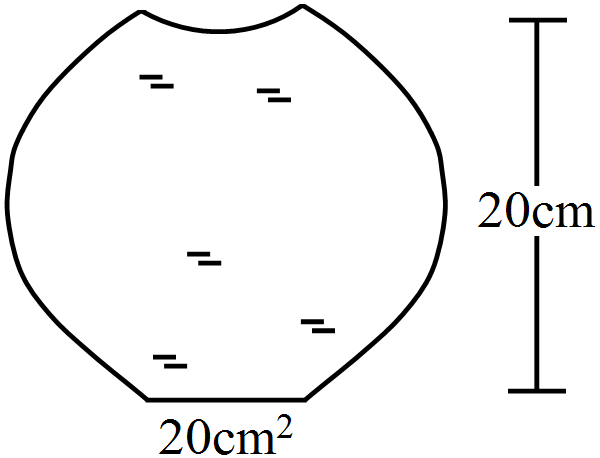
A glass full of water has a bottom of area 20cm2, top of area 20cm2, height 20cm and volume half a litre.
  1. Find the force exerted by the water on the bottom.
  2. Considering the equilibrium of the water, find the.
Resultant force exerted by the sides of the glass on the water. Atmospheric pressure = 1.0 × 105N/m2. Density of water = 1000kg/m3 and g = 10m/s2. Take all numbers to be exact.