A simple pendulum suspended from the ceiling of a stationary lift has period $T_0$. When the lift descends at steady speed, the period is $T_1$, and when it descends with constant downward acceleration, the period is $T_2$. Which one of the following is true?
Easy
Download our app for free and get started
(b)
Pseudo force only when there is an acceleration.
Hence $T_0=T_1$ as there is uniform downward motion.
When it moves downward with a steady acceleration then pseudo force acts upwards, reducing net ' $g$ '
Since $T_2=2 \pi \sqrt{\frac{1}{g_{\text {net }}}}$
When $g$ reduces time period $T_2$ increases
$T_0=T_1 < T_2$

Download our appand get started for free
Experience the future of education. Simply download our apps or reach out to us for more information. Let's shape the future of learning together!No signup needed.*
Similar Questions
- 1Two particle executing $S.H.M.$ of same amplitude of $20 \,cm$ with same period along the same line about same equilibrium position. The maximum distance between the two is $20 \,cm$. Their phase difference in radian is equal toView Solution
- 2A particle is executing $SHM$ about $y=0$ along $y$-axis. Its position at an instant is given by $y=(7 \,m )$ sin( $\pi f)$. Its average velocity for a time interval $0$ to $0.5 \,s$ is ........... $m / s$View Solution
- 3Time period of a simple pendulum is $T$ inside a lift when the lift is stationary. If the lift moves upwards with an acceleration $g / 2,$ the time period of pendulum will beView Solution
- 4When a particle executes $SHM$ the nature of graphical representation of velocity as a function of displacement is :View Solution
- 5A particle of mass $2 \,kg$, executing $SHM$ has amplitude $20 \,cm$ and time period $1 \,s$. Its maximum speed is ......... $m / s$View Solution
- 6A particle of mass $m$ is performing linear simple harmonic motion. Its equilibrium is at $x = 0,$ force constant is $K$ and amplitude of $SHM$ is $A$. The maximum power supplied by the restoring force to the particle during $SHM$ will beView Solution
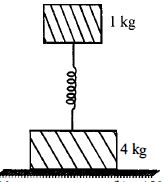
- 7Two bodies of masses $1\, kg$ and $4\, kg$ are connected to a vertical spring, as shown in the figure. The smaller mass executes simple harmonic motion of angular frequency $25\, rad/s$, and amplitude $1.6\, cm$ while the bigger mass remains stationary on the ground. The maximum force exerted by the system on the floor is ..... $N$ ( take $g = 10\, ms^{-2}$)View Solution
- 8The maximum velocity and the maximum acceleration of a body moving in a simple harmonic oscillator are $2\,m/s$ and $4\,m/{s^2}.$ Then angular velocity will be ..... $rad/sec$View Solution
- 9The angular velocity and the amplitude of a simple pendulum is $'\omega '$ and $'A'$ respectively. At a displacement $x$ from the mean position its kinetic energy is $'T'$ and potnetial energy is $'V'$. Then the ratio $\frac{V}{T}$ isView Solution
- 10If $x=5 \sin \left(\pi t+\frac{\pi}{3}\right) \mathrm{m}$ represents the motion of a particle executing simple harmonic motion, the amplitude and time period of motion, respectively, areView Solution