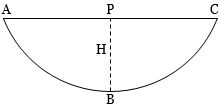
A simple pendulum with a bob of mass $‘m’$ oscillates from $A$ to $ C$ and back to $A$ such that $PB$ is $H.$ If the acceleration due to gravity is $‘g’$, then the velocity of the bob as it passes through $B$ is
AIPMT 1995, Medium


Download our appand get started for free
Experience the future of education. Simply download our apps or reach out to us for more information. Let's shape the future of learning together!No signup needed.*
Similar Questions
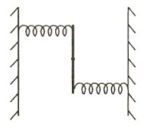
- 1A uniform rod of length $L$ and mass $M$ is pivoted at the centre. Its two ends are attached to two springs of equal spring constants $k$. The springs are fixed to rigid supports as shown in the figure, and the rod is free to oscillate in the horizontal plane. The rod is gently pushed through a small angle $\theta$ in one direction and released. The frequency of oscillation isView Solution
- 2Three simple harmonic motions in the same direction having the same amplitude a and same period are superposed. If each differs in phase from the next by ${45^o}$, thenView Solution
- 3A force of $6.4\, N$ stretches a vertical spring by $0.1 \,m$. The mass that must be suspended from the spring so that it oscillates with a period of $\left( {\frac{\pi }{4}} \right)sec$. is ... $kg$View Solution
- 4Two simple pendulums whose lengths are $100 cm$ and $121 cm$ are suspended side by side. Their bobs are pulled together and then released. After how many minimum oscillations of the longer pendulum, will the two be in phase againView Solution
- 5The instantaneous displacement of a simple pendulum oscillator is given by $x = A\cos \left( {\omega t + \frac{\pi }{4}} \right)$. Its speed will be maximum at timeView Solution
- 6The height of a swing changes during its motion from $0.1\, m$ to $2.5\, m$. The minimum velocity of a boy who swings in this swing is ..... $m/s$View Solution
- 7Force constant of a spring is $K$ . If half part is detached then force constant of the remaining spring will beView Solution
- 8A particle excutes $SHM$ on a straight line path. The amplitude of oscillation is $2\,cm$. When the displacement of the particle from the mean position is $1\,cm$, the numerical value of magnitude of acceleration is equal to the numerical value of magnitude of velocity. The frequency of $SHM$ is (in $second^{-1}$)View Solution
- 9The displacement of a particle executing periodic motion is given by :View Solution
$y = 4cos^2\,(t/2)sin\,(1000t)$
This expression may be considered to be a result of superposition of - 10A force of $6.4\ N$ stretches a vertical spring by $0.1\ m$. The mass that must be suspended from the spring so that it oscillates with a time period of $\pi/4\ second$ is .... $kg$View Solution