Question
A solid sphere is set into motion on a rough horizontal surface with a linear speed v in the forward direction and an angular speed $\frac{\text{v}}{\text{R}}$ in the anticlockwise direction as shown in figure. Find the linear speed of the sphere:
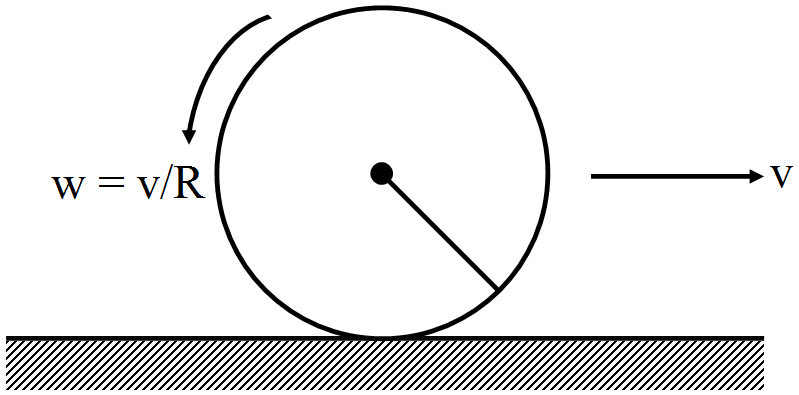
  1. When it stops rotating.
  2. When slipping finally ceases and pure rolling starts.
Answer


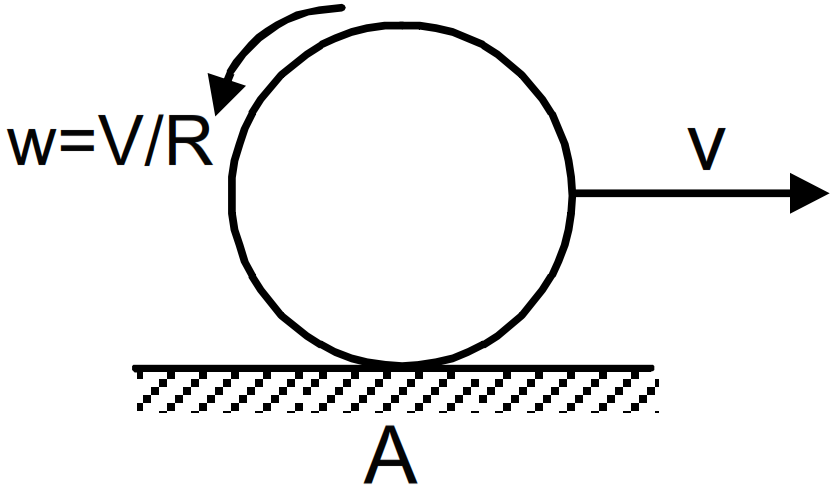
  1. If we take moment at A then external torque will be zero.
Therefore, the initial angular momentum = the angular momentum after rotation stops (i.e. only leniar velocity exits)
$\text{Mv}\times\text{R}-\ell\omega=\text{Mv}_0\times\text{R}$
$\Rightarrow\text{MvR}-\frac{2}{5}\times\frac{\text{MR}^2\text{V}}{\text{R}}=\text{Mv}_0\text{R}$
$\Rightarrow\text{v}_0=\frac{\text{3V}}{5}$
  1. Again, after some time pure rolling starts
Therefore,
$\Rightarrow\text{M}\times\text{v}_0\times\text{R}=\Big(\frac{2}{5}\Big) \text{MR}^2\times\Big(\frac{\text{V}'}{\text{R}}\Big)+\text{Mv}'\text{R}$
$\Rightarrow\text{m}\times\Big(\frac{\text{3V}}{5}\Big)\times\text{R}=\Big(\frac{2}{5}\Big)\text{Mv}'\text{R}+\text{Mv}'\text{R}$
$\Rightarrow\text{V}'=\frac{3\text{V}}{7}$

Need a full question paper?

Generate a complete, print-ready paper with questions like this in minutes — across 16+ boards, with answer keys.

Start Generating Free

Similar questions

Explain how the scattering experiment can be analyzed in detail from Rutherford's nuclear model.
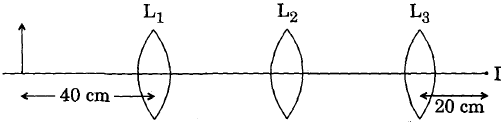
You are given three lenses $L_1, L_2$ and $L_3$ each of focal length $20 \ cm.$ An object is kept at $40 \ cm$ in front of $L_1,$ as shown. The final real image is formed at the focus $I$ of $L_3.$ Find the separations between $L_1, L_2$ and $L_3.$
​​​​​​​
Obtain the relationship between object distance $(u),$ image distance $(v)$ and focal length $(f)$ for a concave mirror. Obtain $\frac{1}{f}=\frac{1}{v}+\frac{1}{u}$ formula for a concave mirror.
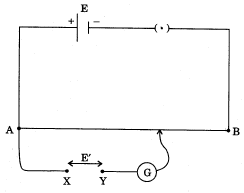
For the potentiometer circuit shown in the given figure, points X and Y reprensent the two terminals of an unknown emf E'. A student observed that when the jockey in moved from the end A to the end B of the potentiometer wire, the deflection in the galvanometer remains in the same direction.What may be the two possible faults in the circuit that could result in this obsevation?
If the galvanometer deflection at the end B is (i) more, (ii) less, than that at the end A, which of the two faults, listed above, would be there in the circuit?
Give reasons in support of your answer in each case.
A resistor of $12 \Omega$, a capacitor of $14 \Omega$ reactance and a pure inductor of inductance 0.1 H are joined in series and an alternating current of 200 V, 50 Hz is joined with them. Compute: (i) current in the circuit and (ii) phase angle between current and the voltage (Take $\pi=3$ ).
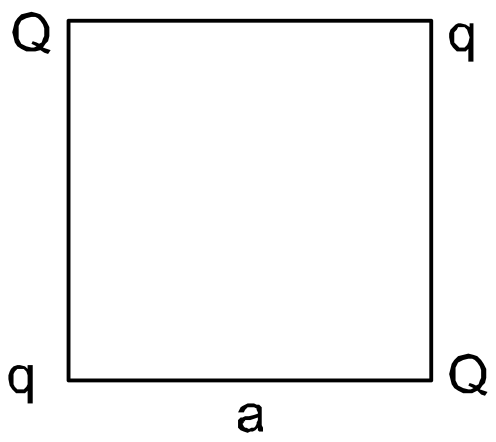
Four point charges $Q, q, Q$ and $q$ are placed at the corners of a square of side $'a\ '$ as shown in the figure.
Find the:
  1. Resultant electric force on a charge $Q$.
  2. Potential energy of this system.
The average translational kinetic energy of air molecules is $0.040\ eV (1\ eV = 1.6 \times 10^{-19}J)$. Calculate the temperature of the air. Boltzmann constant $k = 1.38 \times 10^{-23}JK^{-1}$.
An ideal diode should pass a current freely in one direction and should stop it completely in the opposite direction. Which is closer to ideal-vacuum diode or a p-n junction diode?
Explain the formation of energy band in solids. Draw energy band diagram for (i) a conductor, (ii) an intrinsic semiconductor.
Two capacitors of capacitances $4.0\mu\text{F}$ and $6.0\mu\text{F}$ are connected in series with a battery of 20V. Find the energy supplied by the battery.