MCQ
A taut string at both ends vibrates in its $n^{th}$ overtone. The distance between adjacent Node and Antinode is found to be $'d'$. If the length of the string is $L,$ then
  • $L = 2d (n + 1)$
  • B
    $L = d (n + 1)$
  • C
    $L = 2dn$
  • D
    $L = 2d (n - 1)$

Answer

Correct option: A.
$L = 2d (n + 1)$
a
For a taut string between two ends$:$

$n^{\text {th}}$overtone$=(n+1)$harmonic

$n^{\text {th}}$overtone$=(n+1)$harmonic

$\frac{(n+1)}{2} \lambda=L \ldots \ldots \ldots .(L=\text {lengtho $f$ string}) \ldots \ldots \ldots .(1)$

Distance between node and antinode is given by $\frac{\lambda}{4}$ which is equal to $”d”$  according to

the question. $\left(\frac{\lambda}{4}=d o r \lambda=4 d\right)$

Substituting the value of $\mathrm{d}$ in equation $(1)$

$\frac{(n+1) 4 d}{2}=L$

$(n+1) 2 d=L$

Need a full question paper?

Generate a complete, print-ready paper with questions like this in minutes — across 16+ boards, with answer keys.

Start Generating Free

Similar questions

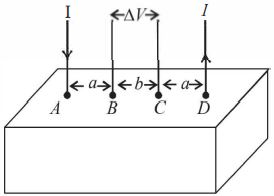
Consider a block of conducting material ofresistivity '$\rho$' shown in the figure. Current '$I$' enters at '$A$' and leaves from '$D$'. We apply superp osition principle to find voltage '$\Delta  V$ ' developed between '$B$' and '$C$'. The calculation is done in the following steps:
$(i)$ Take current '$I$' entering from '$A$' and assume it to spread over a hemispherical surface in the block.
$(ii)$ Calculatefield $E(r)$ at distance '$r$' from $A$ by using Ohm's law $E = \rho  j$, where j is the current per unit area at '$r$'.
$(iii)$ From the '$r$' dependence of $E(r)$, obtain the potential $V(r)$ at $r$.
$(iv)$ Repeat $(i), (ii)$ and $(iii)$ for current '$I$' leaving '$D$' and superpose results for '$A$' and '$D$'.

For current entering at $A$, the electric field at a distance '$r$'
from $A$ is
A particle moves in the $xy$ plane with a constant acceleration $'g'$ in the negative $y$-direction. Its equation of motion is $y = ax-bx^2$, where $a$ and $b$ are constants. Which of the following are correct?
An optical device is constructed by fixing three identical convex lenses of focal lengths $10 \,cm$ each inside a hollow tube at equal spacing of $30 \,cm$ each. One end of the device is placed $10 cm$ away from a point source. ........... $cm$ the image shift when the device is moved away from the source by another $10 \,cm$ ?
A voltmeter of resistance $20000\,\Omega$ reads $5$ volt. To make it read $20$ volt, the extra resistance required is
A simple pendulum, made of a string of length $l$ and a bob of mass $m$ , is released from a small angle $\theta_0$. It strikes a block of mass $M$, kept on a horizontal surface at its lowest point of oscillations, elastically. It bounces back and goes up to an angle $\theta_1$. Then $M$ is given by
In a step-up transformer the voltage in the primary is $220\,V$ and the current is $5\,A$. The secondary voltage is found to be $22000\,V$. The current in the secondary (neglect losses) is......$A$
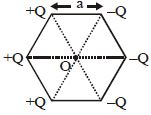
Six charges are placed at the vertices of a regular hexagon as shown in the figure. The electric field on the line passing through point $O$ and perpendicular to the plane of the figure at a distance of $x(>> a)$ from $O$ is
The percentage errors in quantities $P, Q, R$  and $S$  are $0.5\%,\,1\%,\,3\%$  and  $1 .5\%$ respectively in the  measurement of a physical quantity $A\, = \,\frac{{{P^3}{Q^2}}}{{\sqrt {R}\,S }}$ . the maximum percentage error in the value of $A$  will be $......... \%$
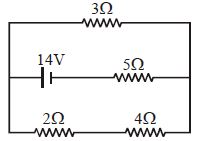
Find out current in $3\,\Omega $  resistance in given circuit
Which of the following statements is true