Question
A thick wire is stretched so that its length become two times. Assuming that there is no change in its density, then what is the ratio of change in resistance of wire to the initial resistance of wire(a) 2 : 1(b) 4 : 1(c) 3 : 1(d) 1 : 4
       

Answer

(c) 3 : 1

Need a full question paper?

Generate a complete, print-ready paper with questions like this in minutes — across 16+ boards, with answer keys.
Start Generating Free

Similar questions

The line on the earth's surface joining the points where the field is horizontal is(a) Magnetic meridian(b) Magnetic axis(c) Magnetic line(d) Magnetic equator
       
The muscles of a normal eye are least strained when the eye is focused on an object:
  1. Far away from the eye.
  2. Very close to the eye.
  3. At about 25cm from the eye.
  4. At about 1m from the eye.
Photoelectric emission is observed from a metallic surface for frequencies $\mathrm{v}_1$ and $\mathrm{v}_2$ of the incident light rays $(\left.\mathrm{v}_1>\mathrm{v}_2\right).$ It the maximum values of kinetic energy of the photoelectrons emitted in the two cases are in the ratio of $1: \mathrm{k},$ then the threshold frequency of the metallic surface is
Focal length of a convex lens of refractive index 1.5 is 2 cm. Focal length of lens when immersed in a liquid of refractive index of 1.25 will be(a) 10 cm (b) 2.5 cm(c) 5 cm   (d) 7.5 cm
       
A parallel plate capacitor is charged. If the plates are pulled apart:
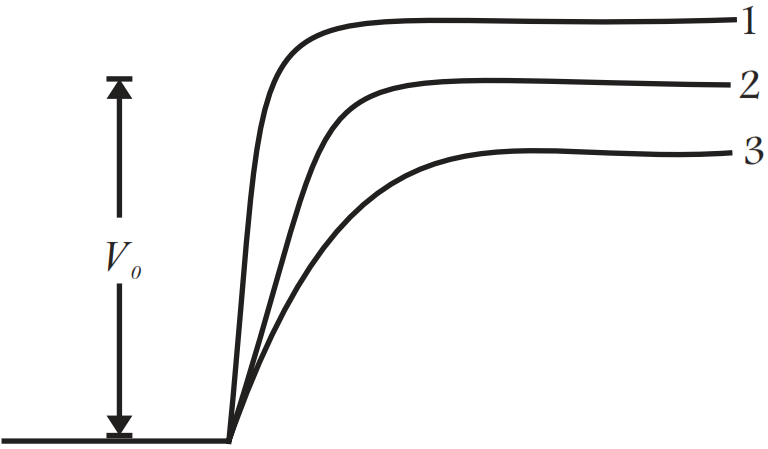
In Fig $,Vo$ is the potential barrier across a $p-n$ junction, when no battery is connected across the junction :
A long wire carries a steady current. It is bent into a circle of one turn and the magnetic field at the centre of the coil is $B .$ It is then bent into a circular loop of $n$ turns. The magnetic field at the centre of the coil will be
The tail of the comet is due to(a) Vaporisation of water on the comet(b) Sublimation of vapour in the comet(c) Cooling of water in the comet(d) Vaporisation of heat in the comet


Which of the following is dependent on the intensity of incident radiation in a photoelectric experiment(a) Work function of the surface(b) Amount of photoelectric current(c) Stopping potential will be reduced(d) Maximum kinetic energy of photoelectrons


If in Rutherford’s experiment, the number of particles scattered at 90° angle are 28 per min, then number of scattered particles at an angle 60°  and 120°  will be (a) 112/min, 12.5/min(b) 100/min, 200/min(c) 50/min, 12.5/min(d) 117/min, 25/min