MCQ
A thin circular ring first slips down a smooth incline then rolls down a rough incline of identical geometry from same height. Ratio of time taken in the two motion is ........
  • A
    $\frac{1}{2}$
  • B
    $1$
  • $\frac{1}{\sqrt{2}}$
  • D
    $\frac{1}{4}$

Answer

Correct option: C.
$\frac{1}{\sqrt{2}}$
c
(c)

case $(i)$ Transitional motion

acceleration $=g \sin \theta$

case $(ii)$ acceleration $=\frac{ g \sin \theta}{1+\frac{1}{ MR ^2}}$

$I = MR ^2$

$a =\frac{ g \sin \theta}{2}$

Now using $\rho=u t+\frac{1}{2} at ^2$

$a _1 t _1^2= a _2 t _2^2 \quad \theta$ and $\rho$ same for both are and $v =0$

$\frac{ t _1{ }^2}{ t _2^2}=\frac{ a _2}{ a _1}=\frac{ g \sin \theta}{2 g \sin \theta}$

$\frac{t_1}{t_2}=\frac{1}{\sqrt{2}}$

$\therefore \frac{t_1}{t_2}=\frac{1}{\sqrt{2}}$

Need a full question paper?

Generate a complete, print-ready paper with questions like this in minutes — across 16+ boards, with answer keys.
Start Generating Free

Similar questions

A mosquito is moving with a velocity $\overrightarrow{ v }=0.5 t ^{2} \hat{ i }+3 t \hat{ j }+9 \hat{ k }\, m / s$ and accelerating in uniform conditions. What will be the direction of mosquito after $2 \,s$ ?
How much work is required to making a soap bubble solution whose radius is r?
A solid cylinder of mass $M$ and radius $R$ rolls without slipping down an inclined plane of length $L$ and height $h$.  What is the speed of its centre of mass when the cylinder reaches its bottom 
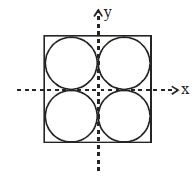
Four holes of radius $R$ are cut from a thin square plate of side $4R$ and mass $M$. The moment of inertia of the remaining portion about $z-$ axis is
The spring balance does not read properly after its long use, because
A stretched string of length $l,$ fixed at both ends can sustain stationary waves of wavelength $\lambda ,$ given by
Four rods of silver, copper, brass and wood are of same shape. They are heated together after wrapping a paper on it, the paper will burn first on
Four particles each of mass $M$, are located at the vertices of a square with side $L$. The gravitational potential due to this at the centre of the square is
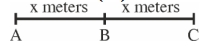
A horse rider covers half the distance with $5\,m / s$ speed. The remaining part of the distance was travelled with speed $10\,m / s$ for half the time and with speed $15 m / s$ for other half of the time. The mean speed of the rider averaged over the whole time of motion is $\frac{x}{7}\,m / s$. The value of $x$ is
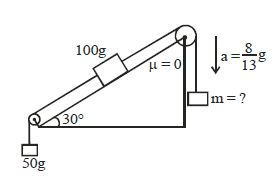
For the given figure find value of $m$ for which blocks have acceleration of $\frac{8}{{13}}\,g$ ............ $kg$