MCQ
A $U-$shaped wire is dipped in a soap solution, and removed. The thin soap film formed between the wire and the light slider supports a weight of $1.5 \times 10^{-2}\; N$ (which includes the small weight of the slider). The length of the slider is $30 \;cm .$ What is the surface tension of the film?
  • A
    $6.32 \times 10^{-3}\; N m ^{-1}$
  • B
    $5.25 \times 10^{-4}\; N m ^{-1}$
  • C
    $6.8 \times 10^{-3}\; N m ^{-1}$
  • $2.5 \times 10^{-2}\; N m ^{-1}$

Answer

Correct option: D.
$2.5 \times 10^{-2}\; N m ^{-1}$
d
The weight that the soap film supports, $W=1.5 \times 10^{-2} N$

Length of the slider, $l=30 cm =0.3 m$

A soap film has two free surfaces.

$\therefore$ Total length $=2 l=2 \times 0.3=0.6 m$

Surface tension, $S=\frac{\text { Force o-Weight }}{2 l}$ $=\frac{1.5 \times 10^{-2}}{0.6}$$=2.5 \times 10^{-2} N / m$

Therefore, the surface tension of the film is $2.5 \times 10^{-2}\; N m ^{-1}$

Need a full question paper?

Generate a complete, print-ready paper with questions like this in minutes — across 16+ boards, with answer keys.

Start Generating Free

Similar questions

Two projectiles are thrown simultaneously in the same plane from the same point. If their velocities are $v_1$ and $v_2$ at angles $\theta _1$ and $\theta_2$ respectively from the horizontal, then answer the following question

If $v_1\,\,cos\,\,\theta _1 = v_2\,\,cos\,\,\theta _2$, then choose the incorrect statement

If the breaking force for a given wire is $F$, then the breaking force of two wires of same magnitude will be
What is the relation between displacement, time and acceleration in case of a body having uniform acceleration
Correct pair is ..........
If in a Vernier callipers $10 \,VSD$ coincides with $8 \,MSD$, then the least count of Vernier calliper is ............ $m$  [given $1 \,MSD =1 \,mm ]$
The position of a particle related to time is given by $x =\left(5 t ^2-4 t +5\right) m$. The magnitude of velocity of the particle at $t=2\,s$ will be $...........ms^{-1}$
Who gave theory of relativity?
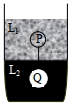
Two spheres $P$ and $Q$ of equal radii have densities $\rho_1$ and $\rho_2$, respectively. The spheres are connected by a massless string and placed in liquids $L_1$ and $L_2$ of densities $\sigma_1$ and $\sigma_2$ and viscosities $\eta_1$ and $\eta_2$, respectively. They float in equilibrium with the sphere $P$ in $L_1$ and sphere $Q$ in $L _2$ and the string being taut (see figure). If sphere $P$ alone in $L _2$ has terminal velocity $\overrightarrow{ V }_{ P }$ and $Q$ alone in $L _1$ has terminal velocity $\overrightarrow{ V }_{ Q }$, then

$(A)$ $\frac{\left|\overrightarrow{ V }_{ P }\right|}{\left|\overrightarrow{ V }_{ Q }\right|}=\frac{\eta_1}{\eta_2}$ $(B)$ $\frac{\left|\overrightarrow{ V }_{ P }\right|}{\left|\overrightarrow{ V }_{ Q }\right|}=\frac{\eta_2}{\eta_1}$

$(C)$ $\overrightarrow{ V }_{ P } \cdot \overrightarrow{ V }_{ Q } > 0$ $(D)$ $\overrightarrow{ V }_{ P } \cdot \overrightarrow{ V }_{ Q } < 0$

The frequency of a sound wave is $n$ and its velocity is $v$. If the frequency is increased to $4n,$ the velocity of the wave will be
The wave described by $y=0.25 \,sin\left[ {10\pi x - 2\pi t} \right]$, where $x$ and $y$ are in meters and $t$ in seconds, is a wave travelling along the