MCQ
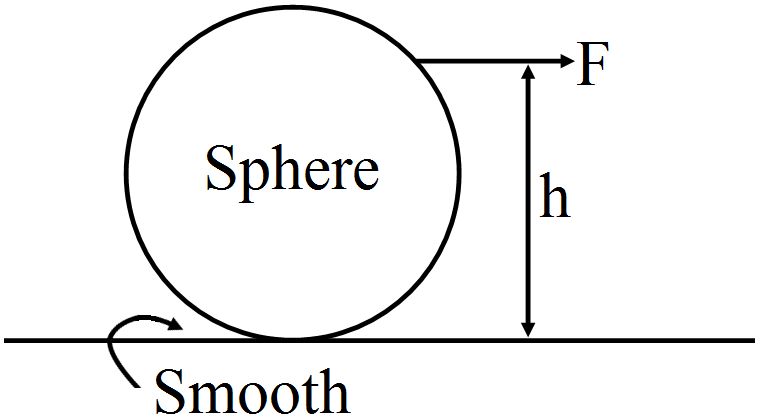
A uniform sphere is placed on a smooth horizontal surface and a horizontal force $F$ is applied on it at a distance h above the surface. The acceleration of the centre:
  • A
    Is maximum when $h = 0.$
  • B
    Is maximum when $h = R.$
  • C
    Is maximum when $h = 2R.$
  • Is independent of $h.$

Answer

Correct option: D.
Is independent of $h.$

As the uniform sphere is placed on a smooth surface, the sphere only slips.
The acceleration of the centre of the sphere is given by,
$\frac{\text{Applied force}}{\text{Mass of the sphere}},$ which is independent of height $h.$

Need a full question paper?

Generate a complete, print-ready paper with questions like this in minutes — across 16+ boards, with answer keys.

Start Generating Free

Similar questions

Mercury does not wet glass, wood or iron because
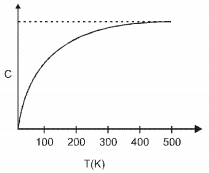
The figure below shows the variation of specific heat capacity $(C)$ of a solid as a function of temperature $(T)$. The temperature is increased continuously from $0$ to $500 \ K$ at a constant rate. Ignoring any volume change, the following statement$(s)$ is (are) correct to a reasonable approximation.$Image$

$(A)$ the rate at which heat is absorbed in the range $0-100 \ K$ varies linearly with temperature $T$.

$(B)$ heat absorbed in increasing the temperature from $0-100 \ K$ is less than the heat required for increasing the temperature from $400-500 \ K$.

$(C)$ there is no change in the rate of heat absorbtion in the range $400-500 \ K$.

$(D)$ the rate of heat absorption increases in the range $200-300 \ K$.

An observer is moving away from source of sound of frequency $100 Hz$. His speed is $33 \,m/s$. If speed of sound is $330 \,m/s$, then the observed frequency is  .... $Hz$
The time period of a second's pendulum in a satellite is:
At time $t = 0$ , a $2\, kg$ particle has position vector $\vec r = \left( {4\hat i - 2\hat j} \right)\,m$ relative to the origin. Its velocity is given by $\vec v = 2{t^2}\hat i\,\left( {m/s} \right)$. The torque acting on the particle about the origin at $t = 2\,s$, is ........ $\hat k\,N - m$
Two cyllinders of same cross-section and length $L$ but made of two material of densities $d_1$ and $d_2$ are cemented together to form a cylinder of length $2L$. The combination floats in a liquid of density $d$ with $a$ length $L/2$ above the surface of the liquid. If $d_1 > d_2$ then:
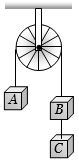
Three equal weights $A, B$ and $C$ of mass $2\, kg$ each are hanging on a string passing over a fixed frictionless pulley as shown in the figure The tension in the string connecting weights $B$ and $C$ is ........... $N$
Magnitude of vector which comes on addition of two vectors, $6\hat i + 7\hat j$ and $3\hat i + 4\hat j$ is
A soap bubble in vacuum has a radius of $3 \,cm$ and another soap bubble in vacuum has a radius of $4 \,cm$. If the two bubbles coalesce under isothermal condition, then the radius of the new bubble is ....... $cm$
A body is moving in a room with a velocity of $20\, m / s$ perpendicular to the two walls separated by $5$ meters. There is no friction and the collisions with the walls are elastic. The motion of the body is