MCQ
Mercury does not wet glass, wood or iron because
  • A
    Cohesive force is less than adhesive force
  • Cohesive force is greater than adhesive force
  • C
    Angle of contact is less than $90^o$
  • D
    Cohesive force is equal to adhesive force

Answer

Correct option: B.
Cohesive force is greater than adhesive force
b
(b) Cohesive force is greater than adhesive force.

Therefore, no mercury particles are left behind on glass, wood or iron.

Need a full question paper?

Generate a complete, print-ready paper with questions like this in minutes — across 16+ boards, with answer keys.
Start Generating Free

Similar questions

A string is wound round the rim of a mounted flywheel (Disc) of mass $20\,kg$ and radius $20\,cm$ . A steady pull of $25\,N$ is applied on the cord. Neglecting friction and mass of the string, the angular acceleration of the wheel in $rad/s^2$ is
What is the number of significant figures in $3400$
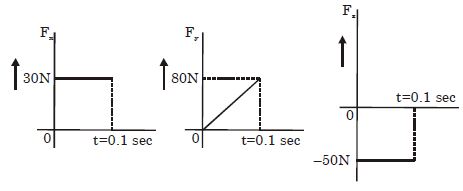
A particle is acted upon by a force whose  component's variations with time are shown in diagrams. Then the magnitude of change in momentum of the particle in $0.1\,\,sec$ will be :-
Nitrogen gas $N _2$ of mass $28 \,g$ is kept in a vessel at pressure of $10 \,atm$ and temperature $57^{\circ} C$. Due to leakage of $N _2$ gas its pressure falls to $5 \,atm$ and temperature to $27^{\circ} C$. The amount of $N _2$ gas leaked out is .......... $g$
Two point masses of mass $m_1 = fM$ and $m_2 = (1 -f)\,M\,(f < 1 )$ are in outer space ( far from gravitational influence of other objects) at a distance $R$ from each other. They move in circular orbits about their centre of mass with angular vaocities $\omega _1$ for $m_1$ and $\omega _2$ for $m_2.$ In that case
A solid cylinder $P$ rolls without slipping from rest down an inclined plane attaining a speed $v_p$ at the bottom. Another smooth solid cylinder $Q$ of same mass and dimensions slides without friction from rest down the inclined plane attaining a speed $v_q$ at the bottom. The ratio of the speeds $\frac{v_q}{v_p}$ is
A rubber cord catapult has cross-sectional area $25\,m{m^2}$ and initial length of rubber cord is $10\,cm.$ It is stretched to $5\,cm.$ and then released to project a missile of mass $5gm.$ Taking ${Y_{rubber}} = 5 \times {10^8}N/{m^2}$ velocity of projected missile is ......... $ms^{-1}$
The time period of a simple pendulum is given by $T =2 \pi \sqrt{\frac{\ell}{ g }}$. The measured value of the length of pendulum is $10\, cm$ known to a $1\, mm$ accuracy. The time for $200$ oscillations of the pendulum is found to be $100$ second using a clock of $1s$ resolution. The percentage accuracy in the determination of $'g'$ using this pendulum is $'x'$. The value of $'x'$ to the nearest integer is ...........$\%$
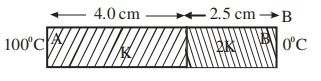
As per the given figure, two plates $A$ and $B$ of thermal conductivity $K$ and $2 K$ are joined together to form a compound plate. The thickness of plates are $4.0 \,cm$ and $2.5 \,cm$ respectively and the area of cross-section is $120 \,cm ^{2}$ for each plate. The equivalent thermal conductivity of the compound plate is $\left(1+\frac{5}{\alpha}\right) K$, then the value of $\alpha$ will be_______
A simple pendulum suspended from the roof of a lift oscillates with frequency $v$ when the lift is at rest. If the lift falls freely under gravity, its frequency of oscillations becomes: