A uniform spring of force constant $k$ is cut into two pieces, the lengths of which are in the ratio $1 : 2$. The ratio of the force constants of the shorter and the longer pieces is
Easy


Download our appand get started for free
Experience the future of education. Simply download our apps or reach out to us for more information. Let's shape the future of learning together!No signup needed.*
Similar Questions
- 1In an angular $SHM$ angular amplitude of oscillation is $\pi $ $rad$ and time period is $0.4\,sec$ then calculate its angular velocity at angular displacement $ \pi/2 \,rad$. ..... $rad/sec$View Solution
- 2The ratio of frequencies of two pendulums are $2 : 3$, then their length are in ratioView Solution
- 3View SolutionWhich of the following function represents a simple harmonic oscillation
- 4An object of mass $0.5\, {kg}$ is executing simple harmonic motion. Its amplitude is $5\, {cm}$ and time period (T) is $0.2\, {s} .$ What will be the potential energy of the object at an instant $t=\frac{T}{4}$ s starting from mean position. Assume that the initial phase of the oscillation is zero. (In ${J}$)View Solution
- 5The average speed of the bob of a simple pendulum oscillating with a small amplitude $A$ and time period $T$ isView Solution
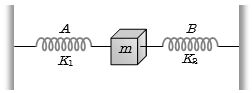
- 6View SolutionIn arrangement given in figure, if the block of mass m is displaced, the frequency is given by
- 7If the time period of a two meter long simple pendulum is $2\, s$, the acceleration due to gravity at the place where pendulum is executing $S.H.M.$ isView Solution
- 8A particle of mass $250\,g$ executes a simple harmonic motion under a periodic force $F =(-25\,x) N$. The particle attains a maximum speed of $4\,m / s$ during its oscillation. The amplitude of the motion is $...........cm$.View Solution
- 9A particle is executing simple harmonic motion $(SHM)$ of amplitude $A,$ along the $x-$ axis, about $x = 0.$ When its potential energy $(PE)$ equals kinetic energy $(KE),$ the position of the particle will beView Solution
- 10Two particles $P$ and $Q$ describe $SHM$ of same amplitude $a$ , frequency $v$ along the same straight line. The maximum distance between the two particles is $a \sqrt 2$ . The initial phase difference between the particles isView Solution