MCQ
 A uniformly accelerated body has ____.
  • A
    Constant speed
  • B
    Constant velocity
  • C
    Constant force
  • D
    Constant momentum

Answer

  1. Constant force

Explanation:

Since the body is accelerated, the speed and velocity will vary. Momentum depends on velocity; hence the momentum will also vary. The force remains constant as F = ma.

Need a full question paper?

Generate a complete, print-ready paper with questions like this in minutes — across 16+ boards, with answer keys.
Start Generating Free

Similar questions

A particle executes simple harmonic motion with an amplitude of $5\, cm$. When the particle is at $4\, cm$ from the mean position, the magnitude of its velocity is $SI\,units$ is equal to that of its acceleration. Then, its periodic time in seconds is
A shell is fired vertically upwards with a velocity $v_1$ from a trolley moving horizontally with velocity $v_2$. A person on the ground observes the motion of the shell as a parabola, whose horizontal range is ....
The ratio of the weights of a body on the Earth's surface to that on the surface of a planet is $9 : 4$. The mass of the planet is $\frac{1}{9}^{th}$ of that of the Earth. If $'R'$ is the radius of the Earth, what is the radius of the planet ? (Take the planets to have the same mass density)
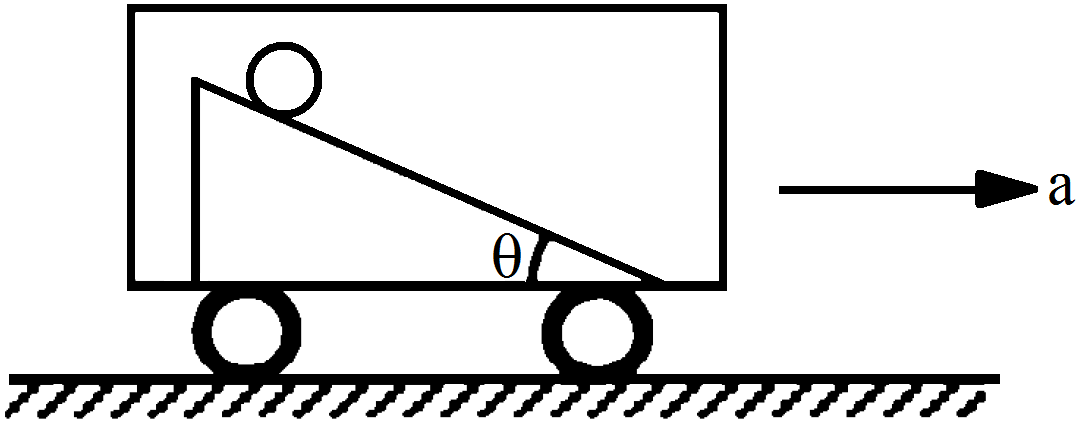
Figure shows a smooth inclined plane fixed in a car accelerating on a horizontal road. The angle of incline 0 is related to the acceleration a of the car as a = g tan°. If the sphere is set in pure rolling on the incline:

  1. It will continue pure rolling.
  2. It will slip down the plane.
  3. Its linear velocity will increase.
  4. Its linear velocity will slowly decrease.
The displacement time graph of a particle executing S.H.M. is shown in Fig.Which of the following statement is/ are true?
In an experiment four quantities $a, b, c$ and $d $ are measured with percentage error $1\%, 2\%, 3\%$ and $4\%$ respectively. Quantity $P$ is calculated as follows $P = \frac{{{a^3}{b^2}}}{{cd}}$. $ \%$ error in $P$ is ........ $\%$
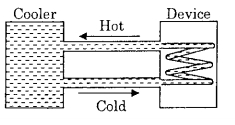
A water cooler of storage capacity $120$ litres can cool water at a constant rate of $P$ watts. In a closed circulation system (as shown schematically in the figure), tr e wat'r from the cooler is used to cool an external device that generates constantly $3 \mathrm{~kW}$ of heat (thermal load). The temperature of water fed into the device cannot exceed $30^{\circ} \mathrm{C}$ and the e.tire stored $120$ litres of water is initially cooled to $10^{\circ} \mathrm{C}$. The entire system is thermally insulat $\mathrm{d}$. The minimum value of $P$ (in watts) for which the device can be operated for $3$ hours is

(Specific heat of water is $4.2 \mathrm{~kJ}^{-1} \mathrm{~kg}^{-1}$ and the density of water is $10.$) $0 \mathrm{k}^2 \mathrm{~m}^{-3}$ )
A Carnot engine, whose efficiency is $40\%$, takes in heat from a source maintained at a temperature of $500\ K$. It is desired to have an engine of efficiency $60\%$. Then, the intake temperature for the same exhaust (sink) temperature must be ....... $K$
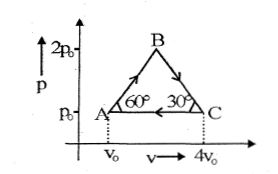
Four moles of an ideal monoatomic gas undergoes a cyclic process $ABCA$ as shown in figure find ratio of temperature of $A$ and $B$ .
A light spring balance hangs from the hook of the other light spring balance and a block of mass $M$ kg hangs from the former one. Then the true statement about the scale reading is