A wire has a resistance of $12\, ohm$. It is bent in the form of equilateral triangle. The effective resistance between any two corners of the triangle is
Medium
Download our app for free and get started
(d) As resistance $\propto$ Length
Resistance of each arm $ = \frac{{12}}{3} = 4\,\Omega $
${R_{effective}} = \frac{{4 \times 8}}{{4 + 8}} = \frac{8}{3}\Omega $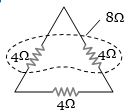

Download our appand get started for free
Experience the future of education. Simply download our apps or reach out to us for more information. Let's shape the future of learning together!No signup needed.*
Similar Questions
- 1The $V-i$ graph for a conductor makes an angle $\theta $ with $V-$ axis. Here $ V$ denotes the voltage and $i$ denotes current. The resistance of conductor is given byView Solution
- 2A piece of copper and another of germanium are cooled from room temperature to $80\, K$. The resistance of :-View Solution
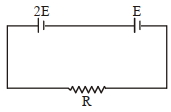
- 3Two cells of emf $2\, E$ and $E$ with internal resistance $r _{1}$ and $r _{2}$ respectively are connected in series to an external resistor $R$ (see $figure$). The value of $R ,$ at which the potential difference across the terminals of the first cell becomes zero isView Solution
- 4Two cells, $e.m.f.$ of each is $E$ and internal resistance $r$ are connected in parallel between the resistance $R$. The maximum energy given to the resistor will be, only whenView Solution
- 5In order to increase the resistance of a given wire of uniform cross section to four times its value, a fraction of its length is stretched uniformly till the full length of the wire becomes $\frac{3}{2}$ times the original length what is the value of this fraction?View Solution
- 6The charge of an electron is $1.6 × 10^{-19}\,C$. How many electrons strike the screen of a cathode ray tube each second when the beam current is $16\,mA$View Solution
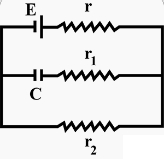
- 7In the given circuit diagram when the current reaches steady state in the circuit, the charge on the capacitor of capacitance $C$ will beView Solution
- 8When three identical bulbs of $60 \;W, 200\;V$ rating are connected in series to a $200 \;V$ supply, the power drawn by them will be ....... $Watt$View Solution
- 9Two cells of $emfs$ $E_1$ and $E_2$ and internal resistances $r_1$ and $r_2$ are connected in parallel. The $emf$ and internal resistance of the equivalent source isView Solution
- 10Two wires each of radius of cross section $r$ but of different materials are connected together end to end (in series). If the densities of charge carriers in the two wires are in the ratio $1 : 4$, the drift velocity of electrons in the two wires will be in the ratio:View Solution