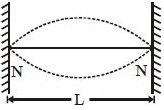
- A$25$
- B$50$
- ✓$75$
- D$100$
Mass per unit length of the wire.
$\mu=4 \times 10^{-2} \mathrm{\,kg} \mathrm{m}^{-1}$
$\therefore $ length of the wire, $L=\frac{M}{\mu}$
$=\frac{30 \times 10^{-3} \mathrm{\,kg}}{4 \times 10^{-2} \mathrm{\,kgm}^{-1}}=0.75 \mathrm{\,m}$
For the fundamental mode $\frac{\lambda}{2}=L$
$\Rightarrow \lambda=2 \mathrm{L}=2 \times 0.75=1.5 \mathrm{\,m}$
Speed of the transverse wave.
$\mathrm{v}=\mathrm{n} \lambda=\left(50 \mathrm{\,s}^{-1}\right)(1.5 \mathrm{\,m})=75 \mathrm{\,ms}^{-1}$
Generate a complete, print-ready paper with questions like this in minutes — across 16+ boards, with answer keys.
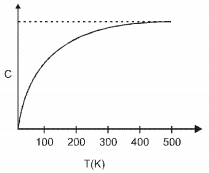
$(A)$ the rate at which heat is absorbed in the range $0-100 \ K$ varies linearly with temperature $T$.
$(B)$ heat absorbed in increasing the temperature from $0-100 \ K$ is less than the heat required for increasing the temperature from $400-500 \ K$.
$(C)$ there is no change in the rate of heat absorbtion in the range $400-500 \ K$.
$(D)$ the rate of heat absorption increases in the range $200-300 \ K$.