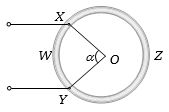
A wire of resistor $R$ is bent into a circular ring of radius $r$. Equivalent resistance between two points $X$ and $Y$ on its circumference, when angle $XOY$ is $\alpha$, can be given by
Diffcult
Download our app for free and get started
(a) Here ${R_{XWY}} = \frac{R}{{2\pi r}} \times (r\alpha ) = \frac{{R\alpha }}{{2\pi }}$
and ${R_{XZY}} = \frac{R}{{2\pi r}} \times r(2\pi - \alpha ) = \frac{R}{{2\pi }}(2\pi - \alpha )$
${R_{eq}} = \frac{{{R_{XWY}}{R_{XZY}}}}{{{R_{XWY}} + {R_{XZY}}}} = \frac{{\frac{{R\alpha }}{{2\pi }} \times \frac{R}{{2\pi }}(2\pi - \alpha )}}{{\frac{{R\alpha }}{{2\pi }} + \frac{{R(2\pi - \alpha )}}{{2\pi }}}}$$ = \frac{{R\alpha }}{{4{\pi ^2}}}(2\pi - \alpha )$
and ${R_{XZY}} = \frac{R}{{2\pi r}} \times r(2\pi - \alpha ) = \frac{R}{{2\pi }}(2\pi - \alpha )$
${R_{eq}} = \frac{{{R_{XWY}}{R_{XZY}}}}{{{R_{XWY}} + {R_{XZY}}}} = \frac{{\frac{{R\alpha }}{{2\pi }} \times \frac{R}{{2\pi }}(2\pi - \alpha )}}{{\frac{{R\alpha }}{{2\pi }} + \frac{{R(2\pi - \alpha )}}{{2\pi }}}}$$ = \frac{{R\alpha }}{{4{\pi ^2}}}(2\pi - \alpha )$

Download our appand get started for free
Experience the future of education. Simply download our apps or reach out to us for more information. Let's shape the future of learning together!No signup needed.*
Similar Questions
- 1The current density in a cylindrical wire of radius $4 \; mm$ is $4 \times 10^{6} \; Am ^{-2}$. The current through the outer portion of the wire between radial distance $\frac{R}{2}$ and $R$ is $\dots \; \pi A .$View Solution
- 2In given circuit find value of ................... $V$View Solution
- 3Two uniform wires $A$ and $B$ are of the same metal and have equal masses. The radius of wire $A$ is twice that of wire $B$. The total resistance of A and $B$ when connected in parallel isView Solution
- 4At room temperature, copper has free electron density of $8.4 \times {10^{28}}$ per ${m^3}$. The copper conductor has a cross-section of $10^{-6} \,m^2$ and carries a current of $5.4\, A$. The electron drift velocity in copper isView Solution
- 5The resistance of the meter bridge $AB$ in given figure is $4\,\Omega $. With a cell of emf $\varepsilon \, = 0.5\,\,V$ and rheostat resistance $R_h = 2\,\Omega $ the null point is obtained at some point $J.$ When the cell is replaced by another one of emf $\varepsilon \, = {\varepsilon _2}$ the same null point $J$ is found for $R_h = 6\,\Omega .$ The $emf$ ${\varepsilon _2}$ is ................. $V$View Solution
- 6The figure here shows a portion of a circuit. What are the magnitude and direction of the current i in the lower right-hand wire .................... $A$View Solution
- 7In a meter bridge, the null point is found at a distance of $25\, cm$ from $A$. If now a resistance of $10\,\Omega $ is connected in parallel with $S$, the null point occurs at mid point of $AB$. The value of $R$ is ................. $\Omega$View Solution
- 8A meter bridge is set up as shown, to determine an unknown resistance ' $X$ ' using a standard $10\,ohm$ resistor. The galvanometer shows null point when tapping-key is at $52\,cm$ mark. The endcorrections are $1\,cm$ and $2\,cm$ respectively for the ends $A$ and $B$. The determined value of ' $X$ ' is $..........\Omega$View Solution
- 9If two bulbs of wattage $25$ and $30$, each rated at $220\, volts$, are connected in series with a $440$ $volt$ supply, which bulb will fuseView Solution
- 10The current in the given circuit is ................ $A$View Solution