A wooden cube (density of wood $'d'$ ) of side $'l'$ floats in a liquid of density $'\rho '$ with its upper and lower surfaces horizontal. If the cube is pushed slightly down and released, it performs simple harmonic motion of period $'T'$. Then, $'T'$ is equal to
AIEEE 2011, Diffcult
Download our app for free and get started
By using $T=2 \pi \sqrt{\frac{m}{A \rho g}}$
Where $m=l^{3} d$ and $A=l^{2}$
$T=2 \pi \sqrt{\frac{l^{3} d}{l^{2} \rho g}} \Rightarrow T=2 \pi \sqrt{\frac{l d}{\rho g}}$

Download our appand get started for free
Experience the future of education. Simply download our apps or reach out to us for more information. Let's shape the future of learning together!No signup needed.*
Similar Questions
- 1A rectangular block of mass $m$ and area of cross-section $A$ floats in a liquid of density $\rho $. If it is given a small vertical displacement from equilibrium it undergoes with a time period $T,$ thenView Solution
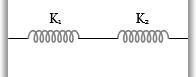
- 2View SolutionThe effective spring constant of two spring system as shown in figure will be
- 3The potential energy of a simple harmonic oscillator when the particle is half way to its end point is (where $E$ is the total energy)View Solution
- 4A massless spring $(k = 800\, N/m)$, attached with a mass $(500\, g)$ is completely immersed in $1\, kg$ of water. The spring is stretched by $2\, cm$ and released so that it starts vibrating. What would be the order of magnitude of the change in the temperature of water when the vibrations stop completely? (Assume that the water container and spring receive negligible heat and specific heat of mass $= 400\, J/kg\, K$, specific heat of water $= 4184\, J/kg\, K$)View Solution
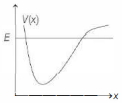
- 5Consider a one-dimensional potential $V(x)$ as shown in the figure below. A classical particle of mass $m$ moves under its influence and has total energy $E$ as shown below. The motion isView Solution
- 6View SolutionThe total energy of a particle, executing simple harmonic motion is
- 7For a particle executing $S.H.M.,\, x =$ displacement from equilibrium position, $v =$ velocity at any instant and $a =$ acceleration at any instant, thenView Solution
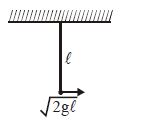
- 8A simple pendulum having length $\ell $ is having speed $\sqrt {2g\ell }$ at bottom most point of its trajectory. Its motion will beView Solution
- 9The motion of a simple pendulum excuting $S.H.M$. is represented by following equation.View Solution
$Y = A \sin (\pi t +\phi)$, where time is measured in $second$.
The length of pendulum is .............$cm$
- 10A spring is stretched by $5 \,\mathrm{~cm}$ by a force $10 \,\mathrm{~N}$. The time period of the oscillations when a mass of $2 \,\mathrm{~kg}$ is suspended by it is :(in $s$)View Solution