Question
A1. Simple Factual Activity:
Complete the following sentences with the information given in the passage:
(1) The man with crooked leg was _______________.
(2) Someone said that the Seth had hanged himself _______________.

    Old Ganpat the beggar, had a crooked leg. He had been squatting on the pavement for years, calling for alms. In the evening someone would come with a barrow and take him away. He had never been known to walk. But now, on learning that the bank was about to collapse, Ganpat astonished everyone, leaping to his feet and actually running at top speed in the direction of the bank. It soon became known that he had a thousand rupees in savings!
     Men stood in groups at street corners discussing the situation. Pipalnagar seldom had a crisis, seldom or never had floods, earthquakes or drought; and the imminent crash of the Pipalnagar Bank set everyone talking and speculating and rushing about in a frenzy. Some boasted of their farsightedness, congratulating themselves on having already taken out their money, or on never having put any in; others speculated on the reasons for the crash, putting it all down to excesses indulged in by Seth Govind Ram. The Seth had fled the State, said one. He had fled the country, said another. He was hiding in Pipalnagar, said a third. He had hanged himself from the tamarind tree, said a fourth, and had been found that morning by the sweeper-boy.
     By noon the small bank had gone through all; its ready cash, and the harassed manager was in a dilemma. Emergency funds could only be obtained from another bank some thirty miles distant, and he wasn’t sure he could persuade the crowd to wait
until then. And there was no way of contacting Seth Govind Ram on his houseboat in Kashmir. 

A2. Complex Factual Activity:
Complete the following sentences that tell you about Ganpat, the beggar:
(1) Ganpat was an old beggar who had a _______________.
(2) He had been _______________ for years.
A3. Activities based on Vocabulary:
Find the describing words for the following from the passage:
(1) fund (2) leg (3) manager (4) speed
A4. Activities based on Contextual Grammar:
(1) I must know the reason. You are late.
(Join the sentence with the word 'why'.)
(2) He was hiding in Pipalnagar.
(Rewrite the sentence using Simple Present Tense.)
A5. Personal Response:
(1) Have you ever heard a rumour that harmed people? Elaborate it.
Answer

A1. Simple Factual Activity:
(1) The man with crooked leg was old Ganpat, the beggar.
(2) Someone said that the Seth had hanged himself from the tamarind tree.
A2. Complex Factual Activity:
(1) Ganpat was an old beggar who had a crooked leg.
(2) He had been squatting on the pavement for years.
A3. Activities based on Vocabulary:
(1) emergency fund
(2) crooked leg
(3) harassed manager
(4) top speed
A4. Activities based on Contextual Grammar:

(1) I must know why you are late.
(2) He hides in Pipalnagar.
A5. Personal Response:
(1) Yes, I have not only heard but also have experienced such a rumour that has harmed people. We had been to a theatre to watch a movie. It was the first show of the movie. In the middle of the show a person shouted 'Fire! Fire!". People in the theatre left their seats in fright and ran helter-skelter to the exits for safety. Many fell and were trampled underfoot in the rush. It was an awful scene. Truth came to light that the miscreant was an agent of a producer who wanted the movie to fail.

Need a full question paper?

Generate a complete, print-ready paper with questions like this in minutes — across 16+ boards, with answer keys.

Start Generating Free

Similar questions

A1. Simple Factual Activities:
Write whether the following sentences are True or False:
(1) Writer's journey from India to Norway is a connect between the two centre of global peace.
(2) The Nobel Committee did not invite the writer to deliver a lecture.
(3) Writer represented the sound of silence and cry of innocence.
(4) Writer humbly accepted the award on behalf of all activists.

     My dear children of the world ... Your Majesties, Your Royal Highnesses, Excellencies, distinguished members of the Norwegian Nobel Committee, dear brother Tom Harkin, brothers and sisters, and my dear daughter Malala.
      From this podium of peace and humanity, I am deeply honoured to recite a mantra from the ancient texts of wisdom, Vedas. This mantra carries a prayer, an aspiration and a resolve that has the potential to liberate humanity from all man-made crises.
      Let’s walk together. In the pursuit of global progress, not a single person should be left out or left behind in any corner of the world, from East to West, from South to North. Let’s speak together, let our minds come together! Learning from the experiences of our ancestors, let us together create knowledge for all that benefits all.
      I bow to my late parents, to my motherland India, and to the mother earth.
      With a warm heart I recall how thousands of times, I have been liberated, each time I have freed a child from slavery. In the first smile of freedom on their beautiful faces, I see the Gods smiling.
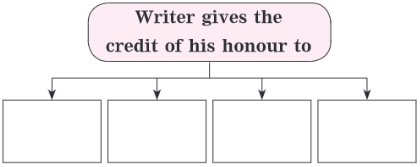
      I give the biggest credit of this honour to my movement’s Kaalu Kumar, Dhoom Das and Adarsh Kishore from India and Iqbal Masih from Pakistan who made the supreme sacrifice for protecting the freedom and dignity of children. I humbly accept this award on behalf of all such martyrs, my fellow activists across the world and my countrymen.
      My journey from the great land of Lord Buddha, Guru Nanak and Mahatma Gandhi; India to Norway is a connect between the two centres of global peace and brotherhood, ancient and modern.
      Friends, the Nobel Committee has generously invited me to present a “lecture.” Respectfully, I am unable to do that. Because, I am representing here - the sound of silence. The cry of innocence. And, the face of invisibility. I represent millions of those children who are left behind and that’s why I have kept an empty chair here as a reminder.

A2. Complex Factual Activities:
Complete the following :
Image
A3. Activities based on Vocabulary:
(1) Use the word 'credit' as a noun and a verb to make a meaningful sentence.
A4. Activities based on Contextual Grammar:
Do as directed:
(1) I humbly accept this award. (Choose the correct question tag.)
(a) do I?  (b) don't I? (c) did I? (d) didn't I?
(2) I am unable to do that.
(Make it negative without changing its meaning)
A5. Personal Response:
(1) What do you know about Kailash Satyarthi? 
A1. Simple Factual Activities:
State whether the following statements are Right or Wrong. Correct the wrong ones:
(1) The author and Meena were great enemies.
(2) Meena was a very cheerful person initially.

     Meena is a good friend of mine. She is an LIC officer earning a good salary. But there was always something strange about her. She was forever unhappy. Whenever I met her, I would start to feel depressed. It was as though her gloom and cynicism had a way of spreading to others. She never had anything positive to say on any subject or about any person.      
     For instance, I might say to her, ‘Meena, did you know Rakesh has come first in his school ?’     
     Meena’s immediate response would be to belittle the achievement. ‘Naturally, his father is a school teacher’, she would say.      
     If I said, ‘Meena, Shwetha is a very beautiful girl, isn’t she ?’ Meena would be pessimistic. ‘When a pony is young, he looks handsome. It is age that matters. Wait for some time. Shwetha will be uglier than anyone you know.’      
     ‘Meena, it’s a beautiful day. Let’s go for a walk’. 
     ‘No, the sun is too hot and I get tired if I walk too much. Besides, who says walking is good for health ? There’s no proof.’
     That was Meena. She stayed alone in an apartment as her parents lived in Delhi. She was an only child and had the habit of complaining about anything and everything. Naturally, she wasn’t a very pleasant company and nobody wanted to visit her. Then one day, Meena was transferred to Bombay and soon we all forgot about her.
     Many years later, I found myself caught in the rain at Bombay’s Flora Fountain. It was pouring and I didn’t have an umbrella. I was standing near Akbarallys, a popular department store, waiting for the rain to subside. Suddenly, I spotted Meena. My first reaction was to run, even in that pouring rain. I was anxious to avoid being seen by her, having to listen to her never-ending complaints. However, I couldn’t escape. She had already seen me and caught hold of my hand warmly. What’s more, she was very cheerful.
     ‘Hey ! I am really excited. It’s nice to meet old friends. What are you doing here ?’
     I explained that I was in Bombay on an official work.

A2. Complex Factual Activities:
Choose the correct alternative and rewrite the sentences:
(1) Meena who is an LIC officer, is _______________.
(a) a pessimistic person
(b) an optimistic person
(c) a disabled person.
(2) The writer was standing near Akbarallys, a popular department store because _______________.
(a) she was waiting for her friend Meena.
(b) she was waiting for the rain to stop.
(c) she wanted to buy something in Akbarallys.
A3. Activities based on Vocabulary:
Match the words with their meanings:

Group 'A'Group 'B'
 (1) gloom (a) to abate
 (2) cynicism (b) expecting the worst
 (3) subside (c) feeling of sadness
 (4) pessimistic (d) a distrustful attitude

A4. Activities based on Contextual Grammar:
(1) Choose the correct alternative of affirmative sentence:
She wasn't a very pleasant company.
(a) She was a very unpleasant company.
(b) She wasn't a very unpleasant company.
(c) She was a very pleasant company.
(d) She was a very beautiful company.
(2) Do as directed:
Meena is a LIC Officer.
(Frame a wh-question to get the underlined part as an answer)
A5. Personal Response:
(1) If you have a friend like Meena, what would be your attitude towards her?

A1. Simple Factual Activity:
State whether you Agree or Disagree with the following statements:
(1) Swami is a close-mouthed little kid.
(2) Swami hated Mathematics even worse.

     A little bit about the book...
     Anything I mention about the book can be mistakenly understood as 'spoilers', so I would rather give a glance into the book without mentioning any events or plots of the story.
     Swami is a mischievous little kid of about 10 years old and living in the era where India was under the British rule... Like most kids of that age, Swami is a kid who cannot stay at one place and absolutely hates school, even worse Mathematics. School is his absolute nightmare. Anyway the story unfolds around the happenings of this kid and how he constantly gets into trouble and gets a good beating from his father.
      Swami is a talkative little kid and thinks that’s his way of facing life, talking himself out of everything. But he does learn the truth the harsh way. As many teens back then, all he wants to do is play under the sun, kick something, climb a tree, break something and harass somebody (unlike kids today!!!). This, in fact, was (and in most parts of India, still is) the life of a typical boy growing up. Technology isn’t big in a kid's life. All they want is to play havoc!!!
       In what ways is Swami a typical boy in his growing years ?
       In this regard, Narayan gets deeply into the workings of Swami’s ten year old mind, explaining exquisitely how he thinks and what his perspective of the world is. The reader does feel like Swami and gets very attached with the character as the story progresses. That's the magic of Narayan.

A2. Complex Factual Activity:
(1) Describe Swami's characteristics in 3-4 sentences. 
A3. Activities based on Vocabulary:
Underline the odd man:
(i) mentioning, happenings, everything, facing
(ii) mischievous, truth, talkative, typical
(iii) give, mention, stay, life
(iv) constantly, absolutely, lovely, deeply
A4. Activities based on Contextual Grammar:
Frame Wh-questions to get the underlined parts as answers:
(1) Narayan gets deeply into the working of Swami's mind.
(2) That's the magic of Narayan.
A5. Personal Response:
(1) Do you think, that even today most of our kids like to live the life Swami was living?
A1. Simple Factual Activities:
Complete the sentences:
(1) A tiny bird was rushing towards _________.
(2) A heavy fire had broken out in the _________.
(3) The speaker is appealing to globalise _________.
(4) The tiny bird was going to _________.

     We can do it ...
     You may ask that - what can one person do? I would recall a story of my childhood: A heavy fire had broken out in the forest. All the animals were running away, including lion, the king of the forest. Suddenly, then he saw a tiny bird rushing towards the fire. He asked the bird, “What are you doing?” To the lion’s surprise, the bird replied “I am going to extinguish the fire.” The lion laughed and said, “How can you do it keeping just one drop of water, in your beak?” The bird was adamant, and she said, “I am doing my bit.”
     Eighteen years ago, millions of individuals marched across the globe. And demanded a new international law for the abolition of worst form of child labour, and it has happened, we did it, millions of individuals did it.
     Friends! We live in an age of rapid globalisation. We are connected through high-speed Internet. We exchange our goods and services in one single global market. Thousands of flights every day connect us from one corner to another corner of the globe. But there is one serious disconnect and there is a lack of compassion. Let us inculcate and transform these individuals’ compassion into a global compassion.
Let us globalise compassion.
     Mahatma Gandhi said, “If we are to teach real peace in this world... we shall have to begin with the children.” I humbly add, let us unite the world through the compassion for our children.
     I ask - Whose children are they who stitch footballs, yet never played with one?
     Whose children are they who harvest cocoa, yet have never tasted chocolate?
     Whose children are they who are dying of Ebola?
     Whose children are they who are kidnapped and held hostage?
     They are all our children.
     I remember an eight-year-old girl we rescued from intergenerational forced labour from stone quarries. When she was sitting in my car right after her rescue, she asked me: “Why did you not come earlier?”
     Her angry question still shakes me – and has the power to shake the whole world. Her question is for all of us. What are we doing? What are we waiting for? How many girls will we allow to go without rescue?
     Children are questioning our inaction and watching our actions. We need collective actions with a sense of urgency.
     Every single minute matters, every single child matters, every single childhood matters.
     Therefore, I challenge the passivity and pessimism surrounding our children. I challenge this culture of silence and this culture of passivity, this culture of neutrality.

A2. Complex Factual Activities:

Complete the following web:
Image

A3. Activities based on Vocabulary:
(1) Use the word 'stitch' as a Noun and a Verb in separate meaningful sentences.
A4. Activities based on Contextual Grammar:
Add a question tag:
(1) We are connected through high-speed internet.
(2) We exchange our goods and services in one single global market.
A5. Personal Response:
(1) What lesson does the story of the lion and the tiny bird teach us? 
A1. Simple Factual Activities:
State whether the following statements are True or False:
(1) Bishamber was a young bridegroom. 
(2) Ramlal had never dreamt that his fourth daughter Bholi would have such a grand wedding.
(3) When Bholi was brought near the sacred fire she was in a red silken bridal dress.
(4) Bholi felt herself lucky to get a well-to-do bridegroom like Bishamber.

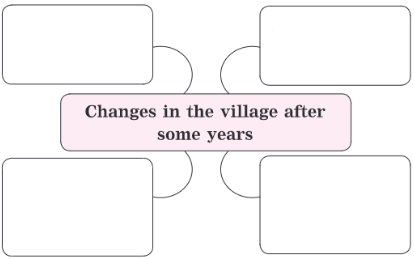
    Thus the years passed.
    The village became a small town. The little primary school became high school. There were now a cinema under a tin shed and a cotton ginning mill. The mail train began to stop at their railway station.
     One night, after dinner, Ramlal said to his wife, “Then, shall I accept Bishamber’s proposal?”
    “Yes, certainly” his wife said. “Bholi will be lucky to get such a well to do bridegroom. A big shop, a house of his own and I hear several thousands in the bank. Moreover, he is not asking for any dowry”.
    “That’s right, but he is not so young, you know -almost the same age as I am- and he also limps. Moreover, the children from his first wife are quite grown up”.
    “So what does it matter ?” his wife replied. “Forty five or fifty-it is no great age for a man. We are lucky that he is from another village and does not know about her pockmarks and her lack of sense. If we don’t accept this proposal, she may remain
unmarried all her life.”
    “Yes, but I wonder what Bholi will say”.
    “What will that witless one say ? She is like a dumb cow.”
    “May be you are right”, muttered Ramlal. In the other corner of the courtyard, Bholi lay awake on her cot, and listened to her parents’ whispered conversation.
     Bishamber Nath was a well - to - do grocer. He came with a big party of friends and relations with him for the wedding. A brass band playing a popular tune from an Indian film headed the procession, with the bridegroom riding a decorated horse. Ramlal was
overjoyed to see such pomp and splendour. He had never dreamt that his fourth daughter would have such a grand wedding. Bholi’s elder sisters who had come for the occasion were envious of her luck.
     When the auspicious moment came the priest said, “Bring the bride”. Bholi, clad in a red silken bridal dress, was led to bride’s place near the sacred fire.
    “Garland the bride,” one of his friends prompted Bishamber Nath.

A2. Complex Factual Activities:
Complete the following web :
Image
A3. Activities based on Vocabulary:
Complete the following sentences using the words given in the brackets:
(envious, procession, overjoyed)
(1) Most of the youngsters like to dance in marriage _______________.
(2) He was _______________ to see his friend after a long time.
A4. Activities based on Contextual Grammar:
Change the following sentences in indirect speech:
(1) "What will that witless one say? She is like a dumb cow". "May be you are right," muttered Ramlal.
(2) "Yes, certainly," his wife said, "Bholi will be lucky to get such a well-to-do bridegroom."
A5. Personal Response:
(1) What is your opinion about Bholi's bridegroom? Should she get married to him?
A1. Simple Factual Activity:
Say whether the following statements are True or False:
(1) At the age of 17, Dr Stephen Hawking was suffering from an extremely rare disease.
(2) Stephen's teachers liked his handwriting very much.
(3) He got his Ph.D. studying the concept of 'Black Holes'.
(4) At the dismal stage Dr Hawking enjoyed his life the most. 

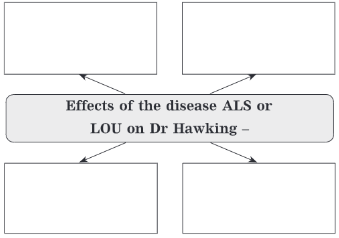
     At the age of 17, Stephen started noticing that he was becoming increasingly clumsy and even fell down a couple of times, for no reason. This perplexed him and he went to see his family doctor, who diagnosed him as suffering from an extremely rare disease - ALS or LOU Gehrig's disease that affects the nervous system and eventually weakens all the muscles of the body. Stephen says that even as a child, his muscle co-ordination was nothing to write home about. He recollects that his handwriting would send his teacher into a fit of frenzy. Nor was he inclined towards sports. Nevertheless, this disease came as a bolt from the blue.
      How much time he had left on this planet was very uncertain. The prognosis was bad and the doctors said they could not do much. Undaunted, Stephen decided to continue his research and even got engaged to a Jane Wilde. Hawking says that,
ironic as it may sound, it is at this dismal stage, began enjoying life the most. This he says was because he started living life for the moment and continued his doctoral research work with renewed vigour.
     In the meanwhile, the disease worked its way into Stephen’s body and left him disabled. He began studying the concept of “Black Holes”, to get his Ph.D. By this time, he was confined to a wheelchair and was rapidly losing control of his hands and
speech. The study of “black holes” sparked his imagination with bright ideas. He made many epochmaking statements that shook established theories.Scientists believe that the universe began with a “Big Bang”. To explain this concept better, Stephen invented what is known as “Lie Algebra”.

A2. Complex Factual Activity:
(1) Complete the following web showing the effects of the disease ALS or LOU on Dr Hawking:
Image
A3. Activities based on Vocabulary:
Match the words in Column 'A' with their meanings in Column 'B':

Column 'A'Column 'B'
 (1) confined (a) determined despite difficulties
 (2) undaunted (b) awkward
 (3) perplexed (c) restricted
 (4) clumsy (d) worried because of difficulty

A4. Activities based on Contextual Grammar:
Change the following sentences as instructed: 
(1) He made many epochmaking statements.
(Rewrite the sentence using Present Continuous Tense.)
(2) This disease came as a bolt from the blue.
(Rewrite the sentence using Past Perfect Tense.)
Ans. This disease had come as a bolt from the blue.
A5. Personal Response:
(1) What, do you think, are the miseries of a person who is confined to wheelchair?

A1. Simple Factual Activities:
State whether you Agree or Disagree with the following statements: 
Statements
(1) The narrator made a mistake by saving the baby langur.
(2) Animals cannot convey emotions.

    For a few seconds, the mother langur looked straight into my eyes. Even today, I cannot forget that look in her eyes, showering silent gratitude on me for saving her child. I was overwhelmed by the emotion, the sentiment and the way she said thanks to me. There sat a universal mother holding a stricken child in her lap.
    Then, in a flash, she jumped with her baby clinging to her belly and reached our kitchen roof. She surveyed the area for the vicious male langur and then leapt away in the direction opposite to the place of the violent encounter.
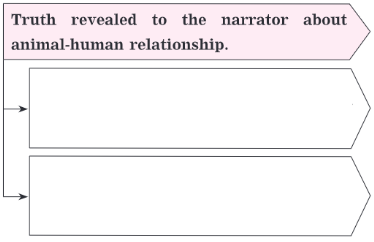
    The brief meeting with the mother and the baby langur convinced me that interspecies communication and mutual trust is indeed a reality and should anyone strike the right chord, the relationship hums into action. The mother langur showed me that food was not the only means of communication between man and animal but that there were other means of establishing a bond through trust, compassion and mutual understanding.
     Fifty-five years have passed since that day. I am now seventy years old. But I still fondly remember that ‘encounter of a special kind’.

A2. Complex Factual Activities:
Complete the web:
Image
 
A3. Activities based on Vocabulary:
Match the words in column 'A' with their meanings in column 'B':

 Column 'A'Column 'B'
 (1) to be overwhelmed by (a) to do something that makes people feel to have  sympathy with.
 (2) in a flash (b) very quickly
 (3) strike the right chord (c) belief felt equally by both people involved.
 (4) mutual trust (d) to be affected emotionally in a powerful way.

A4. Activities based on Contextual Grammar:
Rewrite the sentences as per the tenses mentioned in the brackets:
(1) The mother langur looked straight into my eyes. (Simple Present Tense.)
(2) She surveyed the area for the vicious male langur. (Simple Future Tense.)
A5. Personal Response:
(1) What did the mother langur seem to convey to the narrator?

A1. Simple Factual Activities:
Choose the correct alternative for each of the following questions:
(1) What does the word 'Bholi' mean?
(a) angry (b) foolish (c) simpleton (d) sad.
(2) At what age Bholi had an attack of smallpox?
(a) six (b) two (c) ten (d) nine.

     Her name was Sulekha but since her childhood everyone had been calling her Bholi the simpleton.
    She was the fourth daughter of Numberdar Ramlal. When she was ten months old, she had fallen off the cot on her head and perhaps it had damaged some part of her brain. That was why she remained a backward child and came to be known
as Bholi, the simpleton.
     At birth the child was very fair and pretty. But when she was two years old, she had an attack of small pox. Only the eyes were saved. But the entire body was permanently disfigured by deep black pockmarks. Little Sulekha could not speak till she was five and when at last she learnt to speak, she stammered. The other children often made fun of
her and mimicked her. As a result, she talked very little.
     Ramlal had seven children, three sons and four daughters and the youngest of them was Bholi. It was a prosperous farmer’s household and there was plenty to eat and drink. All the children except Bholi were healthy and strong. The sons had been sent to
the city to study in schools and later in colleges. Of the daughters Radha, the eldest had already been married. The second daughter Mangla’s marriage had also been settled Ramlal would think of third Champa. They were good looking, healthy girls. And
it was not difficult to find bridegrooms for them.
     But Ramlal was worried about Bholi. She had neither good looks nor intelligence.
     Bholi was seven years old when Mangla was married. The same year a primary school for girls was opened in their village. The Tehsildar sahib came to perform its opening ceremony. He said to Ramlal, ‘‘As a revenue official you are the representative of the government in the village and so you must set an example to the villagers. You
must send your daughter to school.’’
      That night when Ramlal consulted his wife. She cried, ‘‘Are you crazy? If girls go to school, who will marry them?’’
      But Ramlal had not the courage to disobey the Tehsildar. At last his wife said, ‘‘I will tell you what to do. Send Bholi to school. As it is there is little chance of her getting married, with her ugly face and lack of sense. Let the teachers at school worry about her.’’

A2. Complex Factual Activities:
(i) Complete the reasons:
Ramlal decided to send Bholi to school because -
A3. Activities based on Vocabulary:
Use the following phrases in the following sentences by making certain changes:
(to shout in terror, to pass on, to look up at.)
(1) Ruta _______________ when she saw a cobra in front of her.
(2) The world _______________ Dr Kalam as a great visionary.
A4. Activities based on Contextual Grammar:
Correct the errors in the following sentences. Focus on verbs and subject:
(1) All children, except Bholi, was healthy and strong.
(2) Since childhood, everyone will have calling her Bholi.
A5. Personal Response:
(1) Explain the following statement: 
A1. Simple Factual Activity:
Complete the sentences using the information from the passage:
(1) According to Mrs Bhushan,  _______________.
(2) Mr Bhushan said to his wife, "You go from one shop to another, like  _______________.

      And Sitaram, glad that he had been of service to both a customer and his friend, hoisted his bag on his shoulders and went his way.
      Mrs. Srivastava had to do some shopping. She gave instructions to the ayah about looking after the baby, and told the cook not to be late with the midday meal. Then she set out for the Pipalnagar market place, to make her customary tour of the cloth shops.
      A large shady tamarind tree grew at one end of the bazaar, and it was here that Mrs. Srivastava found her friend Mrs. Bhushan sheltering from the heat. Mrs. Bhushan was fanning herself with a large handkerchief. She complained of the summer, which she affirmed, was definitely the hottest in the history of Pipalnagar. She then showed Mrs. Srivastava a sample of the cloth she was going to buy, and for five minutes they discussed its shade, texture and design. Having exhausted this topic, Mrs. Srivastava
said, ‘Do you know, my dear, that Seth Govind Ram’s bank can’t even pay its employees? Only this morning I heard a complaint from their sweeper, who hasn’t received his wages for over a month!’
     ‘Shocking!’ remarked Mrs. Bhushan. ‘If they can’t pay the sweeper they must be in a bad way. None of the others could be getting paid either.’
     She left Mrs. Srivastava at the tamarind tree and went in search of her husband, who was sitting in front of Kamal Kishore’s photography shop, talking with the owner.
    ‘So there you are!’ cried Mrs. Bhushan. ‘I’ve been looking for you for almost an hour. Where did you disappear ?’
    ‘Nowhere,’ replied Mr. Bhushan. ‘Had you remained stationary in one shop, I might have found you. But you go from one shop to another, like a bee in a flower garden.’
    ‘Don’t start grumbling. The heat is trying enough.I don’t know what’s happening to Pipalnagar. Even the bank’s about to go bankrupt.’   

A2. Complex Factual Activity:
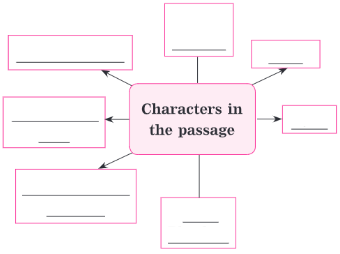
Complete the following web:
Image
A3. Activities based on Vocabulary:
Complete the followinig sentences by using the correct form of the phrases from the bracket:
[to complain of, at the end of, to set out for]
(1) There is an old Shiva's temple at the end of the village.
(2) The travellers set out early in the morning for the tour.
A4. Activities based on Contextual Grammar:
(1) That summer was the hottest in the history of Pipalnagar.
(Change the sentence into Positive Degree.)
(2) I heard a complaint.
(Begin the sentence with 'A complaint.....')
A5. Personal Response:
(1) Do you think, Mr Bhushan was right to compare his wife with a bee in a flower garden? Give your reason.
A1. Simple Factual Activities:
Say whether the following statements are True or False:
(1) A big male langur did not intend to kill the baby langur.
(2) The narrator ignored the commotion at first.
(3) The narrator rushed to the veranda to see where his family was.
(4) According to the custom of animal clan, a dominant male protects another male baby or adult.

   Suddenly, I heard a group of street dogs barking furiously in the distance. I chose to ignore the commotion thinking that the pack of dogs might have cornered a hapless pig. But soon, the barking became louder and more aggressive and the alarmed cawing of a flock of crows added to the cacophony. I also heard the disturbance approaching closer.       
    Curiosity got the better of me. Leaving the book aside, I rushed to the veranda to see what was going on.
    I glanced towards the roof of the club house and saw something horrible. A big male langur, apparently the leader of its group, was holding a baby langur in his hands and mercilessly biting it all over with a definite intent to kill. The helpless mother of the baby and other lesser members of the langur group were scattered on the roofs of the buildings nearby watching the baby being killed. I recalled the terrible custom in the animal clan according to which a dominant male usually does not allow another male baby or adult to survive within its group.
    Without losing any time, I gathered a stout stick in one hand and hurled a piece of stone at the marauding langur. The langur was so infuriated that it hardly took any notice of my assault. But then I started throwing more stones. The dogs on their part raised their pitch of cry.

A2. Complex Factual Activities:
(1) What wicked custom is practised by animals who live in groups?
A3. Activities based on Vocabulary:
Match the phrases given in Column 'A' with their meanings in Column 'B':

Column 'A'Column 'B'
 (1) to take notice of (a) overpowered someone
 (2) got the better of (b) was happening
 (3) pitch of cry (c) to observe and give attention
 (4) was going on (d) high sound of cry

A4. Activities based on Contextual Grammar:
(1) Rewrite the sentence as per the tense mentioned in the brackets:
The big male langur was holding a baby langur in his hands. (Past Perfect Continuous Tense.)
(2) Do as directed:
I started throwing more stones.(Begin with 'More stones were ....')
A5. Personal Response:
(1) Do you think that the custom of baby killing by dominant male in animal clan is good? Explain.