MCQ
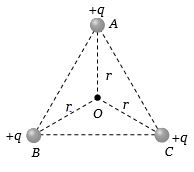
$ABC$ is an equilateral triangle. Charges $ + \,q$ are placed at each corner. The electric intensity at $O$ will be
  • A
    $\frac{1}{{4\pi {\varepsilon _0}}}\frac{q}{{{r^2}}}$
  • B
    $\frac{1}{{4\pi {\varepsilon _0}}}\frac{q}{r}$
  • Zero
  • D
    $\frac{1}{{4\pi {\varepsilon _0}}}\frac{{3q}}{{{r^2}}}$
Answer

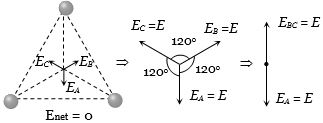
Correct option: C.
Zero
c
(c)

Need a full question paper?

Generate a complete, print-ready paper with questions like this in minutes — across 16+ boards, with answer keys.

Start Generating Free

Similar questions

Which of the following will have the least value of $\frac{q}{m}$
Consider a parallel combination of the cellsshown in the figure.The potential difference in between $B_1$ and $B_2$ is
The anode of a thermionic diode is connected to the negative terminal of a battery and the cathode to its positive terminal:
A medium is said to be dispersive, if
Two small spheres each of mass $10 \,mg$ are suspended from a point by threads $0.5 \,m$ long. They are equally charged and repel each other to a distance of $0.20 \,m$. The charge on each of the sphere is $\frac{ a }{21} \times 10^{-8} \, C$. The value of $a$ will be ...... .

$\left[\right.$ Given $\left.g=10 \,ms ^{-2}\right]$

What determines the hardness of the X-rays obtained from the Coolige tube
A charged particle moves in a uniform magnetic field. The velocity of the particle at some instant makes an acute angle with the magnetic field. The path of the particle will be
A magnet makes $40$ oscillations per minute at a place having magnetic field intensity of $0.1 \times 10^{-5} \,T$. At another place, it takes $2.5 \,sec$  to complete one vibration. The value of earth’s horizontal field at that place is
A convex lens of focal length $100 \,cm$ and a concave lens of focal length $10 \,cm$ are placed coaxially at a separation of $90 \,cm$. If a parallel beam of light is incident on convex lens, then after passing through the two lenses the beam
The acceleration of an electron in the first orbit of the hydrogen atom $(z\, = 1)$ is