MCQ
Absorption co-efficient of an open window is...
  • A
    Zero
  • B
    $0.5$
  • $1$
  • D
    $0.25$

Answer

Correct option: C.
$1$
c
(c) Open window behaves like a perfectly black body.

Need a full question paper?

Generate a complete, print-ready paper with questions like this in minutes — across 16+ boards, with answer keys.
Start Generating Free

Similar questions

A $140\, g$ ball, in horizontal flight with a speed $v_1$ of $39.0\, m/s$, is struck by a bat. After leaving the bat, the ball travel in the opposite direction with speed $v_2 = 39.0\, m/s$. If the impact time $\Delta t$ for the ball-bat collision is $1.20\, ms$, what average net force acts on the ball ......... $N$
A body of mass $3\, kg$ is under a constant force which causes a displacement $s$ in metres in it, given by the relation $s=$$\frac{1}{3}{t^2}$ , where $t$ is in seconds. Work done by the force in $2$ seconds is
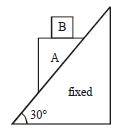
In the given figure acceleration of wedge $'A'$ is $10\ m/s^2$ along the inclined plane. (There is no friction between $A$ $\&$ $B$ and $A$ $\&$ fixed inclined plane.) Then acceleration of block $'B'$ will ............ $m/s^2$
A body starts from rest and moves with uniform acceleration for $3\ s.$ It then decelerates uniformly for $2\ s.$ and stops. If the deceleration is $3 \ ms^{-2}$ the maximum velocity of the body is$. . . ms^{-1}$
The displacement of a particle varies according to the relation $x = 3 \ sin\ 100t + 8\  cos^2\  50t$ . Which of the following is incorrect about this motion
No work is done by a force on an object if :
A uniform rope having some mass hanges vertically from a rigid support. A transverse wave pulse is produced at the lower end. The speed $(v)$ of the wave pulse varies with height $(h)$ from the lower end as:
A body of mass $1 \,\, kg$ is acted upon by a force $\vec F = 2\sin 3\pi t\,\hat i + 3\cos 3\pi t\,\hat j$ find its position at $t = 1 \,\, sec$ if at $t = 0$ it is at rest at origin. 
A real gas behaves like an ideal gas if its
A particle has initial velocity of $\left( {\widehat i + \widehat j} \right)\, m/s$ and an acceleration of $\left( {\widehat i + \widehat j} \right)\, m/s^2$. Its speed after $10s$ will be :-