Question
All energetically effective collisions do not result in a chemical change. Explain with the help of an example.

Answer


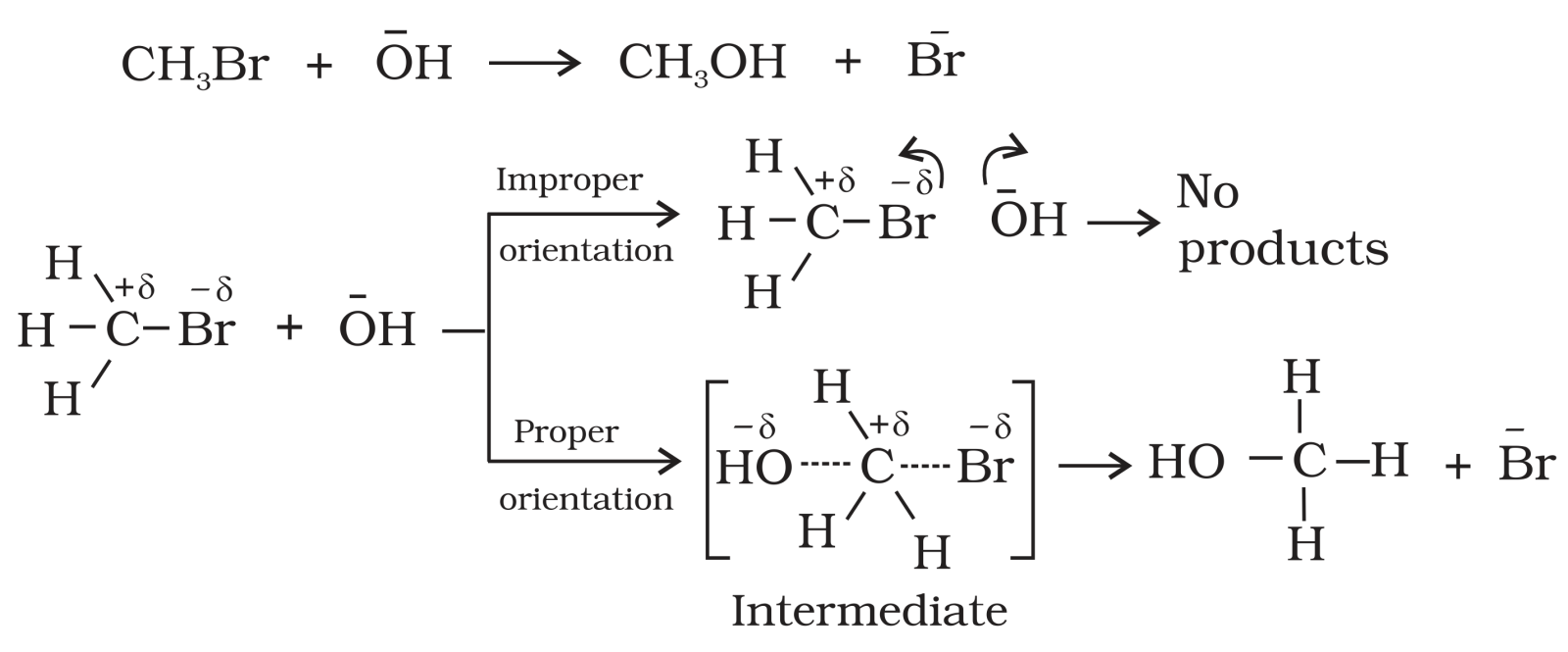
Only effective collision leads to the formation of products. It means that collisions in which molecules collide with sufficient kinetic energy (called threshold energy = activation energy + energy possessed by reacting species). And proper orientation lead to a chemical change because it facilitates the breaking of old bonds between (reactant) molecules and formation of the new ones, i.e., in products.
e.g., formation of methanol from bromomethane depends upon the orientation of the reactant molecules.

The proper orientation of reactant molecules lead to bond formation whereas improper orientation makes them simply back and no products are formed. To account to effective collisions, another factor P (probability or steric factor) is introduced $\text{K}=\text{Ae}^{\frac{-\text{Ea}}{\text{RT}}}.$

Need a full question paper?

Generate a complete, print-ready paper with questions like this in minutes — across 16+ boards, with answer keys.
Start Generating Free

Similar questions

Explain the limitations of valence bound theory.
Write the formulas for the following coordination compounds:
a. Tetraammineaquachloridocobalt(III) chloride
b. Potassium tetrahydroxidozincate(II)
c. Potassium trioxalatoaluminate(III)
d. Dichloridobis(ethane-1, 2-diamine)cobalt(III)
e. Tetracarbonylnickel(0)
Describe the standard hydrogen electrode with diagram.
  1. Account for the following:
  1. Copper $(I)$ compounds are white whereas Copper $(II)$ compounds are coloured.
  2. Chromates change their colour when kept in an acidic solution.
  3. $Zn, Cd$, Hg are considered as d-block elements but not as transition elements.
  1. Calculate the spin-only moment of $Co^{2+} (Z = 27)$ by writing the electronic configuration of $Co$ and $Co^{2+}.$
Explain the mechanism of rusting of iron.
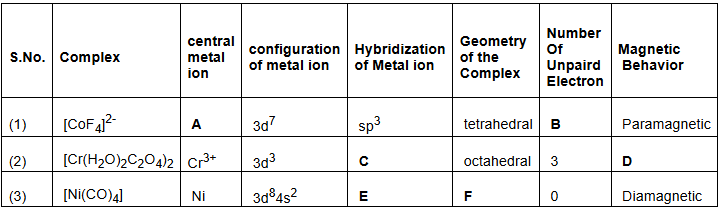
$(a).$ Using, Valence Bond Theory identify $\ce{A, B, C, D, E}$ and $\ce{F}$ in the following table$:$​​​​​​​
Image
$(b).$ Write the ionic equations for the reaction of acidified $\ce{K_2Cr_2O_7}$ with
$\ce{(i) H_2S}$ and $\ce{(ii) FeSO_4}​​​​​​​$​​​​​​​
Which of the following compounds would undergo aldol condensation, which the Cannizzaro reaction and which neither? Write the structures of the expected products of aldol condensation and Cannizzaro reaction.
  1. Methanal
  2. 2-Methylpentanal
  3. Benzaldehyde
  4. Benzophenone
  5. Cyclohexanone
  6. 1-Phenylpropanone
  7. Phenylacetaldehyde
  8. Butan-1-ol
  9. 2,2-Dimethylbutanal.
Differentiate between $1^{\circ}, 2^{\circ}$ and $3^{\circ}$ alcohols by catalytic dehydrogenation.
Explain the relationship between $\Delta G$ and $E _{\text {cell }}^{\circ}$ with the help of an example.