MCQ
Among the given compounds, the correct dehydration order is :
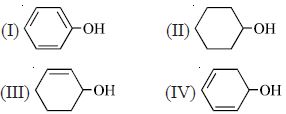
  • $I < II < III < IV$
  • B
    $II < III < IV < I$
  • C
    $I < III < IV < II$
  • D
    $I < II < III = IV$

Answer

Correct option: A.
$I < II < III < IV$
a
Dehydration order is according to the stability of their intermediate. Benzylic carbocation is most stable due to resonance so $IV$ has the highest order. As allylic carbocation are more stable than $2^{\circ}$ carbocation, so the order is $III\, >\, II$.

Phenyl carbocations are least stable, so the order is $I\, <\, II\, < \,III \,<\, IV$.

Need a full question paper?

Generate a complete, print-ready paper with questions like this in minutes — across 16+ boards, with answer keys.
Start Generating Free

Similar questions

Highest covalent character is found in
The rate of first order reaction is $0.04 \mathrm{~mol} \mathrm{~L}^{-1} \mathrm{~s}^{-1}$ at $10$ minutes and $0.03 \mathrm{~mol} \mathrm{~L}^{-1} \mathrm{~s}^{-1}$ at $20$ minutes after initiation. Half life of the reaction is ____________minutes. (Given $\log 2=0.3010, \log 3=0.4771)$
Rank the following alkyl radicals in order of increasing stability (least $< < <$ most).
Which $d-$ block element is expected to have highest enthalpy of atomisation, among the following ?
Frequency of the de-Broglie wave of election in Bohr's first orbit of hydrogen atom is. . . . . . . . . . $\times 10^{13} \mathrm{~Hz}$ (nearest integer).

[Given : $R_{\mathrm{H}}\left(\right.$ Rydberg constant) $=2.18 \times 10^{-18} \mathrm{~J}$.

$h($ Plank's constant $)=6.6 \times 10^{-34}$ J.s. $]$
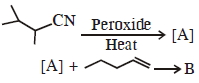
The major products $A$ and $B$ in the following reactions are
A pink coloured salt turns blue on heating. The presence of which cation is most likely ?
Aqueous solutions of two compounds $M_1 -O -H$ and $M_2 -O -H$ are prepared in two different beakers. If, the electronegativity of $M_1$ = $3.4$, $M_2$ = $1.2$, $O$ = $3.5$ and $H$ = $2.1$, then  the nature of two solutions will be respectively
The binding of oxygen by haemoglobin $(Hb)$ forming $(HbO_2)$, is partially regulated by the concentration of $H_3O^+$ and dissolved $CO_2$ in blood.

$Hb{O_2} + {H_3}{O^ + }C{O_2} \rightleftharpoons \left( {{H^ + } - Hb - C{O_2}} \right) + {O_2} + {H_2}O$

Release of $O_2$ is favoured when there is

Which acid on heating produces phosphine ?