MCQ
An electron falls from rest through a vertical distance $h$ in a uniform and vertically upward directed electric field $E.$ The direction of electric field is now reversed, keeping its magnitude the same. A proton is allowed to fall from rest in it through the same vertical distance $h.$ The time of fall of the electron, in comparison to the time of fall of the proton is 
  • smaller
  • B
    $5$ times greater
  • C
    equal
  • D
    $10$  times greater

Answer

Correct option: A.
smaller
a
$h = \frac{1}{2}\frac{{eE}}{m}{t^2}$

$\therefore \,\,t = \sqrt {\frac{{2hm}}{{eE}}} $

$\therefore \,\,t \propto \sqrt m $ as $'e'$ is same for electron and proton.

$\because $ Electron has smaller mass so it will take smaller time.

Need a full question paper?

Generate a complete, print-ready paper with questions like this in minutes — across 16+ boards, with answer keys.

Start Generating Free

Similar questions

Emf of a cell is:
If a copper rod carries a direct current, the magnetic field associated with the current will be
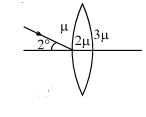
$A$ light ray hits the pole of a thin biconvex lens as shown in figure. The angle made by the emergent ray with the optic axis will be
A tangent galvanometer is connected directly to an ideal battery. If the number of turns in the coil is doubled the deflection will:
At a distance of $10\, cm $ from a long straight wire carrying current, the magnetic field is $0.04\, T$. At the distance of $40\, cm$, the magnetic field will be....$T$
The magnetic suceptibility of a material is $7.54 \times 10^{-3} .$ The nature and relative premeability of the substance is
A plane electromagnetic wave of frequency $20\,MHz$ propagates in free space along $x$-direction. At a particular space and time, $\overrightarrow{ E }=6.6 \hat{ j } V / m$. What is $\overrightarrow{ B }$ at this point?
If a magnet is suspended at an angle $30^o$ to the magnetic meridian, it makes an angle of $45^o$ with the horizontal. The real dip is
A rod of legth l rotates with a uniform angular velocity $\omega$ about its perpendicular bisector. A uniform magnetic field B exists parallel to the axis of rotation. The potential difference between the two ends of the rod is:
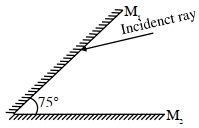
A light ray is incident, at an incident angle $\theta_{1}$, on the system of two plane mirrors $M_{1}$ and $M_{2}$ having an inclination angle $75^{\circ}$ between them (as shown in figure). After reflecting from mirror $M_{1}$ it gets reflected back by the mirror $M _{2}$ with an angle of reflection $30^{\circ}$. The total deviation of the ray will be $\dots$ degree.