MCQ
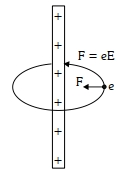
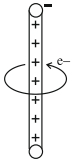
An electron revolves around an infinite cylindrical wire having uniform linear change density $2 \times 10^{-8}\,Cm ^{-1}$ in circular path under the influence of attractive electrostatic field as shown in the figure. The velocity of electron with which it is revolving is $.........\times 10^6\,ms ^{-1}$. Given mass of electron $=9 \times 10^{-31}\,kg$
  • A
    $4$
  • B
    $2$
  • $8$
  • D
    $6$

Answer

Correct option: C.
$8$
c
$e E=\frac{ mV ^2}{ r }$

$e \cdot \frac{2 K \lambda}{ r }=\frac{ mV ^2}{ r }$

$V =\sqrt{\frac{e \cdot 2 k \lambda}{ m }}$

$=\sqrt{\frac{1.6 \times 10^{-19} \times 2 \times 9 \times 10^9 \times 2 \times 10^{-8}}{9 \times 10^{-31}}}$

$=8 \times 10^6\,m / s$

Need a full question paper?

Generate a complete, print-ready paper with questions like this in minutes — across 16+ boards, with answer keys.

Start Generating Free

Similar questions

To make a PN junction conducting
The energy of characteristic $X-$ray is a consequence of which of the following?
The mass defect per nucleon is called
In a Young's double-slit experiment, let $A$ and $B$ be the two slits. $A$ thin film of thickness $t$ and refractive index $\mu$ is placed in front of $A$. Let $\beta =$ fringe width. The central maximum will shift : 
Given below are two statements: one is labelled as Assertion $A$ and the other is labelled as Reason $R$

Assertion $A:$ The binding energy per nucleon is practically independent of the atomic number for nuclei of mass number in the range $30$ to $170$.

Reason $R$ : Nuclear force is short ranged.

In the light of the above statements, choose the correct answer from the options given below on

Potential gradient is defined as
The graph of ln$\Big(\frac{\text{R}}{\text{R}_{\text{0}}}\Big)$ versus In A (R = radius of a nucleus and A - its mass number) is:
A convex lens is in contact with concave lens. The magnitude of the ratio of their focal length is 2/3. Their equivalent focal length is 30 cm. What are their individual focal lengths
Light rays falls on a plane mirror and forms a real image, so the incident rays are
When a pin is moved along the principal axis of a small concave mirror, the image position coincides with the object at a point $0.5\, m$ from the mirror, refer figure. If the mirror is placed at a depth of $0.2\, m$ in a transparent liquid, the same phenomenon occurs when the pin is placed $0.4\, m$ from the mirror. The refractive index of the liquid is