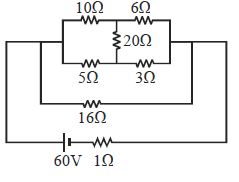
An expression for rate of heat generated, if a current of $I$ ampere flows through a resistance of $R$ $\Omega$, is
Easy


Download our appand get started for free
Experience the future of education. Simply download our apps or reach out to us for more information. Let's shape the future of learning together!No signup needed.*
Similar Questions
- 1$10$ wires (same length, same area, same material) are connected in parallel and each has $1$ $\Omega$ resistance, then the equivalent resistance will be .............. $\Omega$View Solution
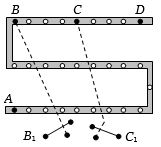
- 2View SolutionFor the post office box arrangement to determine the value of unknown resistance the unknown resistance should be connected between
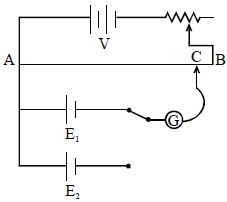
- 3The circuit shown here is used to compare the emf of two cells $E_1$ and $E_2 (E_1 > E_2)$. The null point is at $C$ when the galvanometer is connected to $E_1$. When the galvanometer is connected to $E_2$, the null point will beView Solution
- 4A cylindrical conductor has uniform cross-section. Resistivity of its material increase linearly from left end to right end. If a constant current is flowing through it and at a section distance $x$ from left end, magnitude of electric field intensity is $E$, which of the following graphs is correctView Solution
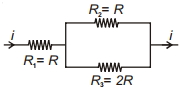
- 5In the circuit shown, the thermal power dissipated in $R_1$ is $P$. The thermal power dissipated in $R_2$ isView Solution
- 6You are given three bulbs of $25$, $40$ and $60\, watt$. Which of them has lowest resistanceView Solution
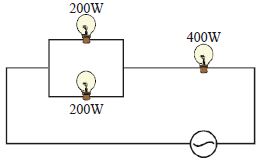
- 7Three electric bulbs of $200\,W,\,\,200\,W$ and $400\,W$ are shown in figure. The resultant power of the combination is ................ $W$View Solution
- 8In a conductor, if the number of conduction electrons per unit volume is $8.5 \times 10^{28}\, m^{-3}$ and mean free time is $25\,fs$ (femto second), its approximate resistivity is $\left( {{m_e} = 9.1 \times {{10}^{ - 31}}\,kg} \right)$View Solution
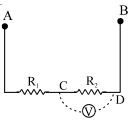
- 9Resistances $R_1$ and $R_2$ each $60\,\Omega$ are connected in series as shown in figure. The Potential difference between $A$ and $B$ is kept $120$ volt. Then what ............. $V$ will be the reading of voltmeter connected between the point $C$ and $D$ if resistance of voltmeter is $120\,\Omega .$View Solution
- 10The current from the cell for the given circuit is ................ $\mathrm{A}$View Solution