MCQ
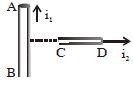
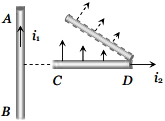
An infinitely long straight conductor $AB$ is fixed and a current is passed through it. Another movable straight wire $CD$ of finite length and carrying current is held perpendicular to it and released. Neglect weight of the wire
  • A
    The rod $CD$ will move upwards parallel to itself
  • B
    The rod $CD$ will move downwards parallel to itself
  • The rod $CD$ will move upward and turn clockwise at the same time
  • D
    The rod $CD$ will move upward and turn anti-clockwise at the same time

Answer

Correct option: C.
The rod $CD$ will move upward and turn clockwise at the same time
c
since the force on the rod $\mathrm{CD}$ is non-uniform it will experience force and torque. From the left hand side it can be seen that the force will be upward and torque is clockwise.

Need a full question paper?

Generate a complete, print-ready paper with questions like this in minutes — across 16+ boards, with answer keys.

Start Generating Free

Similar questions

An electron and a proton enter region of uniform magnetic field in a direction at right angles to the field with the same kinetic energy. They describe circular paths of radius ${r_e}$ and ${r_p}$ respectively. Then
Which of the following sets of concurrent forces may be in equilibrium
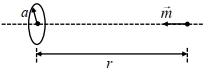
A special metal $S$ conducts electricity without any resistance. A closed wire loop, made of $S$, does not allow any change in flux through itself by inducing a suitable current to generate a compensating flux. The induced current in the loop cannot decay due to its zero resistance. This current gives rise to a magnetic moment which in turn repels the source of magnetic field or flux. Consider such a loop, of radius $a$, with its center at the origin. A magnetic dipole of moment $m$ is brought along the axis of this loop from infinity to a point at distance $r \gg a)$ from the center of the loop with its north pole always facing the loop, as shown in the figure below.

The magnitude of magnetic field of a dipole $m$, at a point on its axis at distance $r$, is $\frac{\mu_0}{2 \pi} \frac{m}{r^3}$, where $\mu_0$ is the permeability of free space. The magnitude of the force between two magnetic dipoles with moments, $m_1$ and $m_2$, separated by a distance $r$ on the common axis, with their north poles facing each other, is $\frac{k m_1 m_2}{r^4}$, where $k$ is a constant of appropriate dimensions. The direction of this force is along the line joining the two dipoles.

($1$) When the dipole $m$ is placed at a distance $r$ from the center of the loop (as shown in the figure), the current induced in the loop will be proportional to

$(A)$ $\frac{m}{r^3}$ $(B)$ $\frac{m^2}{r^2}$ $(C)$ $\frac{m}{r^2}$ $(D)$ $\frac{m^2}{r}$

($2$) The work done in bringing the dipole from infinity to a distance $r$ from the center of the loop by the given process is proportional to

$(A)$ $\frac{m}{r^5}$ $(B)$ $\frac{m^2}{r^5}$ $(C)$ $\frac{m^2}{r^6}$ $(D)$ $\frac{m^2}{r^7}$

Give the answer or qution ($1$) and ($2$)
A student peddles a stationary bicyle. The pedals of the bicycle are attached to a $100$ turn coil of area $0.10$ $m^2$. The coil rotates at half a revolution per second and it is placed in a uniform megnetic field of $ 0.01$ $T$ perpendicular to the axis of rotation of the coil. What is the maximum voltage generated in the coil ?
A particle of mass $m$ is at rest at the origin at time $t = 0$. It is subjected to a force $F(t) = F_0e^{-bt}$ in the $x$ -direction. Its speed $v(t)$ is depicted by which of  the  following curves ?
Which of the following functions for $y$ can never represent a travelling wave?

$(a)$ $\left(x^2-v t\right)^2$

$(b)$ $\log \left[\frac{(x+v t)}{x_0}\right]$

$(c)$ $e^{\left\{-\frac{(x+v t)}{x_0}\right\}^2}$

$(d)$ $\frac{1}{x+v t}$

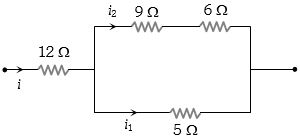
In the following circuit, $5$ $\Omega$ resistor develops $45$ $J/s$ due to current flowing through it. The power developed per second across $12$ $\Omega$ resistor is ............. $W$
Photoelectric effect experiments are performed using three different metal plates $\mathrm{p}, \mathrm{q}$ and $\mathrm{r}$ having work functions $\phi_p=2.0 \mathrm{eV}, \phi_q=2.5 \mathrm{eV}$ and $\phi_r=3.0 \mathrm{eV}$, respectively. A light beam containing wavelengths of $550 \mathrm{~nm}, 450 \mathrm{~nm}$ and $350 \mathrm{~nm}$ with equal intensities illuminates each of the plates. The correct I-V graph for the experiment is [Take $h c=1240 \mathrm{eV} \mathrm{nm}$ ]
A charge $+q$ is fixed at each of the points $x = x_0,\,x = 3x_0,\,x = 5x_0$, .... upto $\infty $ on $X-$  axis and charge $-q$ is fixed on each of the points $x = 2x_0,\,x = 4x_0,\,x = 6x_0$, .... upto $\infty $ . Here $x_0$ is a positive constant. Take the potential at a point due to a charge $Q$ at a distance $r$ from it to be $\frac{Q}{{4\pi {\varepsilon _0}r}}$. Then the potential at the origin due to above system of charges will be
A particle executing simple harmonic motion with amplitude of $0.1 \,m$. At a certain instant when its displacement is $0.02 \,m$, its acceleration is $0.5 \,m/s^2$. The maximum velocity of the particle is (in $m/s$)