MCQ
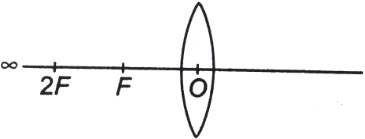
An object is moving towards a converging lens on its axis. The image is also found to be moving towards the lens. Then, the object distance $‘u’$ must satify
  • A
    $2f < u < 4f$
  • B
    $f < u < 2f$
  • C
    $u > 4f$
  • $u < f$

Answer

Correct option: D.
$u < f$
d
When object moves towards $F$ to $O$ virtual erect and magnified image moves from $\infty$ to $O .$

Need a full question paper?

Generate a complete, print-ready paper with questions like this in minutes — across 16+ boards, with answer keys.

Start Generating Free

Similar questions

Given below are two statements: One is labelled as Assertion A and the other is labelled as Reason $R$

Assertion $A:$ The beam of electrons shows wave nature and exhibit interference and diffraction.

Reason $R$ : Davisson Germer Experimentally verified the wave nature of electrons.

In the light of the above statements. Choose the most appropriate answer from the options given below :

Assertion : In Young’s experiment, the fringe width for dark fringes is different from that for white fringes.
Reason : In Young’s double slit experiment the fringes are performed with a source of white light, then only black and bright fringes are observed.
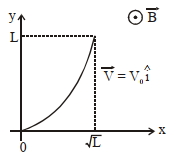
A conducting wire of parabolic shape, initially $y=x^2$, is moving with velocity $\overrightarrow{ V }= V _0 \hat{ i }$ in a nonuniform magnetic field $\vec{B}=B_0\left(1+\left(\frac{y}{L}\right)^\beta\right) \hat{k}$, as shown in figure. If $V_0, B_0, L$ and $\beta$ are positive constants and $\Delta \phi$ is the potential difference developed between the ends of the wire, then the correct statement(s) is/are:

$(1)$ $|\Delta \phi|$ remains the same if the parabolic wire is replaced by a straight wire, $y=x$ initially, of length $\sqrt{2} L$

$(2)$ $|\Delta \phi|$ is proportional to the length of the wire projected on the $y$-axis.

$(3)$ $|\Delta \phi|=\frac{1}{2} B _0 V _0 L$ for $\beta=0$

$(4)$ $|\Delta \phi|=\frac{4}{3} B_0 V_0 L$ for $\beta=2$
Ratio of magnetic intensities for an axial point and a point on broad side-on position at equal distance d from the centre of magnet will be or The magnetic field at a distance d from a short bar magnet in longitudinal and transverse positions are in the ratio
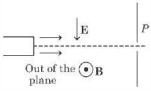
A collimated beam of charged and uncharged particles is directed towards a hole marked $P$ on a screen as shown below. If the electric and magnetic fields as indicated below are turned $ON$
A source $S_1$ is producing, $10^{15}$ photons per second of wavelength $5000 \;\mathring A.$ Another source $S_2$ is producing $1.02 \times 10^{15}$ photons per second of wavelength $5100\;\mathring A$. Then, $($ power of $S_2)/$  $($ power of $S_1)$ is equal to
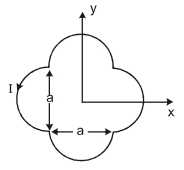
A loop carrying current $I$ lies in the $x$-y plane as shown in the figure. the unit vector $\hat{ k }$ is coming out of the plane of the paper. the magnetic moment of the current loop is :
A non-conducting solid sphere of radius R is uniformly charged. The magnitude of the electric field due to the sphere at a distance r from its centre
Two mirrors are inclined at an angle $\theta$ as shown in the figure. Light ray is incident parallel to one of the mirrors. The way will start retracting its path after third reflection if $\theta = ........$
In a compound microscope, the focal length of two lenses are $1.5\,cm$ and $6.25\,cm$. If an object is placed at $2\,cm$ from objective and the final image is formed at $25\,cm$ from eye lens the distance between two lenses is......$cm$