MCQ
An object moving in a circular path at constant speed has constant
  • Displacement
  • B
    Velocity
  • C
    Acceleration
  • D
    Energy

Answer

Correct option: A.
Displacement
a
(a)

An object undergoing uniform circular motion is moving with a constant speed nonetheless, it is accelerating due to its change in direction. The direction of the acceleration is inwards. An object moving in uniform circular motion will cover the same linear distance in each second of time(constant speed)

Need a full question paper?

Generate a complete, print-ready paper with questions like this in minutes — across 16+ boards, with answer keys.
Start Generating Free

Similar questions

Variation of atmospheric pressure, with height from earth is ................
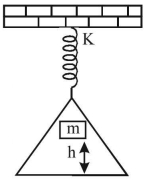
A load of mass $m$ falls from a height $h$ on to the scale pan hung from the spring as shown in the figure. If the spring constant is $k$ and mass of the scale pan is zero and the mass $m$ does not bounce relative to the pan, then the amplitude of vibration is
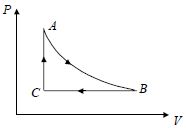
A fixed amount of a gas undergoes a thermodynamic process as shown such that heat interaction along path $B \to C \to A$ is equal to the work done by the gas along path $A \to B \to C$. Then process $A \to B$ is :-
A particle of mass $m $ is moving in a horizontal circle of radius $r$  under a centripetal force equal to $ - K/{r^2}$, where $K$  is a constant. The total energy of the particle is
A small spherical ball of radius $0.1 \,mm$ and density $10^{4} \,kg m ^{-3}$ falls freely under gravity through a a distance $h$ before entering a tank of water. If after entering the water the velocity of ball does not change and it continue to fall with same constant velocity inside water, then the value of $h$ wil be $m$. (Given $g =10 \,ms ^{-2}$, viscosity of water $=1.0 \times 10^{-5} \,N - sm ^{-2}$ )
A beaker is completely filled with water at $4°C$. It will overflow if
A bullet of mass $ a$  and velocity $b$ is fired into a large block of mass $c$. The final velocity of the system is
One mole of an ideal gas goes from an initial state $A$ to final state $B$ via two processes : It first undergoes isothermal expansion from volume $V$ to $3\, V$ and then its volume is reduced from $3\, V$ to $V$ at constant pressure. The correct $P-V$ diagram representing the two processes is
A body of mass $2\, kg$ is hung on a spring balance mounted vertically in a lift. If the lift descends with an acceleration equal to the acceleration due to gravity $‘g’$, if the lift moves up with an acceleration equal to the acceleration due to gravity, the reading on the spring balance will be .......... $kg$
Which of the following best define the acceleration of a particle: